![[Bild]](/common/img/default.png)
Locus Peccatorum and the student murder of 1829
Attraction
Stroll
about ½ hour
Locus Peccatorum
There is a house in Lund called Locus Peccatorum, which means "The House of Sin". On this page
you can read more about how and why it got that name. The building also has an interesting
history, being the oldest of all the old houses at Lund’s open-air museum “Kulturen”, still
situated on the very spot where it was once built. The house is located at the intersection of
Sankt Annegatan and Adelgatan and currently houses various offices of Kulturen. Therefore, you
can’t enter the building. Fortunately, the house is clearly visible from the street, so there
is no need to pay the fee to enter the open-air museum just to view it.
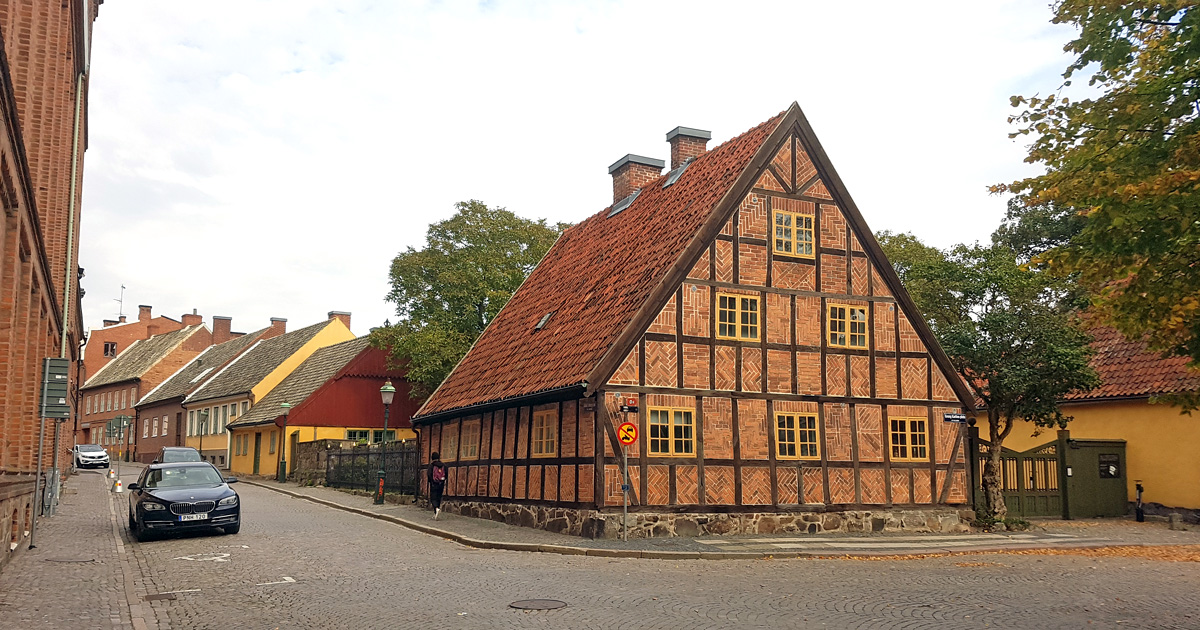 The house called Locus Peccatorum.
The house is a one-story building with 2 loft levels and has a saddle roof with steep inclination. The walls are half- timbered with oak beams and red brick sections laid out in various patterns. The windows have double sashes with rails close to each other. The top of the gable end facing north is clad in brown timber panel, and the roof is covered with red clay roof tiles.
House older history
The house was built sometime between 1693 and 1727 as a residence for either Christian Papke or Bonde Humerus. Christian Papke was the bishop of Lund between 1688 and 1694. Bonde Humerus was an academy librarian and later became professor of mathematics and theology, and the dean of Lund. The land that belonged to the house initially included what is today most of the northern part of Kulturen, all the way up to the eastern garden pavilion. This house was probably the only one on the yard, which may also have been used for grazing cattle.
The house changed owners frequently, most of them being bishops or professors. Around 1750, the long yellow house next to this house was built as the main building on the yard. It’s called The Lindfors house and was at the time owned by the professor of theology, Carl Jesper Benzelius, who was appointed bishop of Strängnäs in 1776.
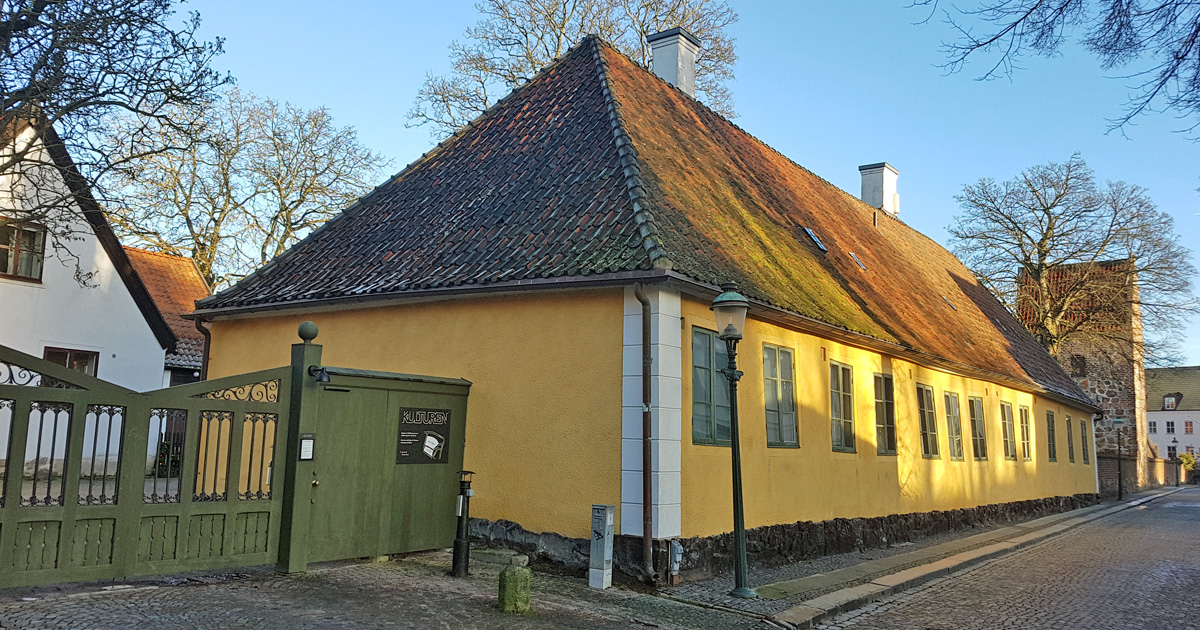 The Lindfors house, built around 1750.
At some point towards the end of the 18th century / beginning of the 19th, when it was common to render half-timbered buildings, the house was plastered. It was made completely white and looked much like rendered buildings do today. The rendering wasn’t removed until 1906, when the house already had become a part of the open-air museum Kulturen.
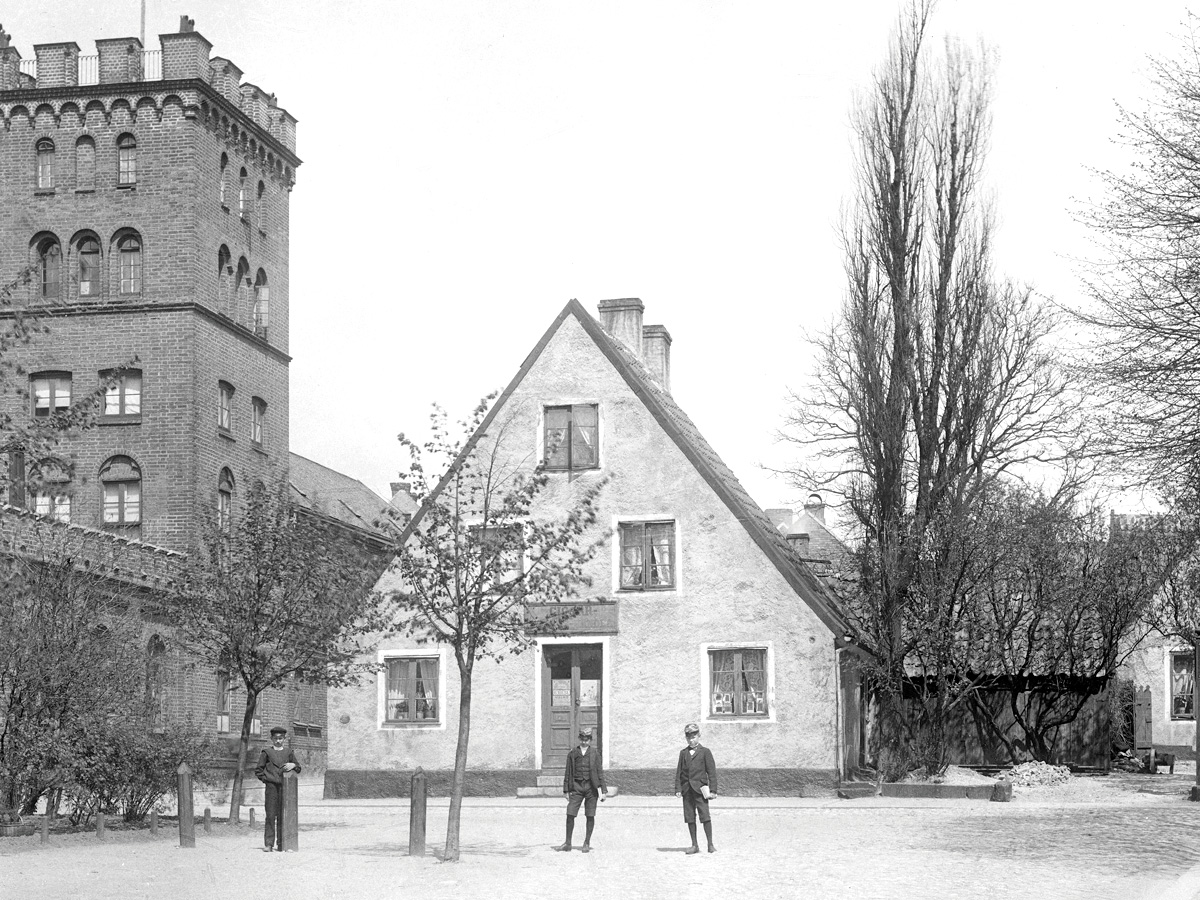 A picture of the house taken in 1899, showing what it looked like rendered in white.
In 1807, physical education teacher and poet Pehr Henrik Ling, acquired the property. He had
the western building (as the house was then called to distinguish it from The Lindfors house)
repaired.
A picture of the house taken in 1899, showing what it looked like rendered in white.
In 1807, physical education teacher and poet Pehr Henrik Ling, acquired the property. He had
the western building (as the house was then called to distinguish it from The Lindfors house)
repaired.
After repairs where finished the house was insured against fire and was then specified to have 4 rooms and a kitchen on the ground floor plus 6 attic chambers on the upper floors. Adjoined to the north side of the house was also another small building.
In 1811 Pehr Henrik Ling sold of the part of the property with this house. The house then changed owners several times over the years to come. The 6 attic chambers, and at times the whole house, were usually rented out to students from the University. Here, in 1829, the incident that forever gave the house the name Locus Peccatorum “The House of Sin” took place. The door of the southern gable, visible in the picture above, wasn’t there at that time.
The student murder of 1829
 University Vice Chancellor Anders Otto Lindfors.
It all started in the morning of September 8th, 1829 when the university Vice Chancellor was
alerted of a dead person lying in the street in front of his house (The Lindfors House
mentioned above) on Adelgatan. The head of the body was so badly battered that it made
identification impossible, but a laundry maid passing by recognized the shirt worn by the
deceased. She informed the Vice Chancellor that the dead person was a student named Anders
Landén who lived in the house next door, i.e. Locus Peccatorum that this visitors guide is all
about.
University Vice Chancellor Anders Otto Lindfors.
It all started in the morning of September 8th, 1829 when the university Vice Chancellor was
alerted of a dead person lying in the street in front of his house (The Lindfors House
mentioned above) on Adelgatan. The head of the body was so badly battered that it made
identification impossible, but a laundry maid passing by recognized the shirt worn by the
deceased. She informed the Vice Chancellor that the dead person was a student named Anders
Landén who lived in the house next door, i.e. Locus Peccatorum that this visitors guide is all
about.
The Vice Chancellor started following the blood trail which ended up on the 3rd floor of Locus Peccatorum. There he found the confused 25-year-old student Jacob Wilhelm Blomdahl who was arrested. He had tried in vain to hide the body of his, equally old, student friend. At first in the toilet and then somewhere outside town in the countryside, but he was too weak to move it any further than to Adelgatan.
The trial
Jacob Wilhelm Blomdahl appeared in front of “Större akademiska konsistoriet” (the University board, i.e. all regular professors) that at the time still had jurisdiction over all university staff and students. It’s not clear if Jacob Wilhelm caused the death of his friend accidentally while drunk, or if it was a premeditated murder. He was nonetheless sentenced, according to the penal code of the time, to death by beheading and the body was to be buried at the site of execution. Sentence was later confirmed by the court of appeal for Scania and Blekinge. Pardon applications from Jacob Wilhelm and his father were denied by King Carl XIV Johan. Justice must run its cause according to the strict principal “if you take a life you pay with your life”.
The execution
The day of execution was set to April 16th 1830, but neither the university nor the City of Lund had an executioner of their own, and consequently the county executioner had to be used. The University Consistory requested, in an official letter to the king, that the execution should take place in Malmö, where the convict had been imprisoned. Reasons given for this was that the execution, which was ordered to take place close to the city and public highway, would have a “disadvantageous influence on the delicate minds of the students, and also entail difficult and sad duties for the university staff”. The answer from King Carl XIV Johan was a brief and harsh NO.
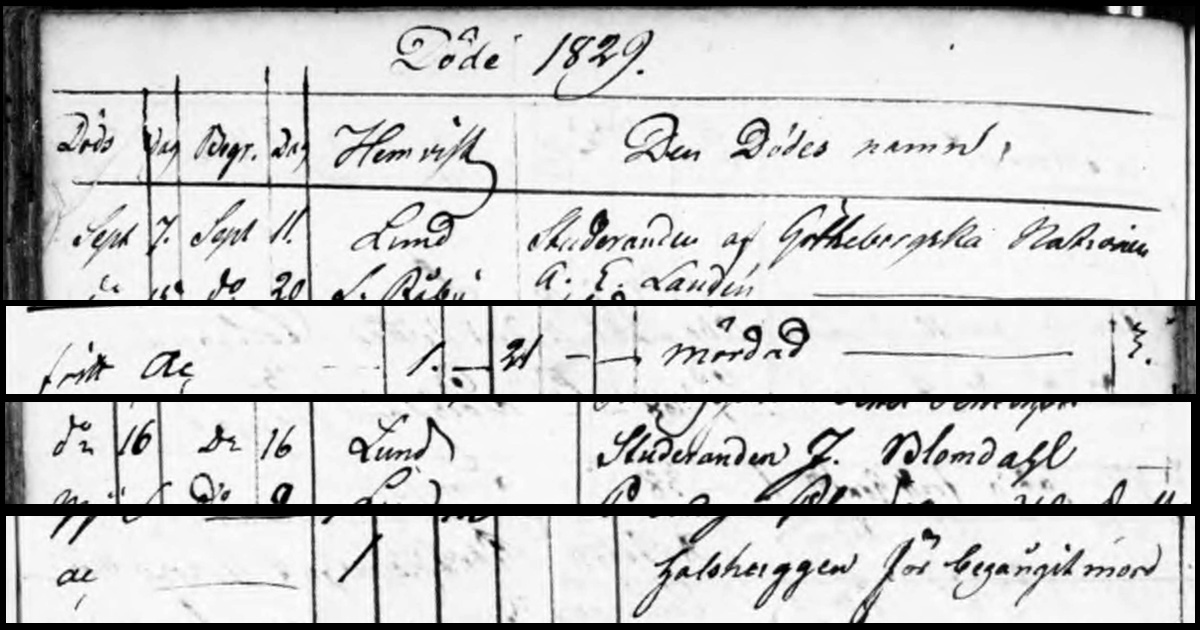 In the death book of Lund Cathedral Parish is written that the student of Göteborg’s Nation,
Anders Landén, was murdered on September 7th, 1829, (the two top pictures above), and that the student
Jacob Wilhelm Blomdahl was executed on April 16th,
1830 by beheading for committing the crime of murder (the two bottom pictures above).
In the death book of Lund Cathedral Parish is written that the student of Göteborg’s Nation,
Anders Landén, was murdered on September 7th, 1829, (the two top pictures above), and that the student
Jacob Wilhelm Blomdahl was executed on April 16th,
1830 by beheading for committing the crime of murder (the two bottom pictures above).
It was decided, as kind of sentence remission, that Jacob Wilhelm Blomdahls body was to be buried in hallowed ground at the Northen Cemetery (Norra Kyrkogården) in Lund, instead of at the place of execution. The burial took place “in silence” in a part of the cemetery reserved for people who committed suicide.
The execution place
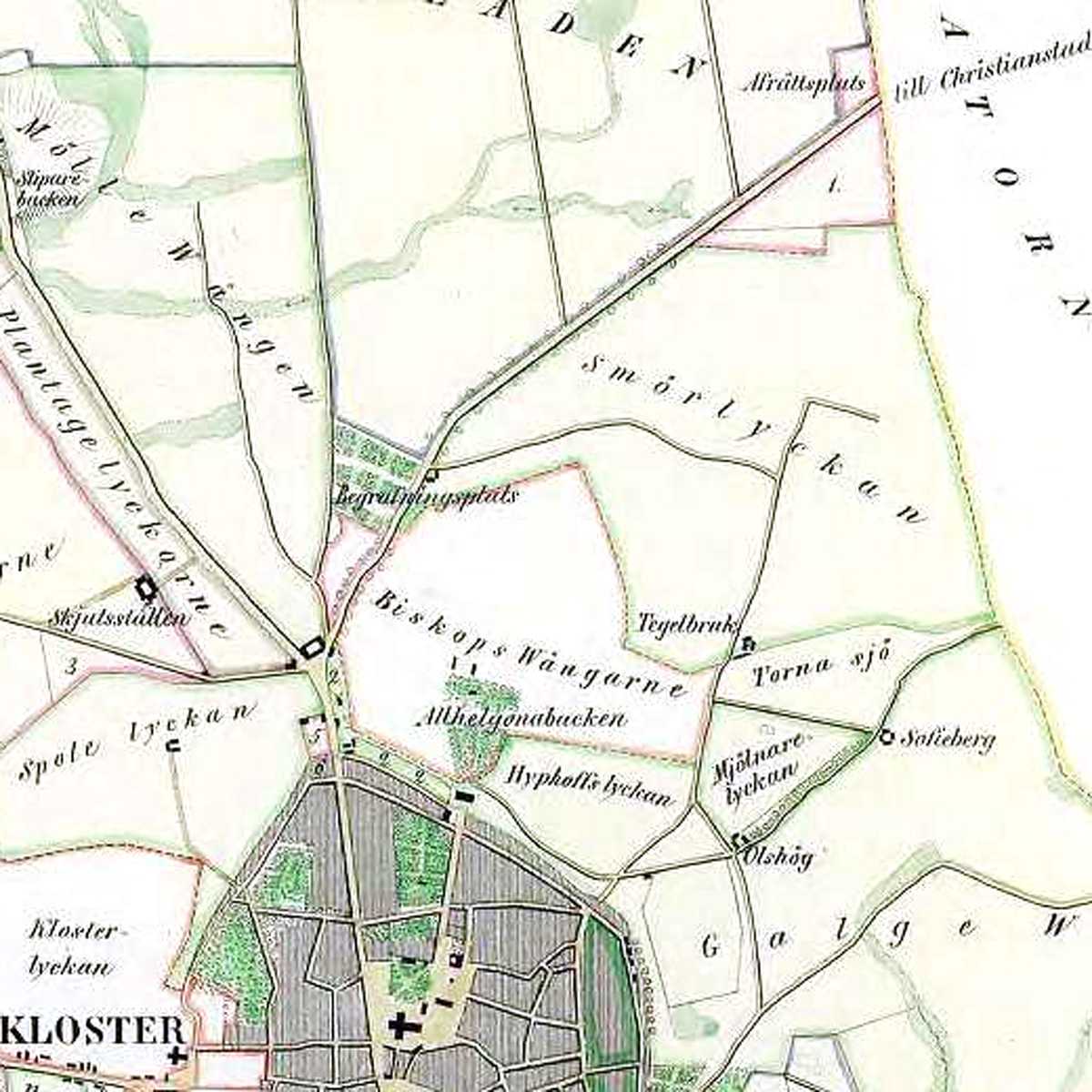 The Gustaf Ljunggren map from 1853 shows where the place of execution was located in the
upper right-hand corner.
The execution place was located in the northern part of Lund, east of the current riding
stables. This was the first and only time this location was used for an execution. The Gustaf
Ljunggren map from 1853 shows where the execution place was located.
The Gustaf Ljunggren map from 1853 shows where the place of execution was located in the
upper right-hand corner.
The execution place was located in the northern part of Lund, east of the current riding
stables. This was the first and only time this location was used for an execution. The Gustaf
Ljunggren map from 1853 shows where the execution place was located.
The Academic Society is started
This gruesome event put a lot of focus on the alcohol habits and general social situation of students in Lund. A few temperance societies were started. A direct consequence of the student murder was the foundation of the Academic Society (AF, Akademiska Föreningen), with the Copenhagen student association (Köpenhamns Studenterforening), as a role model. Professor Carl Adolph Agardh, who later became Bishop in Karlstad, was one of the initiators when AF was started. He saw the association as a way to keep the students away from "friends without moral" and to involve them in "more worthy" activities.
In the aftermath of this event the house has become known as Locus Peccatorum, meaning The House of Sin. The house next to this building where the museum´s café is located thoday, was rebuilt as student housing sometime after the death of Anders Otto Lindfors in 1841. When the rebuild was finished that house was called Locus Virtutum, The House of virtues, as opposed to Locus Peccatorum.
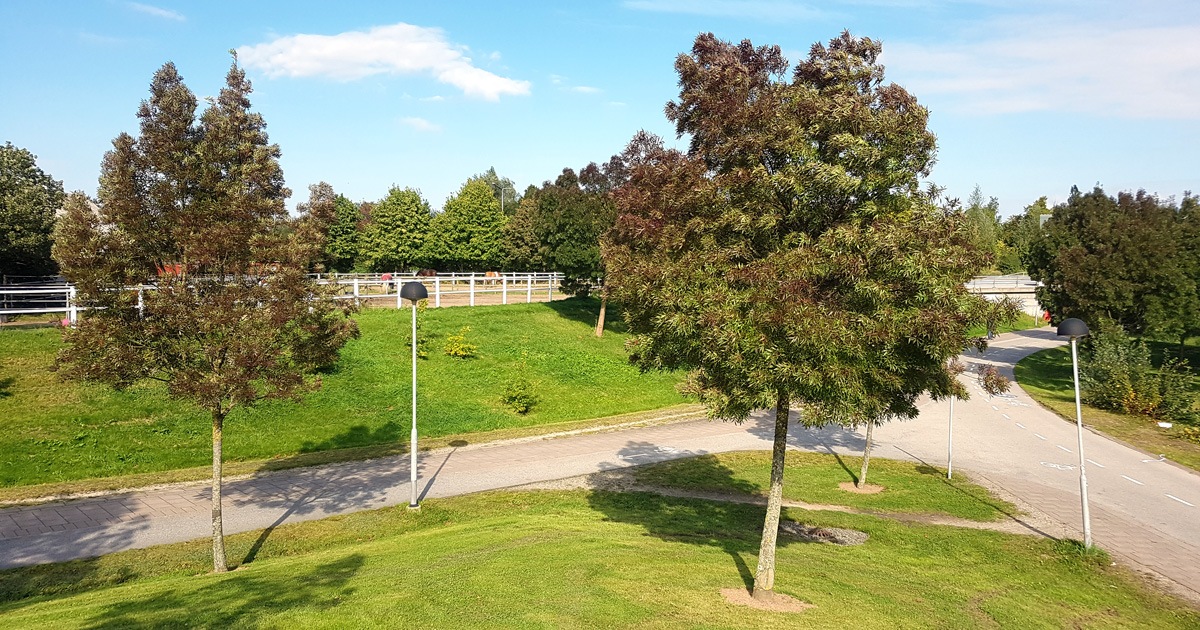 The site where the student Jacob Wilhelm Blomdahl was beheaded on April 16th, 1830, as it
looks today.
The site where the student Jacob Wilhelm Blomdahl was beheaded on April 16th, 1830, as it
looks today.
House history after the student murder
A few years after these events, in 1834, the property was purchased by Anders Otto Lindfors, who by then already was the owner of The Lindfors House next door. Anders Otto Lindfors lived here until his death in 1841 and his widow until 1882, when the family sold the property.
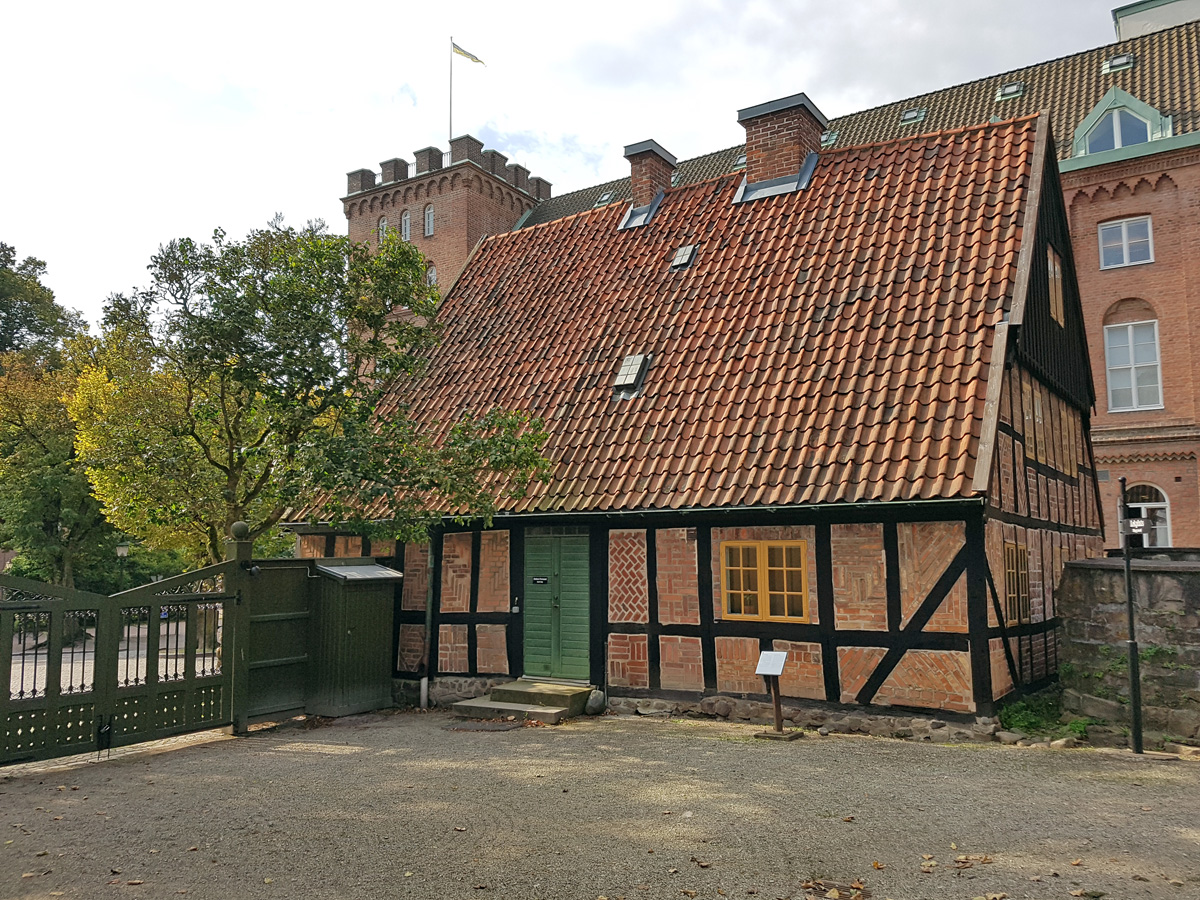 Locus Peccatorum seen from inside Kulturen open-air museum.
In 1898 the open-air museum Kulturen bought the property where both this house and The
Lindfors house are situated. Kulturen had, already in 1892, acquired the surrounding area
where the manor house (Herrehuset) and the garden pavilion are located. To get permission from
the board to buy the property, the founder and Curator of Kulturen at that time, Georg Karlin,
had to form a consortium that could guarantee the money necessary for the purchase. This was
also necessary when purchasing the land where the manor house and the garden pavilion are
located, but this time only for 6 years. The deed of sale was signed and Kulturen took
ownership from April 1st, 1898.
Locus Peccatorum seen from inside Kulturen open-air museum.
In 1898 the open-air museum Kulturen bought the property where both this house and The
Lindfors house are situated. Kulturen had, already in 1892, acquired the surrounding area
where the manor house (Herrehuset) and the garden pavilion are located. To get permission from
the board to buy the property, the founder and Curator of Kulturen at that time, Georg Karlin,
had to form a consortium that could guarantee the money necessary for the purchase. This was
also necessary when purchasing the land where the manor house and the garden pavilion are
located, but this time only for 6 years. The deed of sale was signed and Kulturen took
ownership from April 1st, 1898.
When Kulturen took ownership of the building there was a cigar shop on the ground floor, and there was a door in the middle of the gable facing Adelgatan (see picture from 1899 above). During the first years of Kulturen ownership the house was home to an arts and crafts shop and exhibition room. These days Kulturen has offices in the building, and it’s not possible to go inside.
The white rendering was removed from the house in 1906, and since then it has looked the same as it does today. In 1937 it was renovated again and the door in the gable was replaced with a window. All other windows of the house were replaced with period correct units with close rails. During the restoration the red brick sections were also refurbished and given their current brick patterns.