![[Bild]](/common/img/default.png)
Northern Cemetery in Lund
Attraction
about 3-4 hours
High resolution map
Northern Cemetery
• Brief overview
Northern Cemetery (Norra kyrkogården) in Lund, within walking distance of the city centre,
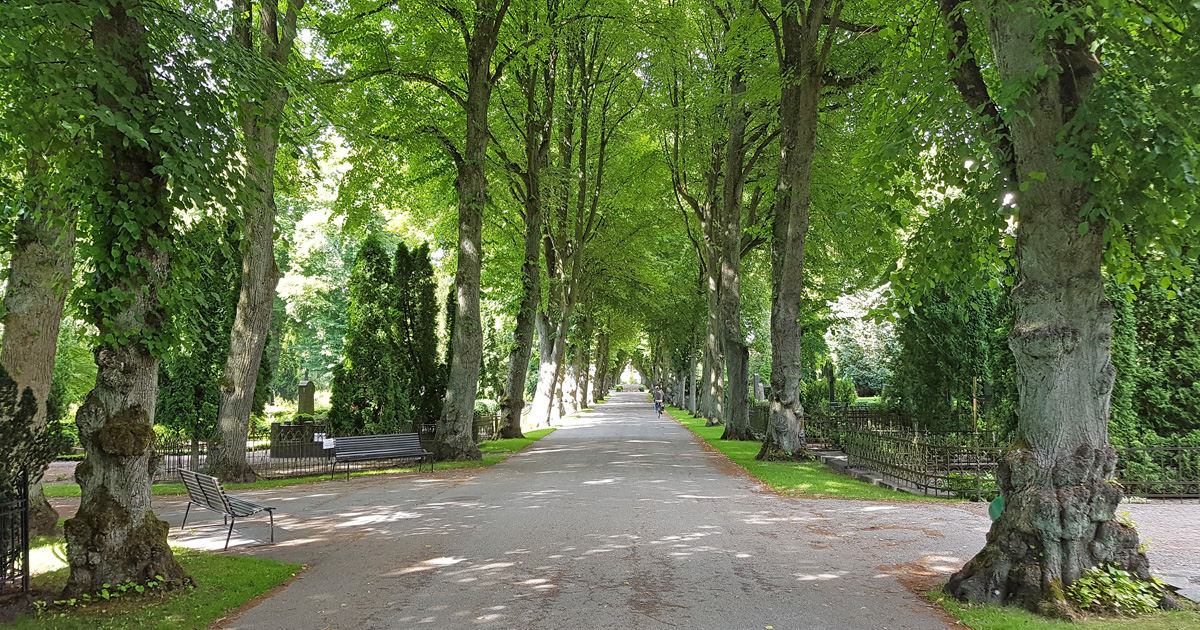
isn't just a burial site. It's also a large green oasis and an interesting tourist attraction
filled with history and connections to fascinating cultural events in Lund's past. This
visitors guide tells the story of several famous people connected to Lund in the 19th and 20th
century who are buried there. The cemetery is a beautiful place for walks throughout the year.
With this guide in hand, you can spend a few hours on a culturally and historically
interesting walk.
Black numbers in white circles identify places/graves described below. Black numbers NOT placed in circles identify the different blocks of the cemetery for navigation purposes. There are also a few blocks with special designations that aren't identified in the map. Blocks along the southern line are called LSA and LSB. Along the west line the blocks are called LSV and along the north line LNA.
The visitors map below shows the position of places, and persons of interest buried at the Cemetery (Norra kyrkogården), described in this guide. If you wish to find a certain spot in the cemetery it's usually easier if you locate the correct block first.
Blocks are numbered according to the map and identified by the corresponding number on stones like the one in the picture below. In the high resolution map it's easier to get a better feeling for where the graves are located.
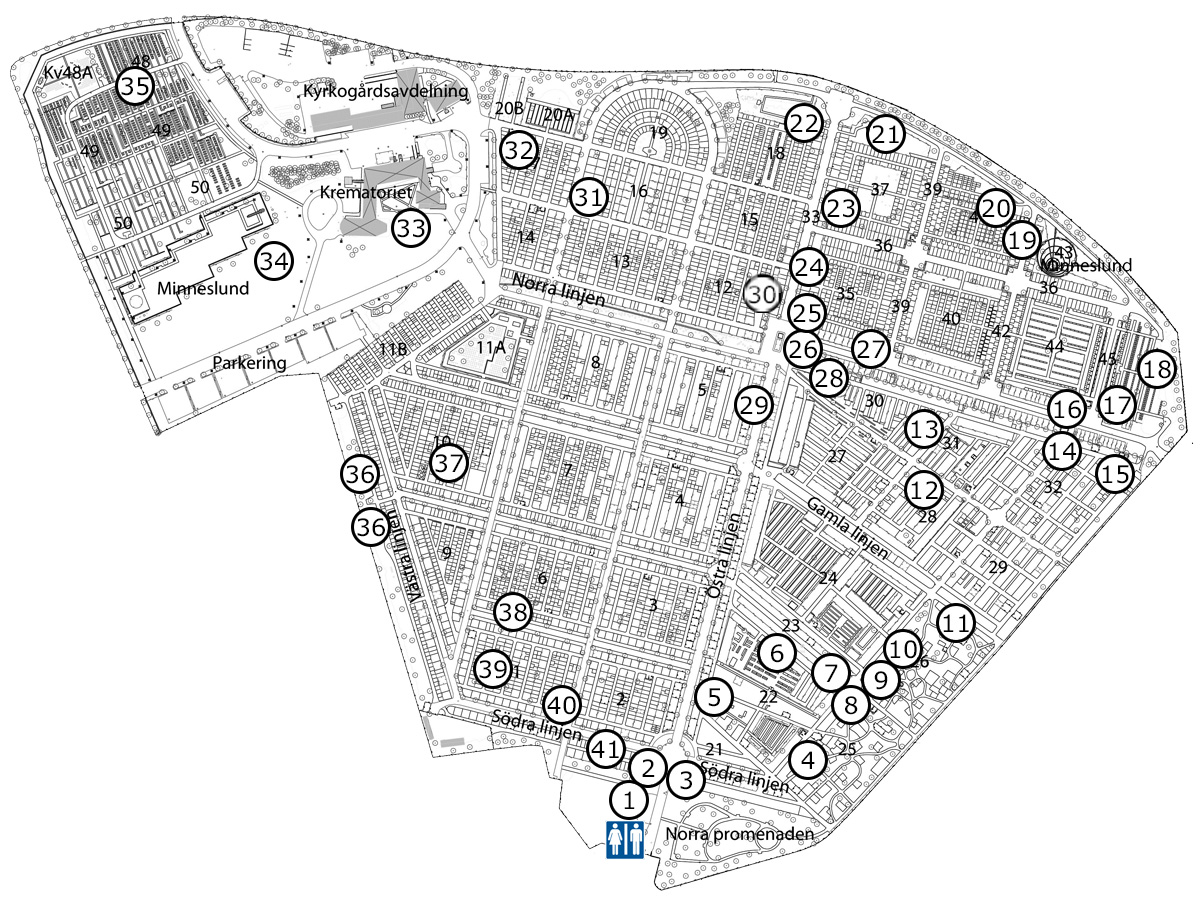 Overview map of Northern Cemetery (Norra kyrkogården) with places of interest mentioned in
this guide identified by black numbers in white circles.
Overview map of Northern Cemetery (Norra kyrkogården) with places of interest mentioned in
this guide identified by black numbers in white circles.
A toilets can be found next to the southern entrance to the cemetery. Sometimes it is unfortunately closed, and then the nearest toilet is to be found inside the entrance of the hospital main building , about 300 meters from the southern entrance to the Northern Cemetery.
The history of Northern Cemetery
During medieval times, and all the way up until the beginning of the 19th century, the dead inhabitants of Lund were buried in cemeteries within the city walls. Many city-cemeteries were more than full, and their proximity to people and buildings was quickly becoming a sanitary problem. In 1805, by royal decree from King Gustav IV Adolf, cemeteries were ordered to be placed outside the city limits.
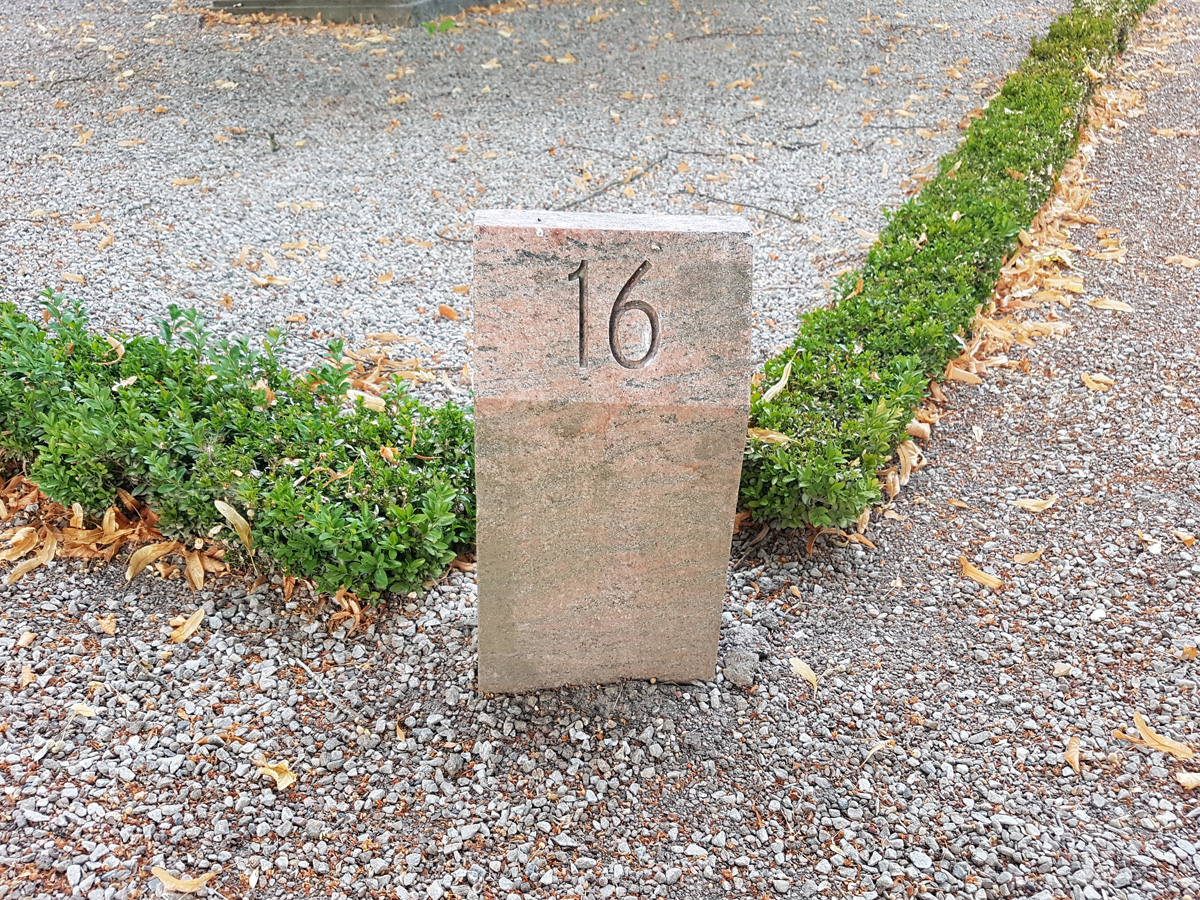 One of all the stones at the cemetery identifying what block you are in.
The southern army had established a hospital in Lund, but it was plagued by various diseases.
In 1809 this fact was brought to the attention of the magistrate by Lund Dean and professor
Johan Jacob Hellman in an official letter. In it he writes that "people are dying on a daily
basis and a suitable graveyard outside the city limits is of the essence in order to minimize
the risk of an epidemic spreading among the citizens of Lund". The suggestion was accepted and
a plot of land next to Getingevägen was purchased the same year. The costs were to be divided
between city, church and university.
One of all the stones at the cemetery identifying what block you are in.
The southern army had established a hospital in Lund, but it was plagued by various diseases.
In 1809 this fact was brought to the attention of the magistrate by Lund Dean and professor
Johan Jacob Hellman in an official letter. In it he writes that "people are dying on a daily
basis and a suitable graveyard outside the city limits is of the essence in order to minimize
the risk of an epidemic spreading among the citizens of Lund". The suggestion was accepted and
a plot of land next to Getingevägen was purchased the same year. The costs were to be divided
between city, church and university.
But it would take until May 27th, 1816, before the cemetery was put into use, mainly because of the poor state of the Cathedral council finances and consequent discussions about how to split the cost of land between the three financers. At that time the cemetery consisted of what today are blocks 25 and 26. The blacksmith Jacob Löfgren was the first person to be buried on the new site, but unfortunately his gravestone is no longer to be found. From the beginning there were no fences or stone walls, like there are today, lining the boundaries of the cemetery. In the east there was a stone fence, in the west a hawthorn hedge and on the remaining sides just ditches. The cemetery was divided into eight blocks and along the pathways were elm trees in close formation.
Between 1837 and 1839 another two plots of land, west of the cemetery of that time, were purchased, and in 1841 blocks 21 and 24 (as they're called today) were added to the cemetery. By then the older part was full of graves, both beneath the lawns and under the pathways. In 1843 the academy gardener Carl Lundberg was asked to come up with a suggestion of pathways and lawns both in the old and the new part of the cemetery. He suggested a solution with meandering walkways inspired by English parks of that time for the older part of the cemetery, and these remain to this day. The new part was planned as two big blocks with three parallel pathways.
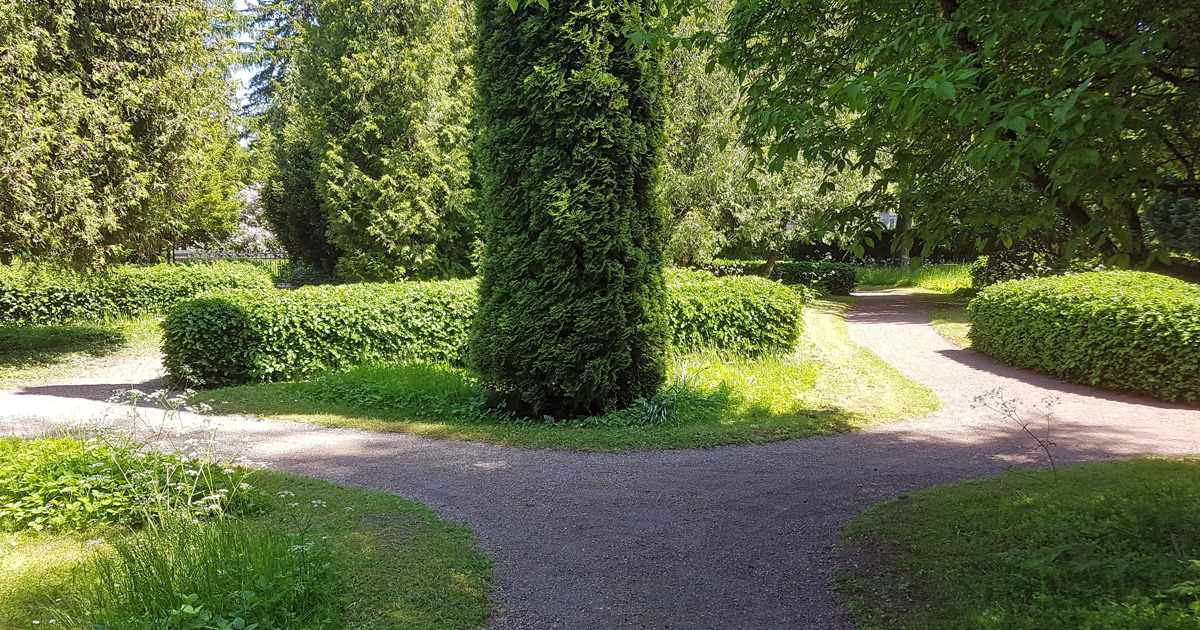 The two oldest blocks, today numbered 25 and 26, are still the same as in 1843, inspired by
English parks of that time.
The two oldest blocks, today numbered 25 and 26, are still the same as in 1843, inspired by
English parks of that time.
In 1873 the cemetery was extended to the north with what today are blocks 27-32. In 1887–1890 another two plots of land, west of the cemetery, were purchased. The biggest extension was made in 1890 with today's blocks 1 to 11.
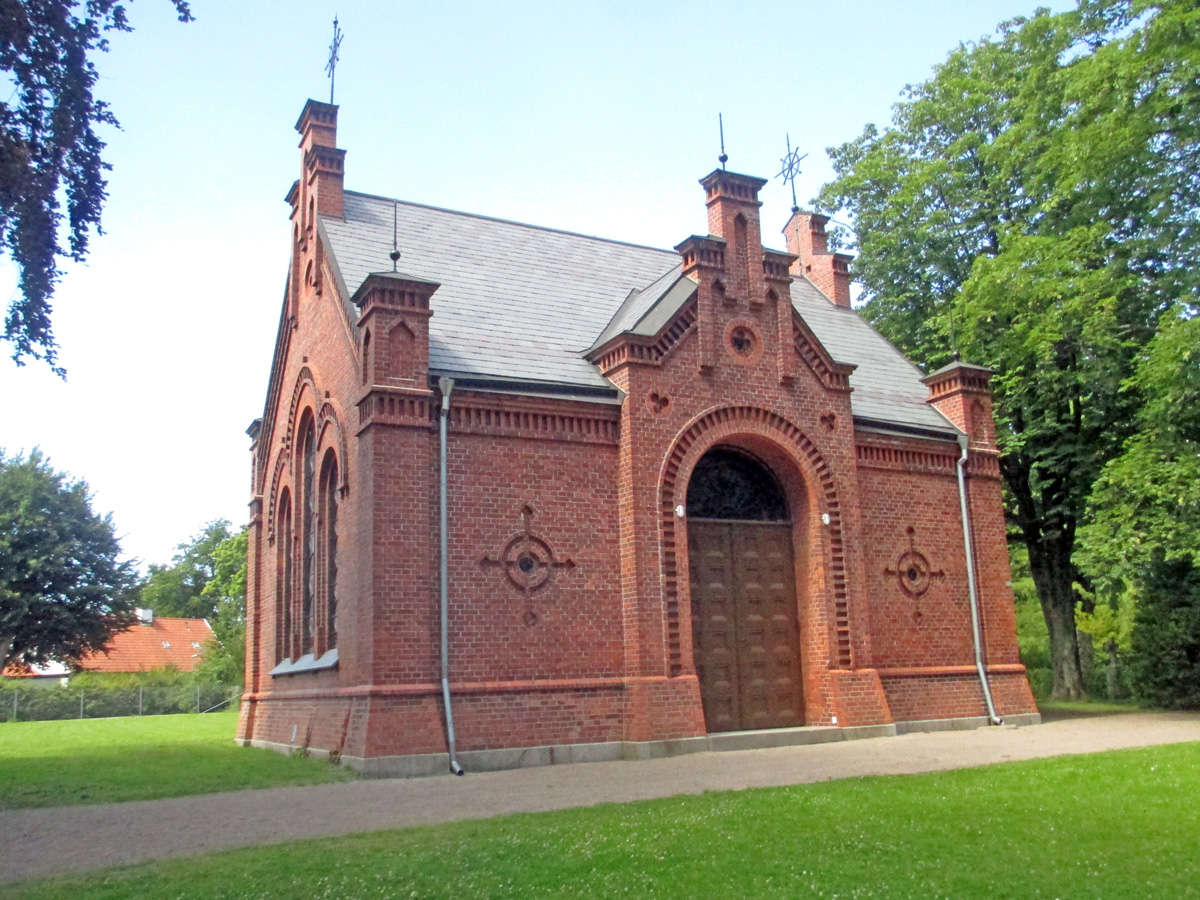 The Chapel (1) was built in 1895. It was designed by the architect Henrik Sjöström
who is buried at (8).
For a long time, the cemetery was missing a building where funeral services could be held. Up
until All Saints church (Allhelgonakyrkan) was ready in 1891, Cloister church (Klosterkyrkan)
and Lund Cathedral (Domkyrkan) were the only buildings available for such services. The
distance from either of these churches to the cemetery (Norra Kyrkogården) was considered too
far to walk, and therefore a chapel (1) was built next to the southern entrance in 1895.
It was designed by Henrik Sjöström, who was a student of the Lund Cathedral architect Helgo
Zettervall, and it was in use for burial services up until 1960. These days the
Ethiopian-orthodox congregation in Lund uses the chapel for church services. Henrik Sjöström
is buried at (8).
The Chapel (1) was built in 1895. It was designed by the architect Henrik Sjöström
who is buried at (8).
For a long time, the cemetery was missing a building where funeral services could be held. Up
until All Saints church (Allhelgonakyrkan) was ready in 1891, Cloister church (Klosterkyrkan)
and Lund Cathedral (Domkyrkan) were the only buildings available for such services. The
distance from either of these churches to the cemetery (Norra Kyrkogården) was considered too
far to walk, and therefore a chapel (1) was built next to the southern entrance in 1895.
It was designed by Henrik Sjöström, who was a student of the Lund Cathedral architect Helgo
Zettervall, and it was in use for burial services up until 1960. These days the
Ethiopian-orthodox congregation in Lund uses the chapel for church services. Henrik Sjöström
is buried at (8).
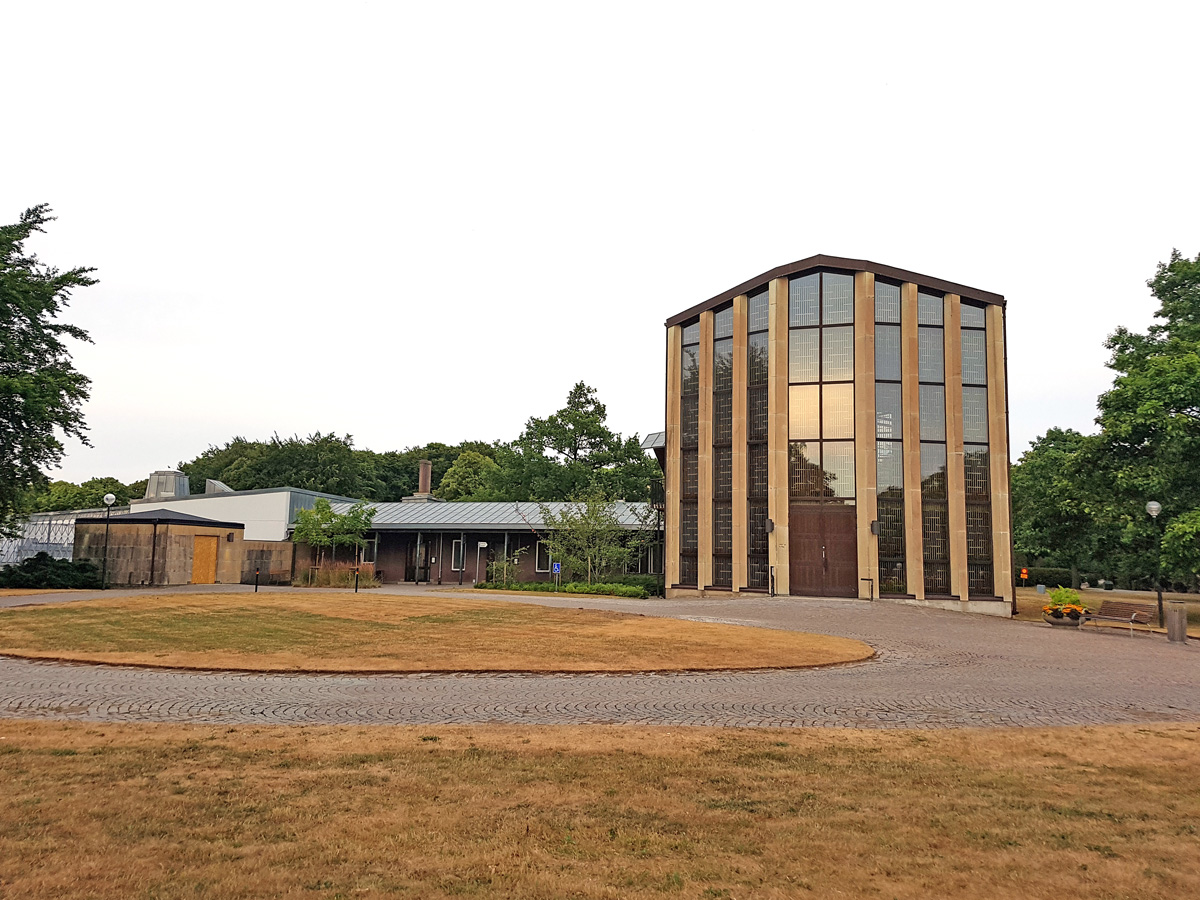
In 1912–1913 the cemetery was extended further to the northwest with today's blocks 12 to 20, and in 1924–1925 to the northeast with the current blocks 34 to 46. In 1950 the southern part of the northwestern area was added, and in 1953 the cemetery was extended all the way out to Kävlingevägen. In 1960, St. Olof and the Resurrection Chapel (Sankt Olofs och Uppståndelsens kapell) with a crematorium (33), were built in the northwestern part of the cemetery. The final extension was made in 1971 when today's blocks 48 to 50 were added in the northwest.
1) The Chapel
The beautiful chapel by the southern entrance to Northern Cemetery (Norra kyrkogården), see picture above, was designed by the architect Henrik Sjöström and built in 1895. These days the Ethiopian-orthodox congregation in Lund uses the chapel for church services. Henrik Sjöström, who was a student of the Lund Cathedral architect Helgo Zettervall, is buried at (8).
2) Åke Hansson
To the left of the wide main entrance to the cemetery from the south, in the block called "the southern line (LSA)", you find the grave of innkeeper Åke Hansson. He was born in Stångby on November 1st, 1836, and died here in Lund on March 14th, 1899.
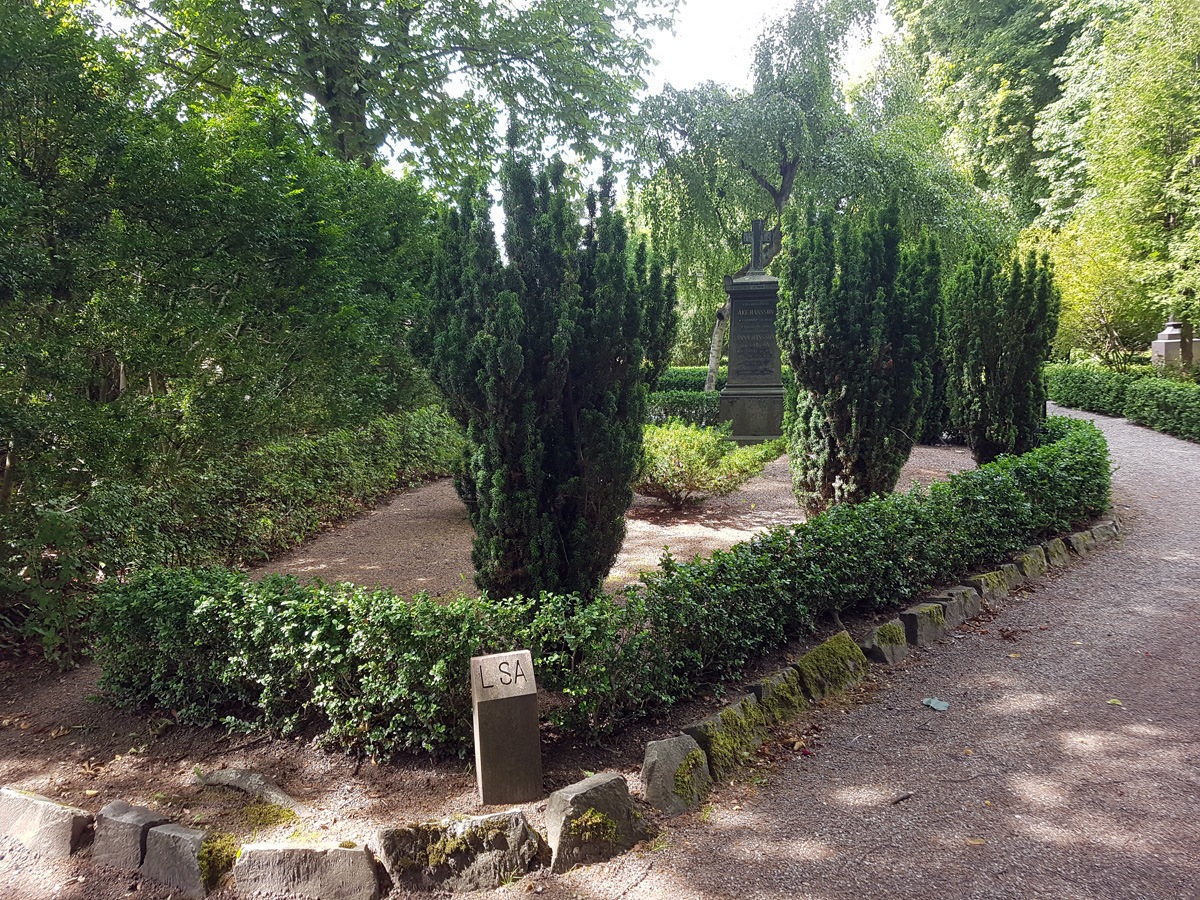 Grave of Innkeeper Åke Hansson.
Åke Hansson was a farmer in Stångby before he became an innkeeper. In 1887 he took over the
Inn located in what is now The Swedish Federation of Business Owners house (företagarnas hus,
(formerly Fabriks och Hantverksföreningens hus) on Bredgatan 5. The Inn became known as "Åke
Hans", and counted among its regular customers August Strindberg, during his time in Lund from
1897 to 1899. August Strindberg often socialized at "Åke Hans" with the cousin of Axel
Wallengren, Waldemar Bülow, and Bengt Lidforss, who later became a professor of botany and one
of the leading figures of the social democratic party in Sweden.
Grave of Innkeeper Åke Hansson.
Åke Hansson was a farmer in Stångby before he became an innkeeper. In 1887 he took over the
Inn located in what is now The Swedish Federation of Business Owners house (företagarnas hus,
(formerly Fabriks och Hantverksföreningens hus) on Bredgatan 5. The Inn became known as "Åke
Hans", and counted among its regular customers August Strindberg, during his time in Lund from
1897 to 1899. August Strindberg often socialized at "Åke Hans" with the cousin of Axel
Wallengren, Waldemar Bülow, and Bengt Lidforss, who later became a professor of botany and one
of the leading figures of the social democratic party in Sweden.
When Åke Hansson died, the Swedish author August Strindberg was part of the funeral procession.
3) Martin Weibull
To the right of the wide main entrance to the cemetery from the south, in the block called "the southern line (LSA)", you find the grave of history professor Martin Weibull.
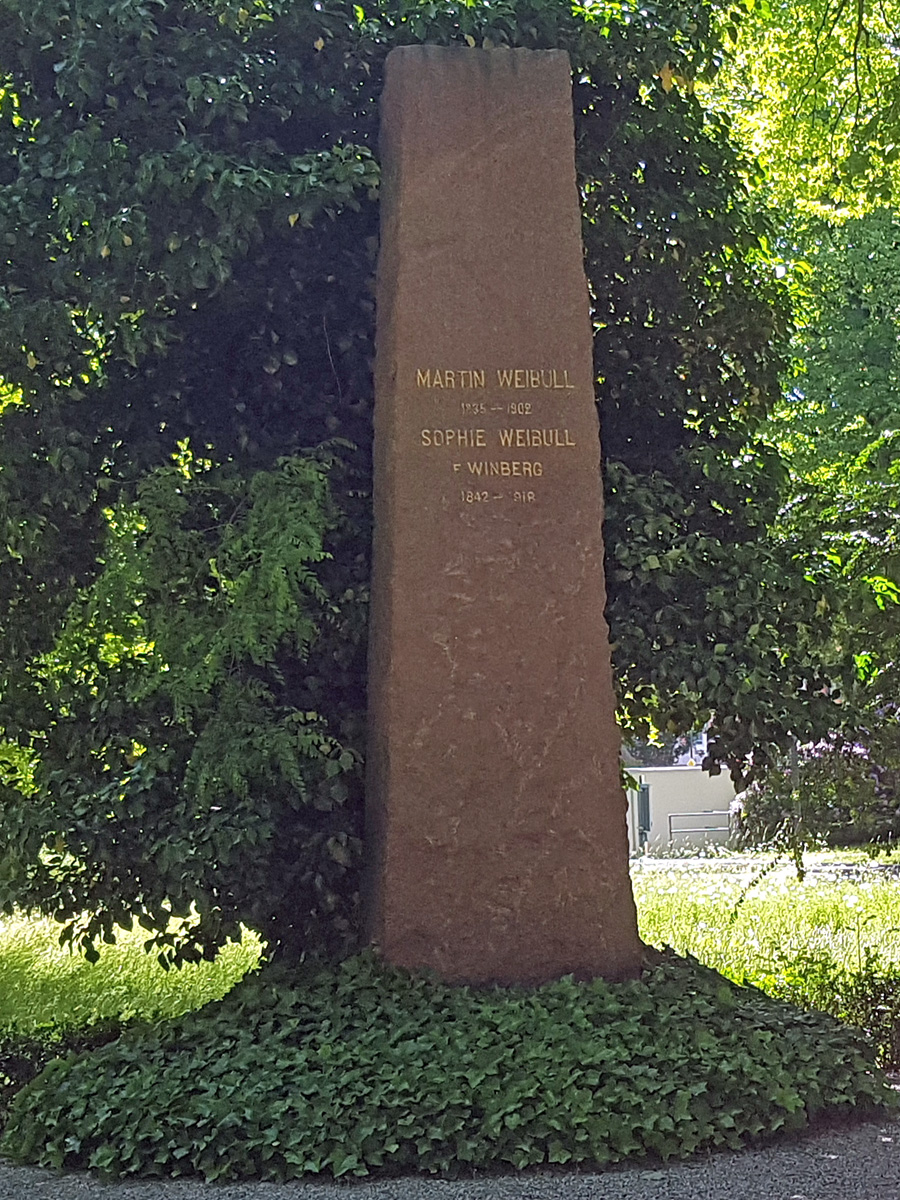 Grave of history professor Martin Weibull.
Martin Weibull was born on December 24th 1835 in Landskrona and started his studies at Lund
university in 1853, where he eventually became a history professor. He was an early follower
of Scandinavism, a movement that wanted the Scandinavian peoples to become closer since they
shared both cultural, geographical and historical ties. In 1866 Martin Weibull was one of the
founders of the "Association of ancient monuments and history in Scania". A few years later
this association merged with its sister association in Halland (the province just north of
Scania) to form "The historical and archaeological society of the Scanian provinces".
Grave of history professor Martin Weibull.
Martin Weibull was born on December 24th 1835 in Landskrona and started his studies at Lund
university in 1853, where he eventually became a history professor. He was an early follower
of Scandinavism, a movement that wanted the Scandinavian peoples to become closer since they
shared both cultural, geographical and historical ties. In 1866 Martin Weibull was one of the
founders of the "Association of ancient monuments and history in Scania". A few years later
this association merged with its sister association in Halland (the province just north of
Scania) to form "The historical and archaeological society of the Scanian provinces".
Martin Weibull and "The historical and archaeological society of the Scanian provinces" was the major force behind the erection of the monument commemorating the Battle of Lund (just west of Northern Cemetery). The association was also instrumental in starting "the Association of Cultural History for South Sweden" on November 22nd, 1882. The association was started as a cooperation between several smaller local heritage groups and their representatives. One being Georg Karlin of the "Scanian local heritage group". Martin Weibull was the first President of "the Association of Cultural History for South Sweden". He died on April 17th, 1902, in Lund.
4) Gösta Adrian-Nilsson (GAN)
In block 25, one of the oldest two blocks of Northern Cemetery, you find the grave of artist and author Gösta Adrian-Nilsson, aka GAN. He and silver smith Wiven Nilsson (23) are generally considered Lund's two foremost representatives of modernism. Gösta Adrian-Nilsson was born April 2nd, 1884, and grew up in the house on the corner of Korsgatan and Trädgårdsgatan in the part of Lund called "Nöden" (back in the day an area for "Destitute" inhabitants). Gösta Adrian-Nilsson travelled to Berlin in 1914 to study modernism. In 1916 he moved to Stockholm where he became a pioneer within Swedish modernist art. Gösta Adrian-Nilsson and Wiven Nilsson were inspired a lot by each other. GAN died March 29th,1965, in Stockholm.
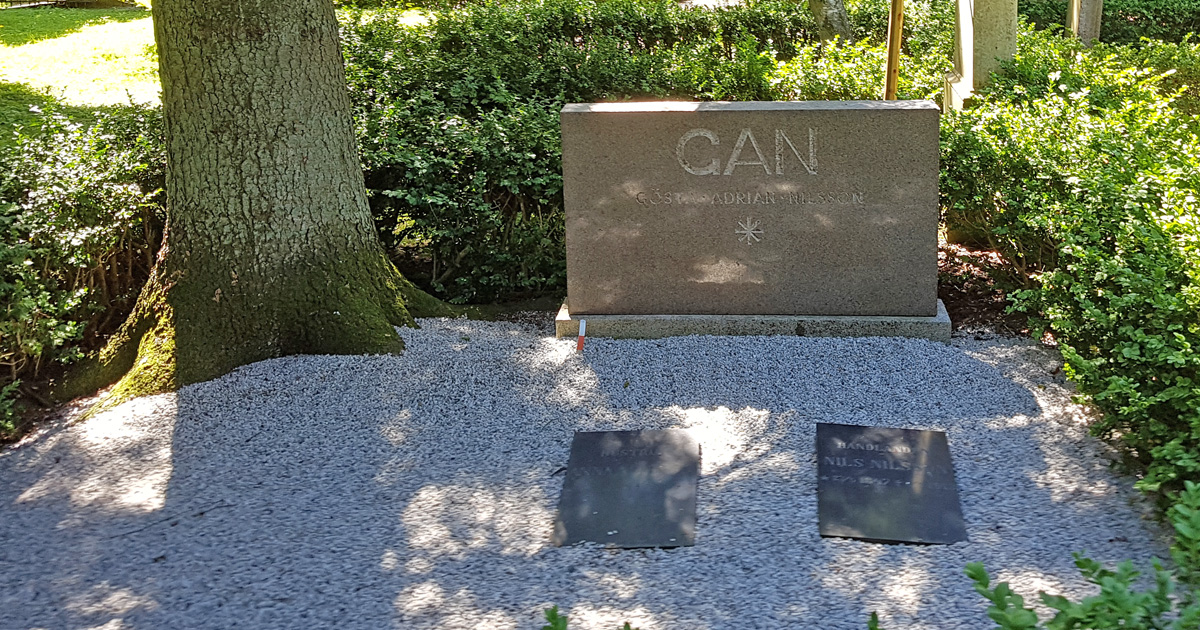 Grave of modernist artist and author Gösta Adrian-Nilsson (GAN).
5) Harry Karlsson
Building contractor Harry Karlsson, whose grave is to be found in block 22, was born on June 12th, 1903, in Trelleborg and started his career as a journeyman carpenter.
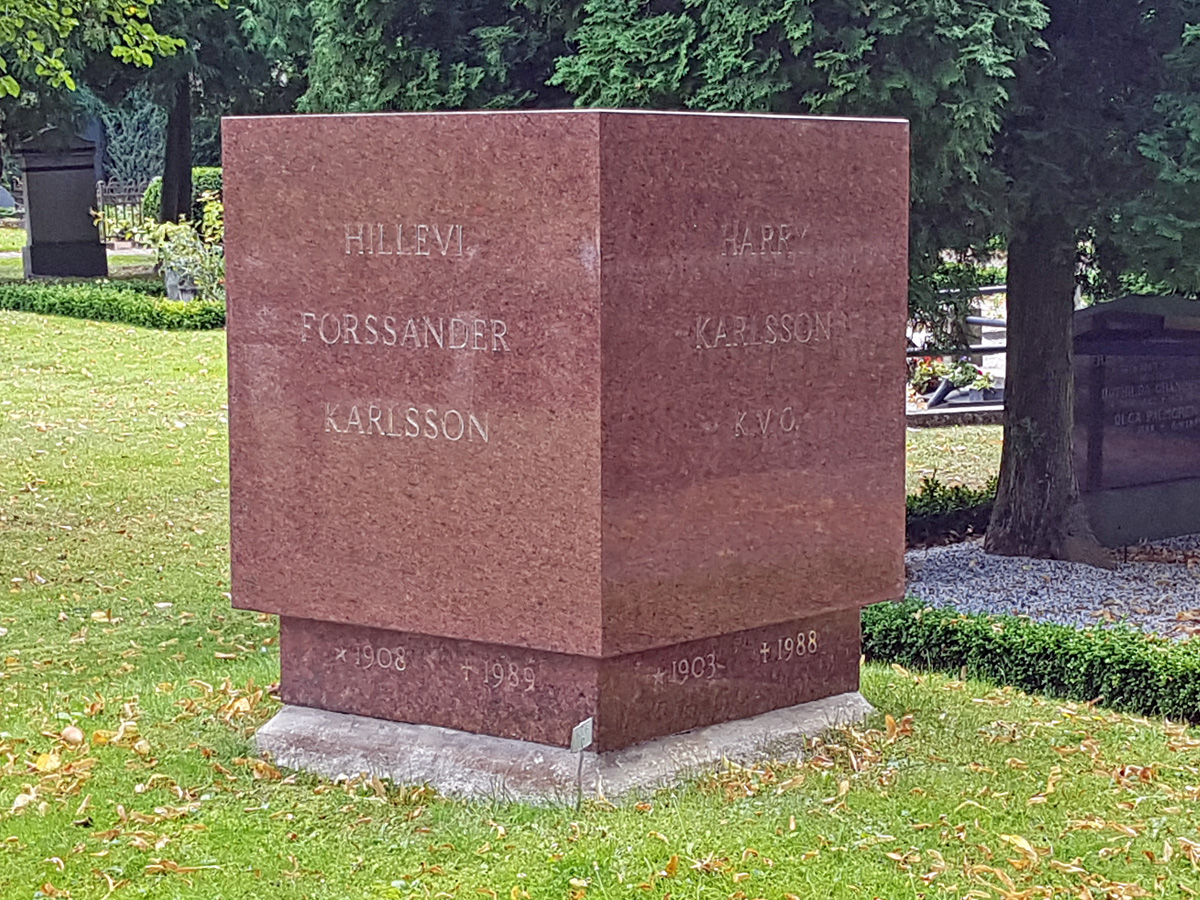 Grave of building contractor Harry Karlsson.
In 1936 he started "Byggnads AB Harry Karlsson i Lund" which he owned until 1967 when the
company was sold. He started out by building small USA-inspired prefab houses put together on
the spot of land designated for them. He built thousands of detached and semidetached houses
and town houses. Mainly in Lund, but also in Trollhättan, Göteborg and Stockholm among other
places.
Grave of building contractor Harry Karlsson.
In 1936 he started "Byggnads AB Harry Karlsson i Lund" which he owned until 1967 when the
company was sold. He started out by building small USA-inspired prefab houses put together on
the spot of land designated for them. He built thousands of detached and semidetached houses
and town houses. Mainly in Lund, but also in Trollhättan, Göteborg and Stockholm among other
places.
The gravestone has the unusual shape of a cube. Besides Harry Karlsson himself, his first wife Hedda Karlsson and Hillevi Forssander whom he lived with after his 2nd marriage ended, are buried here. Harry Karlsson died March 22nd, 1988, in Lund.
Harry Karlsson and Marianne Wahlgren, his 2nd wife, were parents of author Anna Wahlgren. She in turn is the mother of Sara Danius, professor of literature and the permanent secretary of the Swedish Academy between 2015 and 2018. She died in 2019 and Harry Karlsson was her maternal grandfather.
6) Theodor Wåhlin
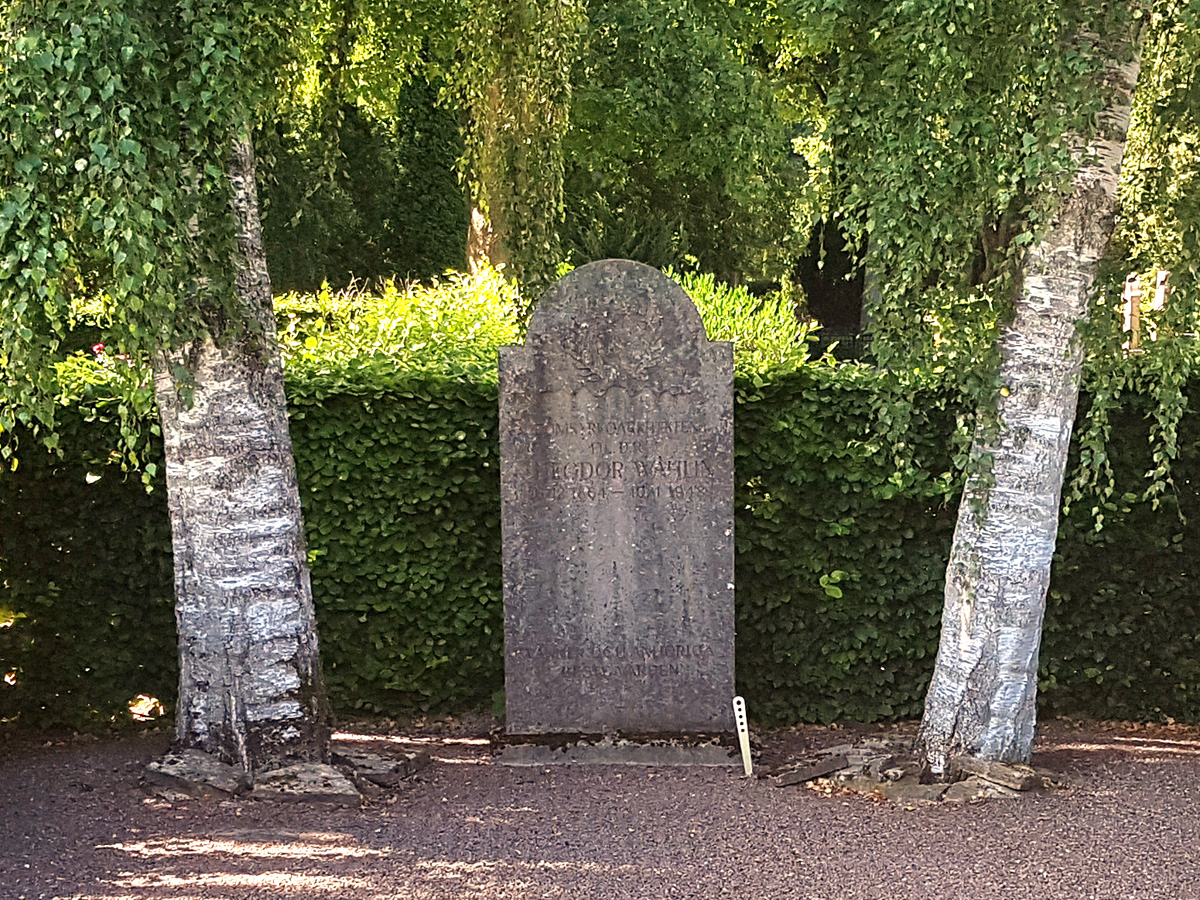 Grave of Cathedral Architect Theodor Wåhlin.
At the northern edge of block 22 you can find the grave of Cathedral architect Theodor Wåhlin.
He was born December 16th, 1864, in Lund and died there on January 10th, 1948.
Grave of Cathedral Architect Theodor Wåhlin.
At the northern edge of block 22 you can find the grave of Cathedral architect Theodor Wåhlin.
He was born December 16th, 1864, in Lund and died there on January 10th, 1948.
In 1910 Theodor Wåhlin became the Cathedral architect. Among other things he was responsible, together with tower clock maker Julius Bertram-Larsen, for reconstruction of the Astronomical clock you can still find in the Cathedral today. The Clock was reinaugurated when celebrating the 800th anniversary of the crypt in the Cathedral in 1923. Theodor Wåhlin is also the architect behind several buildings still to be found in Lund today. One example is the building by Krafts Square (Krafts torg) behind the Cathedral, where the Lund Diocese has its offices. Another example is the big brick building at the northern end of Main Square (Stortorget) south of the Cathedral.
7) Otto Lindfors
The grave of Otto Lindfors is located at the southeastern end of block 23. He was born on July 28th, 1781, in Karstorp northwest of Vetlanda in Småland, where his father was an assistant vicar within the church. In 1798 he was accepted at Lund university and 4 years later he received his master's degree.
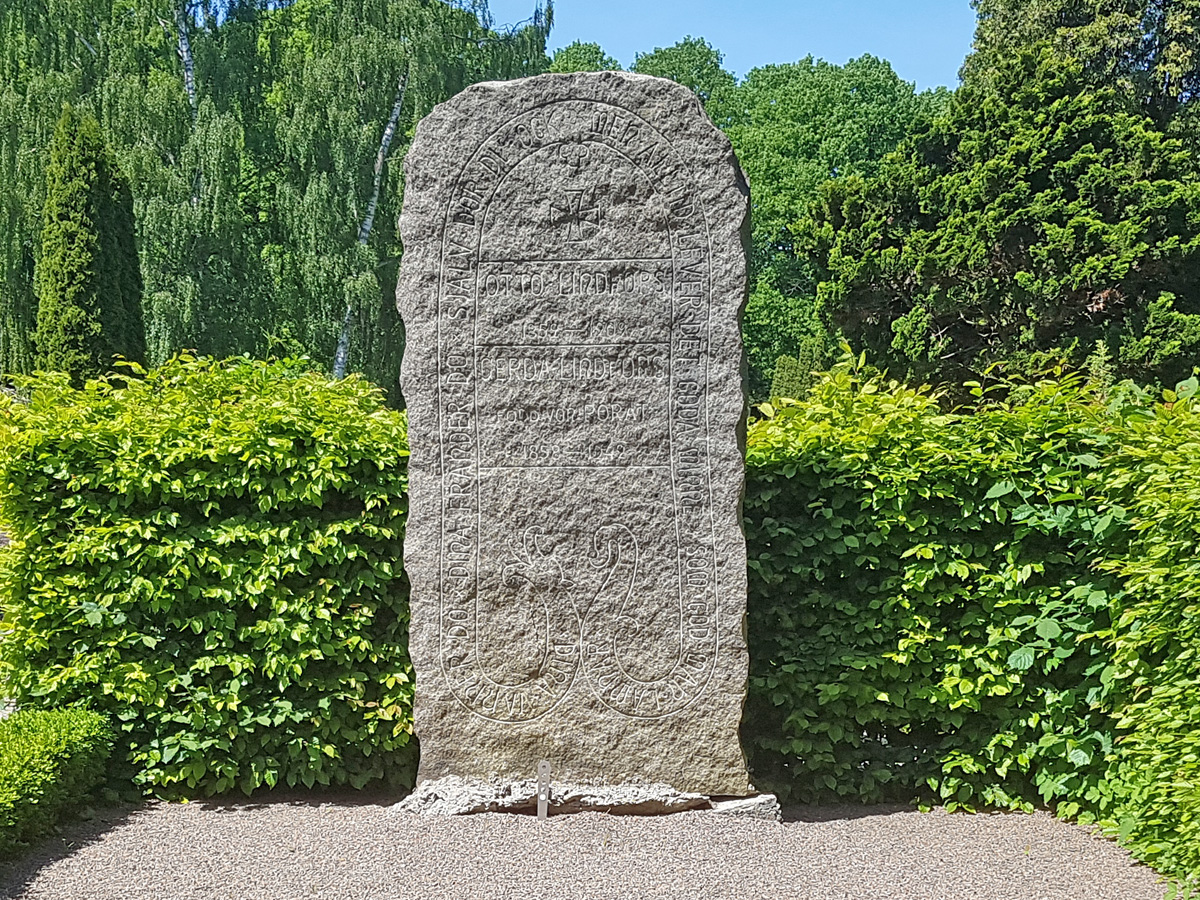 Grave of Professor Otto Lindfors.
During 1802-1803 Otto Lindfors gave five disputations in Latin about gymnastics, playing games
and taking part in athletics, this made him a pioneer and predecessor of Per Henrik Ling who
is usually accredited with being the father of Swedish gymnastics. Otto Lindfors became an
associate professor of theoretical philosophy in 1805 and a professor of history in 1816. In
1819 he was ordained as a priest and in 1826 he became a professor of Latin and roman
eloquence. In 1822–1823 and 1829–1830 he was vice chancellor of Lund University.
Grave of Professor Otto Lindfors.
During 1802-1803 Otto Lindfors gave five disputations in Latin about gymnastics, playing games
and taking part in athletics, this made him a pioneer and predecessor of Per Henrik Ling who
is usually accredited with being the father of Swedish gymnastics. Otto Lindfors became an
associate professor of theoretical philosophy in 1805 and a professor of history in 1816. In
1819 he was ordained as a priest and in 1826 he became a professor of Latin and roman
eloquence. In 1822–1823 and 1829–1830 he was vice chancellor of Lund University.
In 1818 Otto Lindfors bought the so called Lindfors House in Adelgatan, which is now a part of Lund open air museum Kulturen. This house was previously owned from 1807 by above mentioned Per Henrik Ling. It was while Otto Lindfors was vice chancellor of Lund University that he, in the morning of September 8th, 1829, was alerted to the fact that there was a dead person lying in the street in Adelgatan in front of his house. It was a student that had been murdered in the house next door during the night. That house has since then been known as Locus Peccatorum, which means the house of sin. You can read more about this in the visitor´s guide Locus Peccatorum and the student murder of 1829. Otto Lindfors died on March 8th, 1841, still residing in the house at Adelgatan.
8) Henrik Sjöström
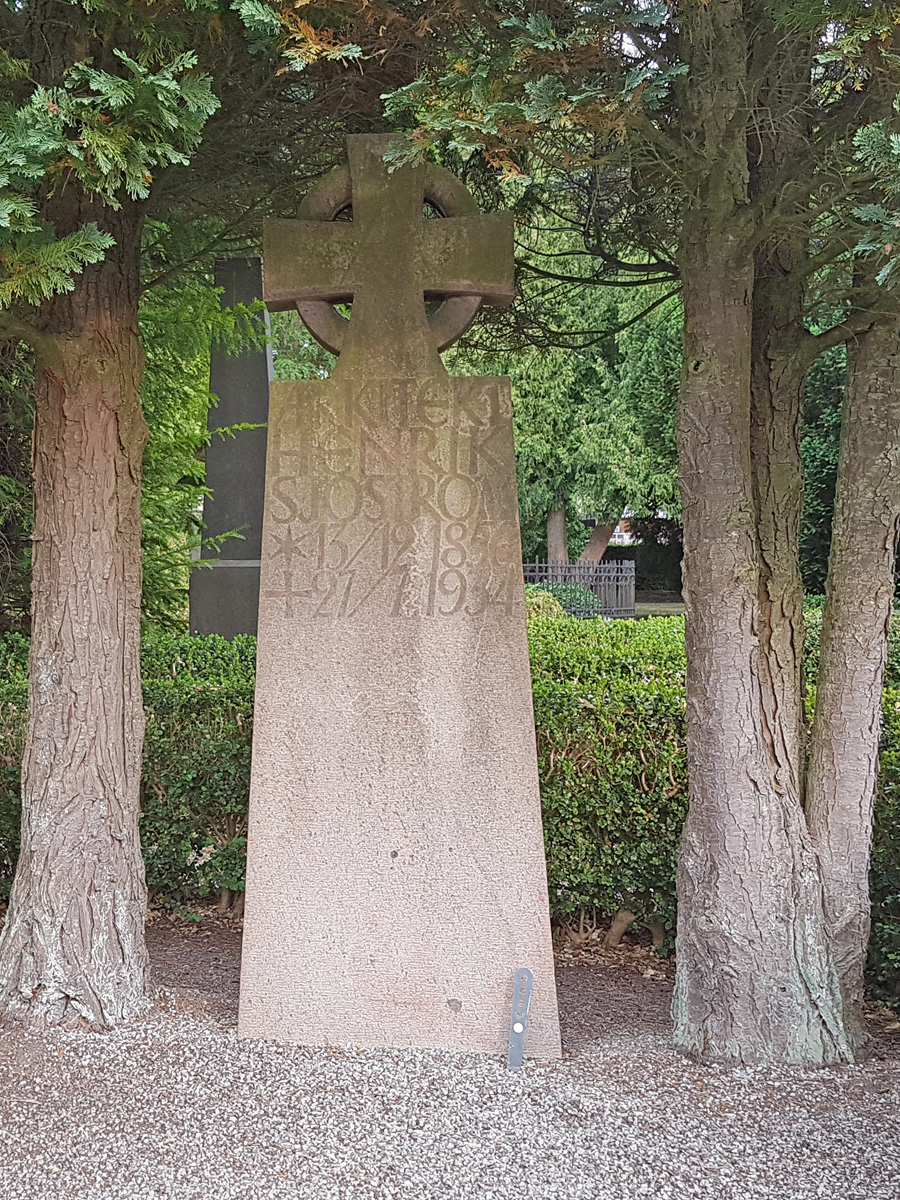 Grave of Architect Henrik Sjöström.
In the northwestern corner of block 25, one of the two oldest blocks at Northern Cemetery you
find the grave of architect Henrik Sjöström. He was born December 13th, 1856, in Lund and died
there July 27th, 1934.
Grave of Architect Henrik Sjöström.
In the northwestern corner of block 25, one of the two oldest blocks at Northern Cemetery you
find the grave of architect Henrik Sjöström. He was born December 13th, 1856, in Lund and died
there July 27th, 1934.
Henrik Sjöström a student of the Cathedral architect Helgo Zettervall, between 1874 and 1881. Henrik Sjöström had his own architectural bureau in Lund. He designed several buildings in town, and quite a few are still standing. One of those is the cemetery chapel mentioned above in the history section. Another example is "The Thomander student home" (Tomanderska studenthemmet) where he was responsible for the renovation in 1895.
9) Jöns Petter Borg
Textile-dyeing factory owner Jöns Petter Borg's family grave is to be found at the southern end of block 26, one of the two oldest blocks at Northern Cemetery. He was born August 13th, 1781, and died March 13th, 1851.
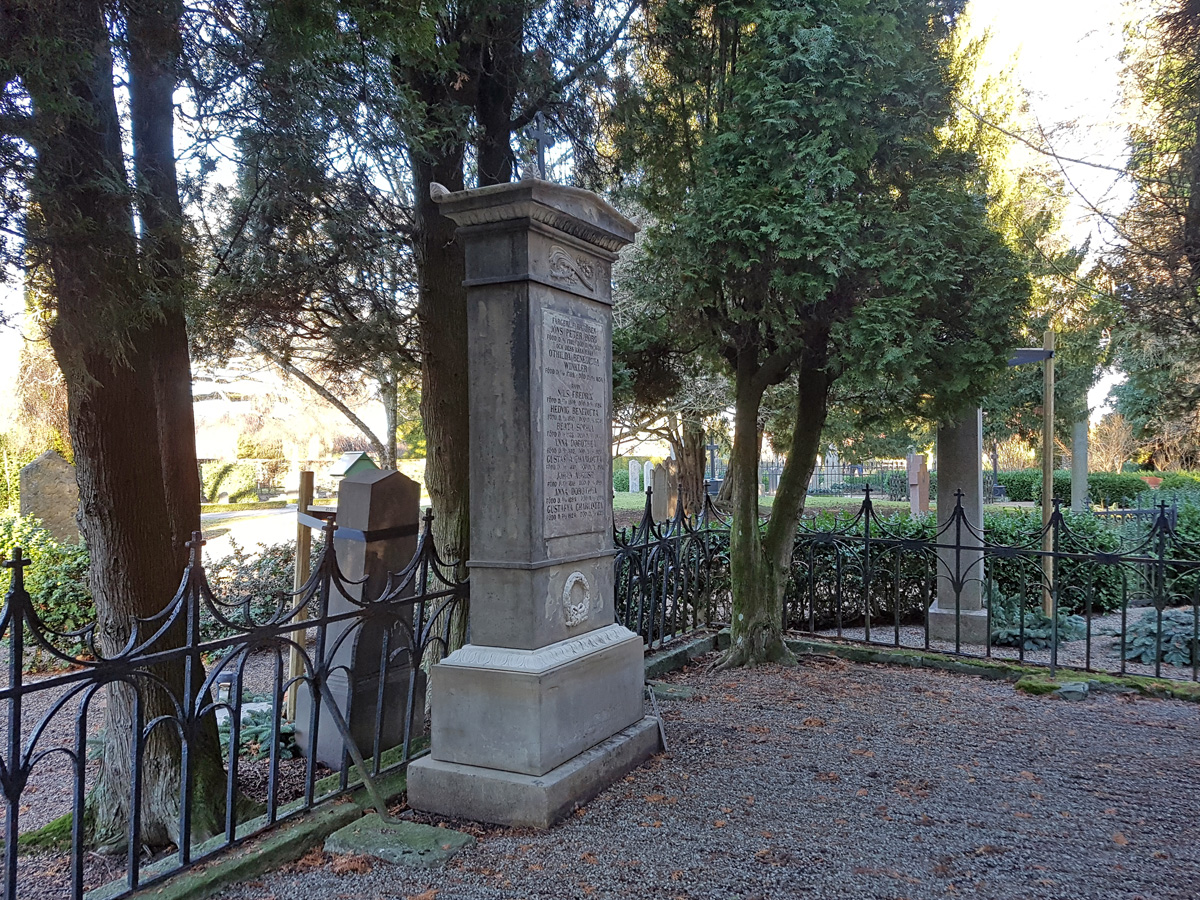 Family grave of textile-dyeing factory owner Jöns Petter Borg.
The factory was founded in 1739 by Jöns Petter's grandfather Hans Petter Borg, and was located
in the Lund city block that today is named "färgaren" (the dyer) across from the street from
Main Square (Stortorget). Jöns Petter Borg was only 15 years old when his father Fredrik Borg
died in 1796, and his mother Hedvig Möller was then appointed guardian of her children. She
oversaw the factory until 1806, when Jöns Petter took over responsibility for the family
business. Jöns Petter later also became a member of the Swedish parliament.
Family grave of textile-dyeing factory owner Jöns Petter Borg.
The factory was founded in 1739 by Jöns Petter's grandfather Hans Petter Borg, and was located
in the Lund city block that today is named "färgaren" (the dyer) across from the street from
Main Square (Stortorget). Jöns Petter Borg was only 15 years old when his father Fredrik Borg
died in 1796, and his mother Hedvig Möller was then appointed guardian of her children. She
oversaw the factory until 1806, when Jöns Petter took over responsibility for the family
business. Jöns Petter later also became a member of the Swedish parliament.
At the beginning of the 19th century Main Square (Stortorget) was considered too small to serve as the city's main trade square and it was then discussed to establish a new square on top of St. Peter Cemetery, today named Petriplatsen or Linnéplatsen (situated where the city library is today). This wasn't to the liking of Jöns Petter Borg, because there his father and his father's two wives and Jöns Petter Borgs first wife Gunilla Ruhe, were buried. Where Mårtens Square (Mårtenstorget) is today was then a big private garden. Jöns Petter Borg purchased this garden and offered to donate it to the city if the new trade square was placed there instead. In this way he wanted to prevent the cattle market taking place in the cemetery where his family was buried. The offer was accepted and Mårtenstorget was established in the 1840's.
10) Henric Schartau
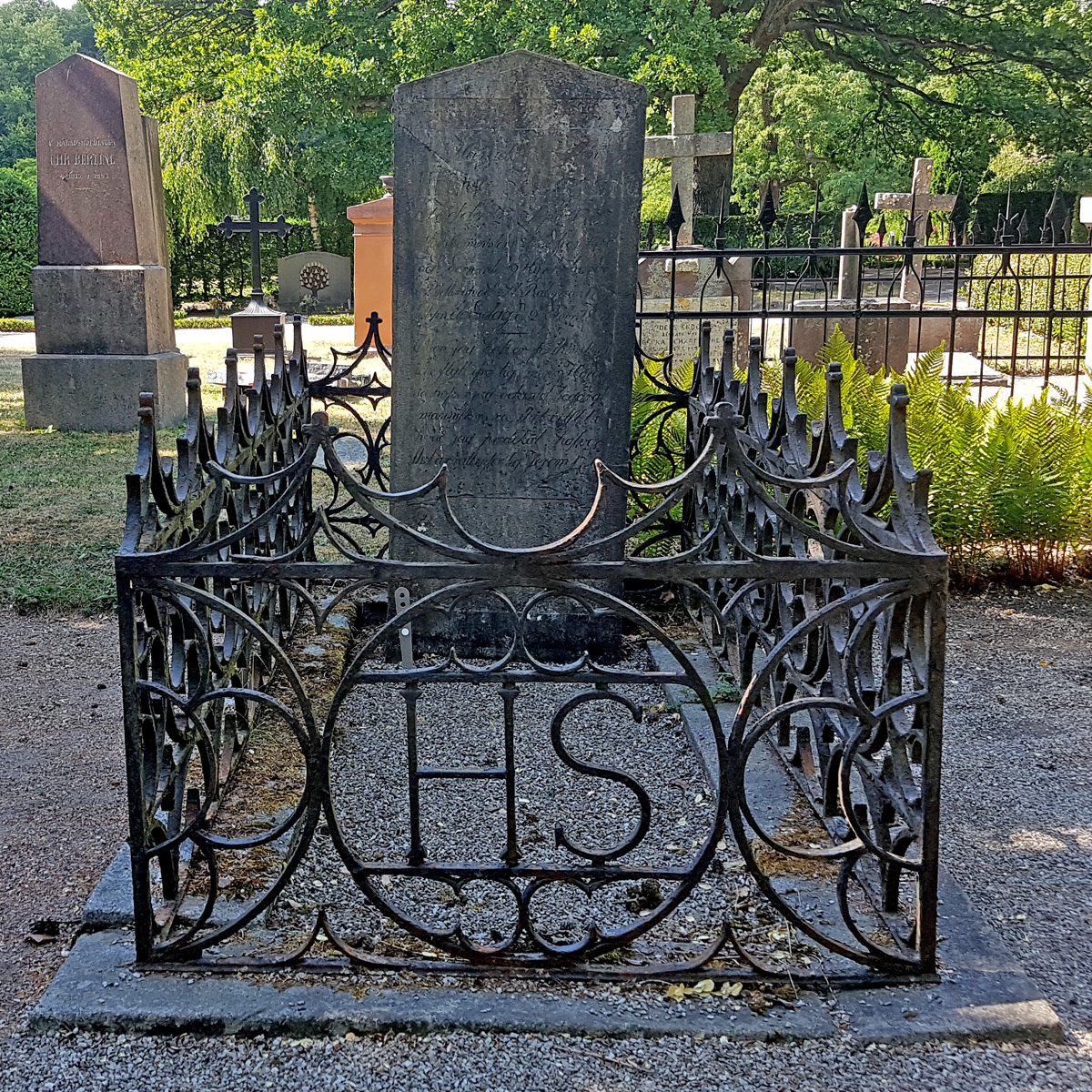 Revival preacher Henric Schartau's grave.
In the northwestern corner of block 26, one of Northern Cemetery oldest blocks, you find the
grave of Revival preacher Henric Schartau. He was born in Lund September 27th, 1757, and died
on February 3rd, 1825. Henric Schartau studied at Lund University in the 1770's and was
ordained as priest in Kalmar 1780. He later became an assistant pastor at Lund Cathedral.
Revival preacher Henric Schartau's grave.
In the northwestern corner of block 26, one of Northern Cemetery oldest blocks, you find the
grave of Revival preacher Henric Schartau. He was born in Lund September 27th, 1757, and died
on February 3rd, 1825. Henric Schartau studied at Lund University in the 1770's and was
ordained as priest in Kalmar 1780. He later became an assistant pastor at Lund Cathedral.
Henric Schartau was a revival preacher, and he started the revival movement known as Schartauanism. The movement mainly existed in Scania and up along the west coast. It's signified by strictly applying the order of the church and office, with emphasis on word and sacrament, in true Lutheran fashion.
In Domkyrkoplatsen (the square south of the Cathedral) here in Lund is a statue of Henric Schartau. It was erected in 2003.
11) Gottfrid Billing
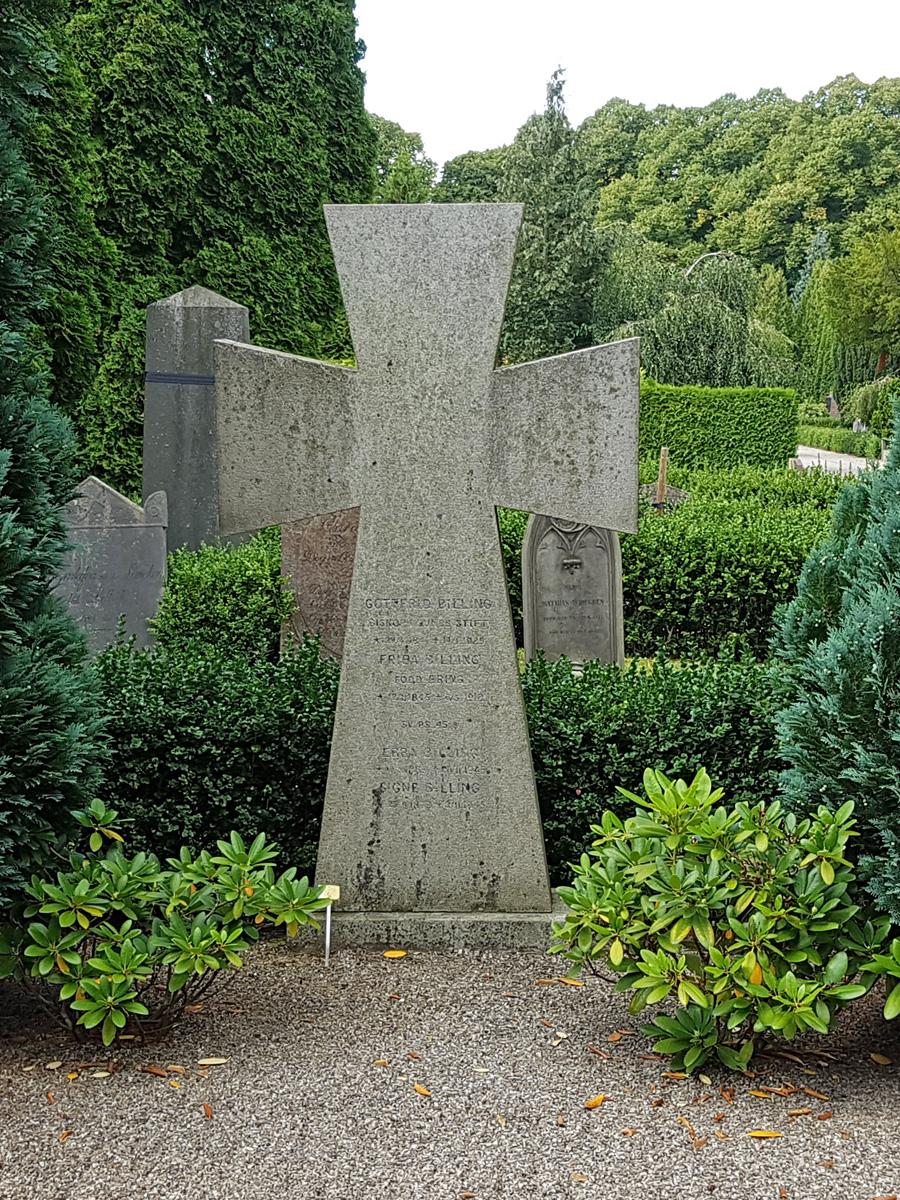 Grave of Bishop Gottfrid Billing.
Gottfrid Billing, whose grave is to be found at the northern end of block 26, was born in
Önnestad April 29th, 1841. He started his studies in theology at Lund University at the
beginning of the 1860's. From 1898 until January 14th, 1925, when he died, he was the bishop
of Lund. From 1889 until 1906 he was also a member of the 1st chamber of the Swedish Parliament,
as a very strict conservative politician. He was also the court preacher, both to King Oscar
II and Gustaf V. From the year 1900 until he died, he was a member of the Swedish Academy.
Grave of Bishop Gottfrid Billing.
Gottfrid Billing, whose grave is to be found at the northern end of block 26, was born in
Önnestad April 29th, 1841. He started his studies in theology at Lund University at the
beginning of the 1860's. From 1898 until January 14th, 1925, when he died, he was the bishop
of Lund. From 1889 until 1906 he was also a member of the 1st chamber of the Swedish Parliament,
as a very strict conservative politician. He was also the court preacher, both to King Oscar
II and Gustaf V. From the year 1900 until he died, he was a member of the Swedish Academy.
In Parliament debates Gottfrid Billing was always opposed to any suggestions on implementing the rights for everyone to vote in general elections, and in the 1st chamber he always considered the liberals as the greatest threat to society. In a debate within the Swedish church around 1908-1910 on the actual existence of the Devil, he believed the devil did exist because the Savior had said so. On September 28th, 1918, he became honorary doctor here in Lund, and on June 6th, 1921, he received the royal order of the Seraphim.
12) Elin Wägner
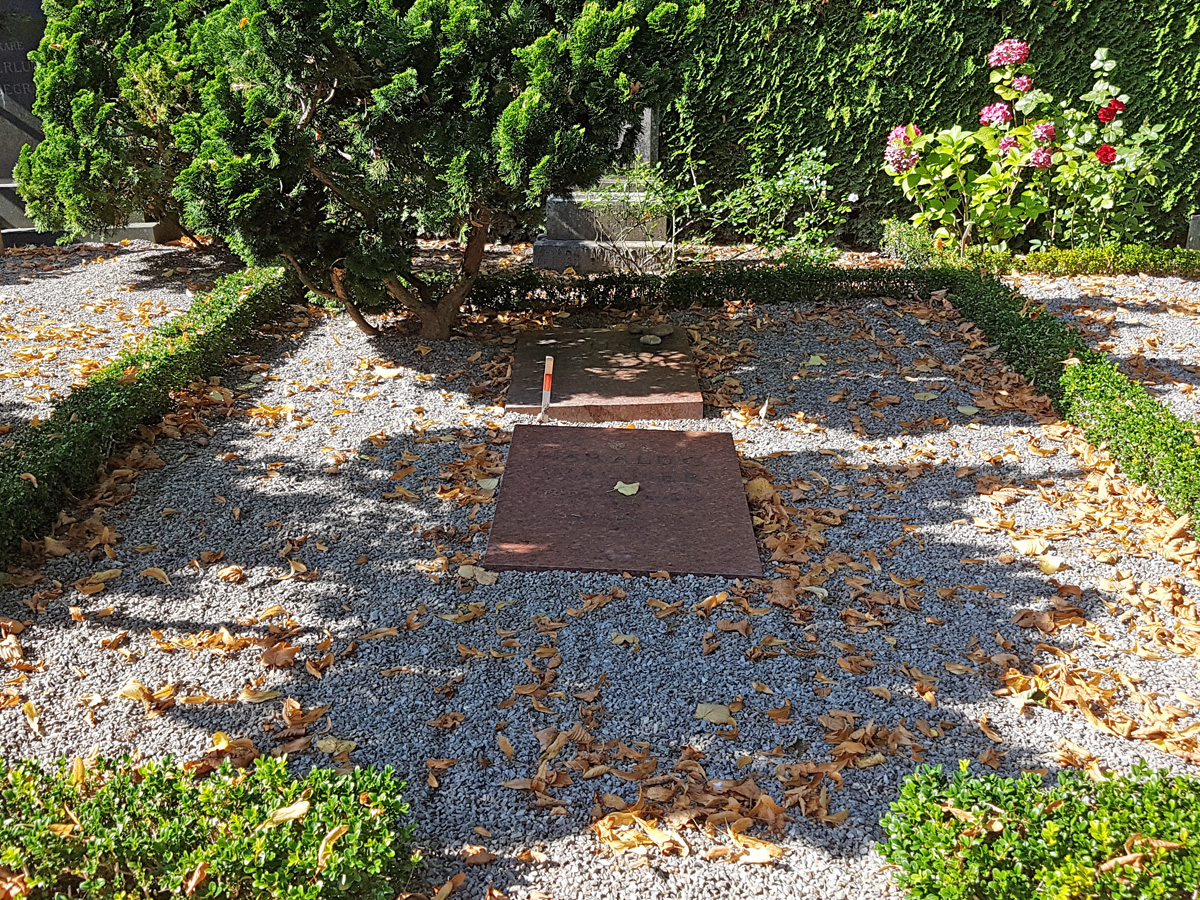 Grave of author, journalist and feminist Elin Wägner. The inner gravestone is hers.
Author, journalist and feminist Elin Wägner is buried in the northern part of block 28. She
was born in Lund May 16th, 1882, and died in Berg, north of Växjö, January 7th, 1949.
Grave of author, journalist and feminist Elin Wägner. The inner gravestone is hers.
Author, journalist and feminist Elin Wägner is buried in the northern part of block 28. She
was born in Lund May 16th, 1882, and died in Berg, north of Växjö, January 7th, 1949.
Except her authorship Elin Wägner is known for being an active suffragette. She was also one of the founders of "Rädda Barnen" ("Save the Children", a Swedish organization fighting for children and their rights) in 1919. In 1944 she was made a member of the Swedish Academy.
When Elin Wägner was born, the family resided on the top floor of "Lund Private Elementary School", then located in Vårfrugatan next to the city arrest. Later she lived in a small yard house at Grönegatan 10, where a memorial plaque on the wall tells that she lived there.
13) Gaby Stenberg
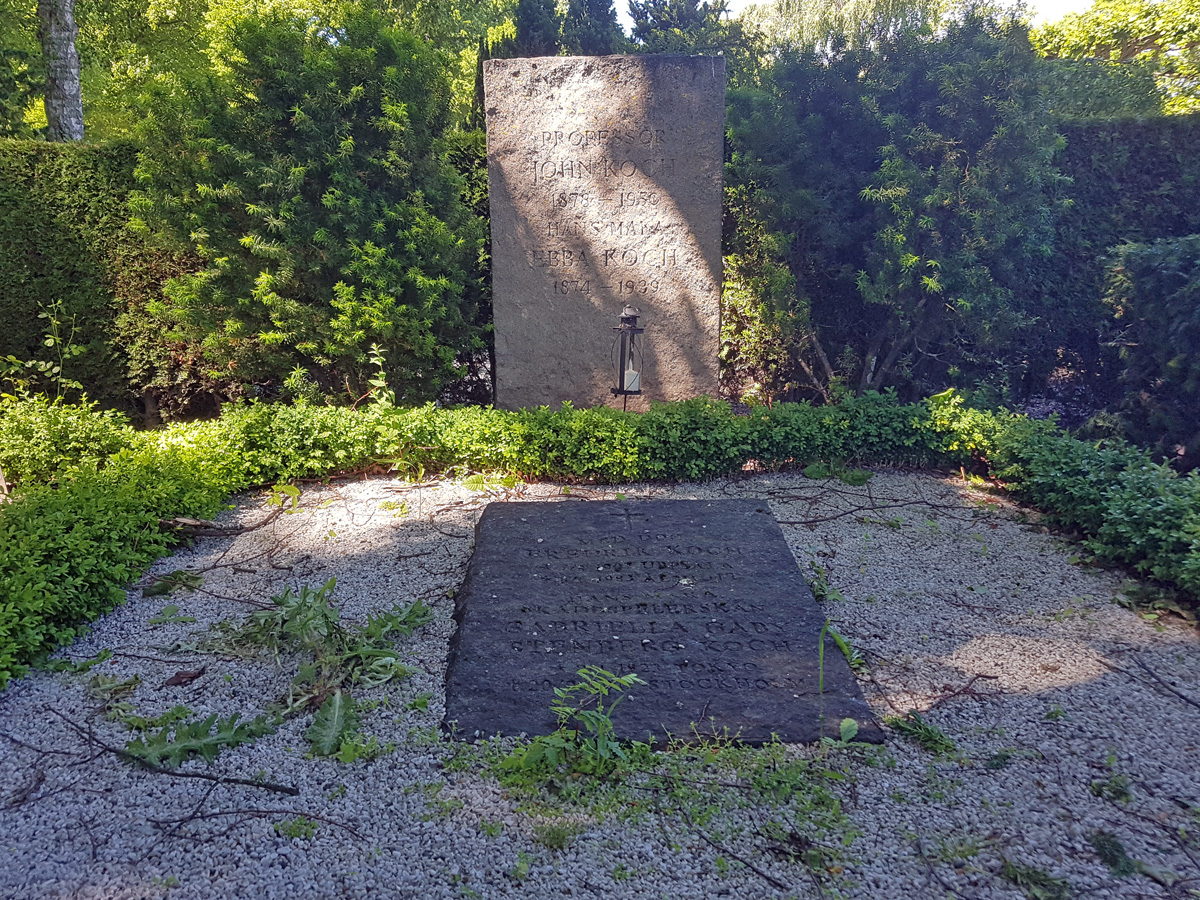 Grave of actress Gaby Stenberg. The gravestone lying on the ground is over her and her
husband.
Gaby Stenberg, whose grave is at the eastern edge of block 30, was born January 9th, 1923, in
Tokyo. She was the daughter of Swedish businessman Sven Stenberg, who at that time was working
for a Japanese trading company. The family moved back to Sweden the same year Gaby was born.
Grave of actress Gaby Stenberg. The gravestone lying on the ground is over her and her
husband.
Gaby Stenberg, whose grave is at the eastern edge of block 30, was born January 9th, 1923, in
Tokyo. She was the daughter of Swedish businessman Sven Stenberg, who at that time was working
for a Japanese trading company. The family moved back to Sweden the same year Gaby was born.
Gaby went to music school in Stockholm and there she learnt to play the piano and took singing lessons. Later she attended theater school, but already before that she had made her movie debut with a small role in a film called "Bombi Bitt och jag", and later with a bigger part in the film "Sigge Nilsson och jag".
Gaby Stenberg played in around 40 films and TV-series, during the 1990's in "Goda Grannar" and "Rederiet" (where she played the part of Beatrice Dahlén). She also had parts in plays at Oscarsteatern in Stockholm and at Malmö Stadstad. For a period, she also worked as a speech therapist in Malmö and later as a teacher at the Vadstena-Academy. She died September 20th, 2011, in Stockholm.
14) The Cathedral Grave
The Cathedral Grave in block 32 was created under unusual circumstances. When Cathedral architect Georg Brunius was responsible for the cathedral renovation in 1833 there were 14 coffins in a crypt under the stairs leading up to the main altar. The crypt is still intact today, but not accessible. In one of the coffins lay the remains of Peder Winstrup (last Danish and first Swedish bishop of Lund, and first vice chancellor of Lund University, in the late 1600's) and in the remaining 13 coffins lay his family and relatives, all buried in the same crypt. Brunius decided to move the coffins to another crypt, together with some other coffins that where in the way during the renovation, but the coffins didn't remain in that place for long.
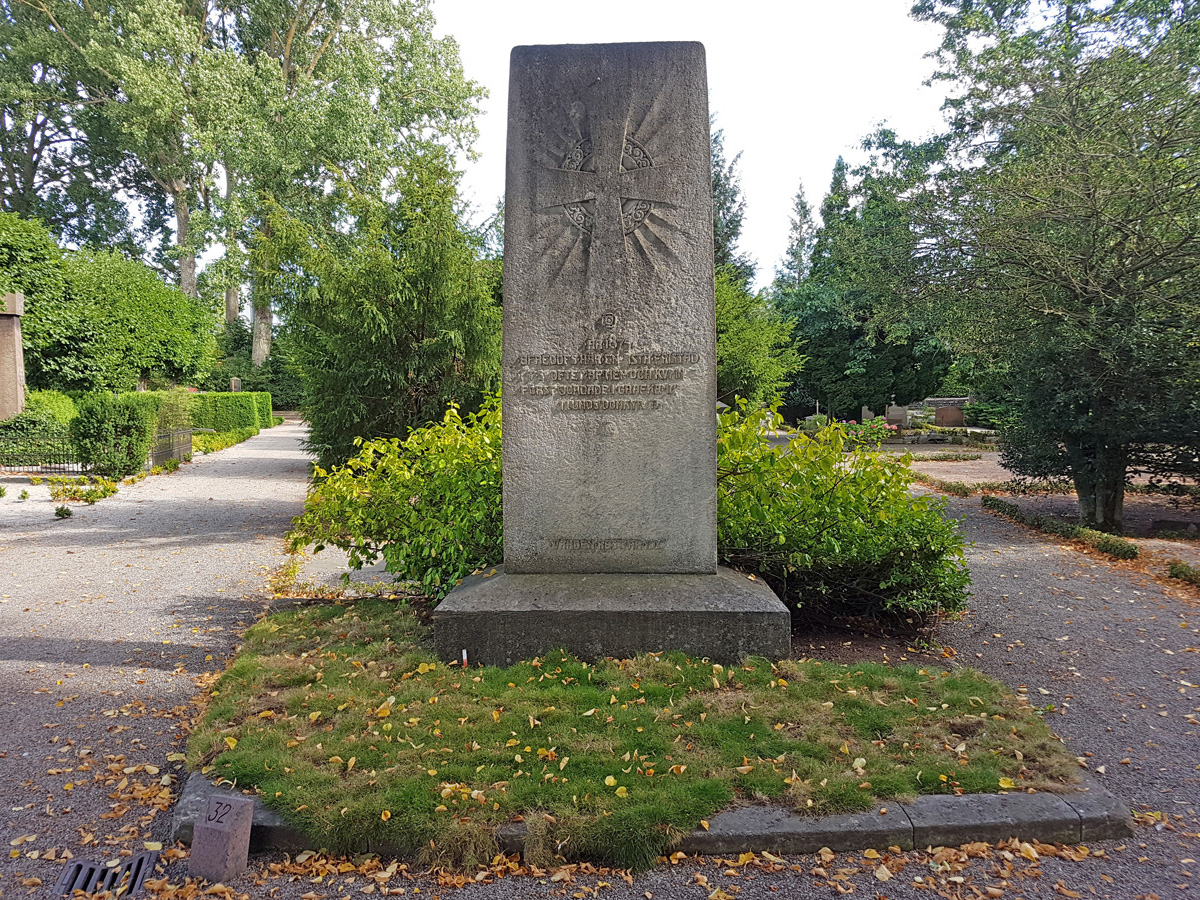 The Cathedral Grave (Domkyrkograven)..
The coffins were moved to a room in the lower part of the northern tower, and here they
remained until the 1850's when that space was needed for other purposes. They were then moved
to a room in the lower part of the southern tower, and this room was then permanently closed
out of respect to right to be buried in the Cathedral.
The Cathedral Grave (Domkyrkograven)..
The coffins were moved to a room in the lower part of the northern tower, and here they
remained until the 1850's when that space was needed for other purposes. They were then moved
to a room in the lower part of the southern tower, and this room was then permanently closed
out of respect to right to be buried in the Cathedral.
In 1860 Helgo Zettervall was appointed the new Cathedral architect, and in 1869 his plans to restore the Cathedral were approved. These plans meant that the cathedral towers were to be demolished, and therefore, the coffins had to be moved again. The problem of moving them was solved by Zetterwall in 1875. Under cover of darkness 26 coffins, all coffins in the Cathedral tower room except the one containing the remains of bishop Winstrup, were transported by horse and cart from the Cathedral to Northern Cemetery where they were interred in an initially unmarked mass grave.
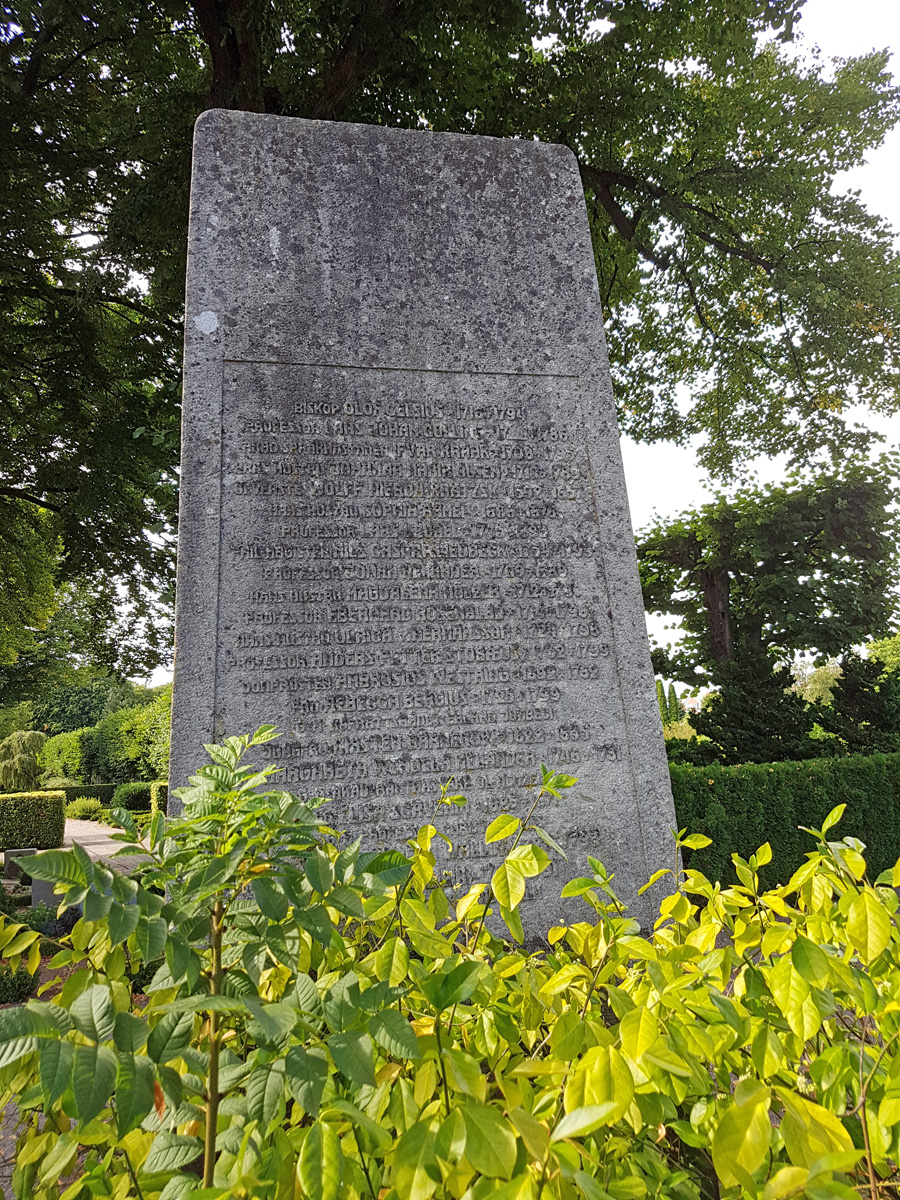 Backside of gravestone at The Cathedral Grave (Domkyrkograven) with names that are now
hard to read.
But in 1913, when Theodor Wåhlin was cathedral architect, it was decided that a gravestone was
to be erected on the unmarked grave. Quite possibly the decision taken by the cathedral board
was founded on of shame and regret over how the coffins had been treated over the years. The
coffins were disinterred and coffin plates with inscriptions to identify the buried were
searched for. The names on the plates found are the original basis of who were thought to be
buried in the grave. These names can be found on the backside of the gravestone, but today
they are hardly legible.
Backside of gravestone at The Cathedral Grave (Domkyrkograven) with names that are now
hard to read.
But in 1913, when Theodor Wåhlin was cathedral architect, it was decided that a gravestone was
to be erected on the unmarked grave. Quite possibly the decision taken by the cathedral board
was founded on of shame and regret over how the coffins had been treated over the years. The
coffins were disinterred and coffin plates with inscriptions to identify the buried were
searched for. The names on the plates found are the original basis of who were thought to be
buried in the grave. These names can be found on the backside of the gravestone, but today
they are hardly legible.
However, the plates found in the grave were not attached to any coffins, and in hindsight it's become clear that the plates didn't belong to any of the 25 coffins moved from the cathedral that dark night in 1875. Instead, they belonged to other people buried in the cathedral at a later point in time, mainly bishops and university professors. This means that the names on the back of the gravestone are not those of the people buried in the grave.
Full certainty of whom are buried in the grave, we will probably never have. But in all probability, it should be family and relatives of Peder Winstrup. In the grave there are also the people buried in the crypt next to the Winstrup crypt under the stairs leading up to the main altar in the Cathedral. The remains of Peder Winstrup himself are to be found in a new coffin in the northern tower of the Cathedral, where he was "re-buried" on December 11th, 2015.
15) The Holmgren family grave
To the inhabitants of Lund the Holmgren name has, for more than 100 years, been synonymous with Holmgrens Delicatessen in Lund Market Hall (saluhallen). The family grave can be found at the northeastern corner of block 32. It was Nils Holmgren and his wife Elna Persson who started a butcher's shop on Tomegatan in Lund on November 14th, 1898. Nils Holmgren was born in Härslöv north of Landskrona August 2nd, 1871, and Elna was born in Lund November 6th, 1879.
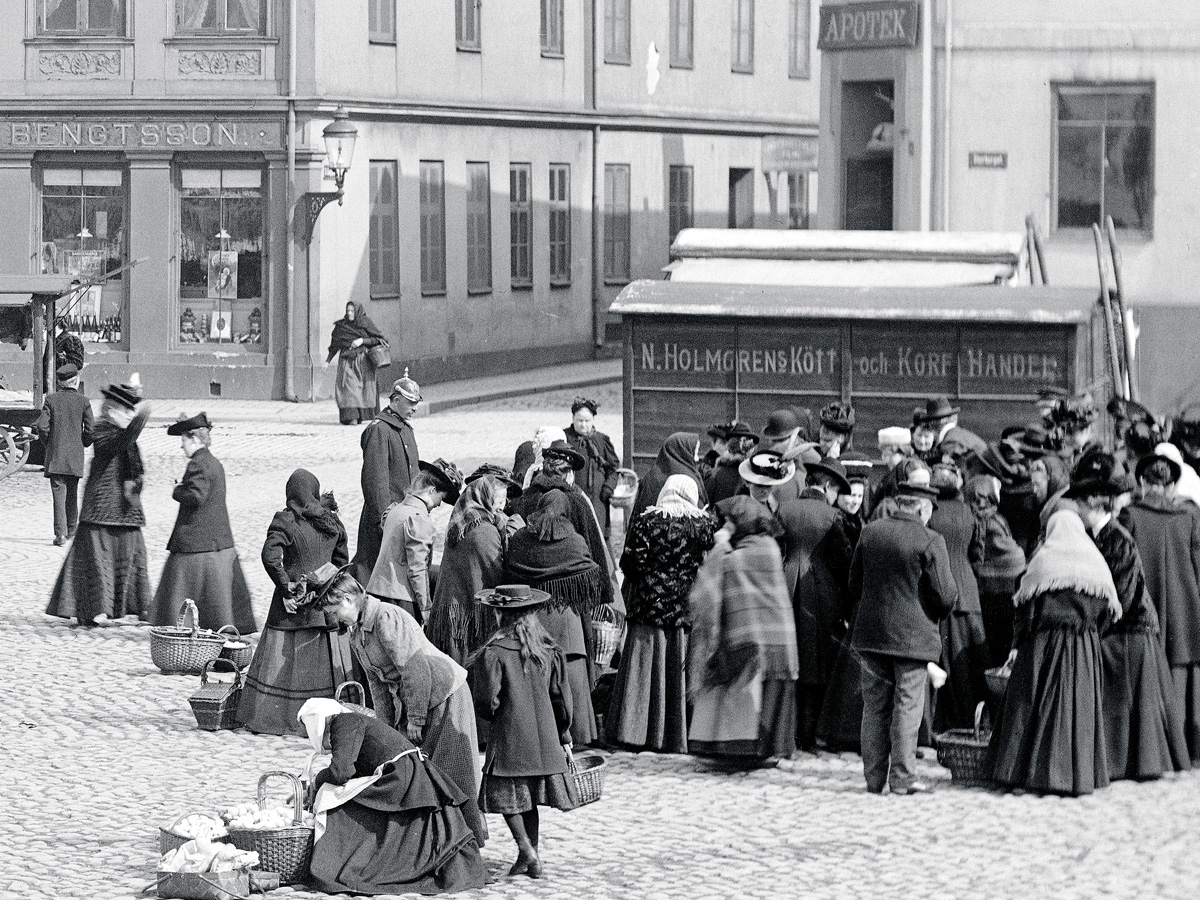 Nils Holmgrens delicatessen (on wheels) at Main Square (Stortorget) in Lund 1907.
From the year 1900 they had a stall on wheels in Stortorget Square where they would sell their
products. When the market hall next to Mårtens Square (Mårtenstorget) opened on April 21st,
1909, they moved their business there. Today, more than 100 years later, they still do
business there. Nils died May 22nd, 1947, and Elna December 11th, 1954, both here in Lund.
Nils Holmgrens delicatessen (on wheels) at Main Square (Stortorget) in Lund 1907.
From the year 1900 they had a stall on wheels in Stortorget Square where they would sell their
products. When the market hall next to Mårtens Square (Mårtenstorget) opened on April 21st,
1909, they moved their business there. Today, more than 100 years later, they still do
business there. Nils died May 22nd, 1947, and Elna December 11th, 1954, both here in Lund.
Helga Ahlfors, daughter of Nils and Elna, worked at Holmgrens Delicatessen in the Market Hall for around 60 years. She was born in Lund July 25th, 1904. She changed her family name to Ahlfors when she married Wilhelm Ahlfors, born January 26th, 1903, in Lund. He was working in another delicatessen in the market hall, the one owned by Arthur and Amalia Borglin. Helga and Wilhelm took over Holmgrens deli after Nils and Elna and ran it together. In 1951 they bought the deli owned by Arthur and Amalia Borglin and turned the two companies into one, keeping the name Holmgrens.
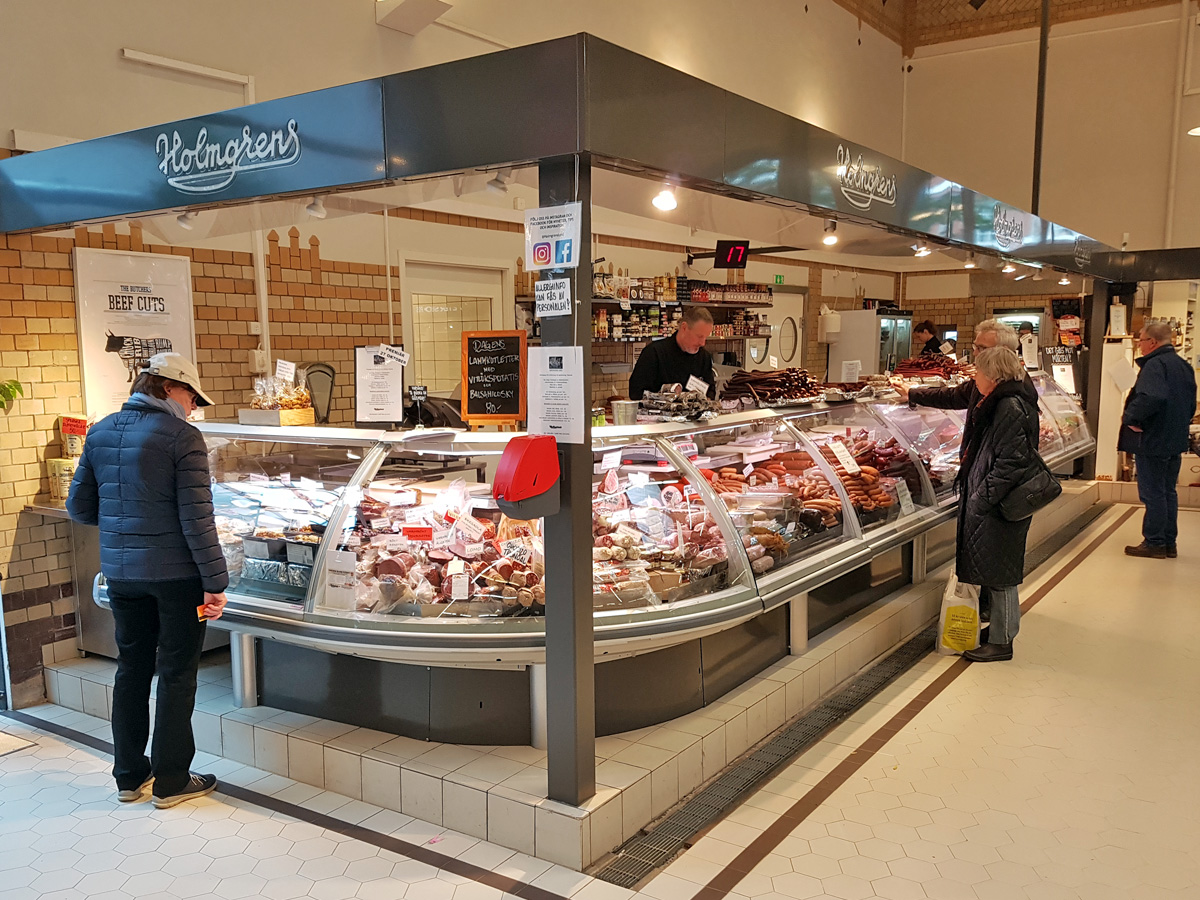 Holmgrens Delicatessen is still today to be found in the Lund market hall next to Mårtens
Square (Mårtenstorget).
Wilhelm Ahlfors died May 31st, 1961, but Helga kept running Holmgrens Delicatessen until their
sons Leif Ahlfors (born July 9th, 1931) and Lennart Ahlfors (born December 9th, 1938) took
over the company. Helga Ahlfors died December 4th, 1985.
Holmgrens Delicatessen is still today to be found in the Lund market hall next to Mårtens
Square (Mårtenstorget).
Wilhelm Ahlfors died May 31st, 1961, but Helga kept running Holmgrens Delicatessen until their
sons Leif Ahlfors (born July 9th, 1931) and Lennart Ahlfors (born December 9th, 1938) took
over the company. Helga Ahlfors died December 4th, 1985.
Perhaps the most famous thing that the people of Lund associates with Holmgrens is the special sausage called Knake. Arthur och Amalia Borglin deli started to make their own version of a German knackwurst already around 1910. The spice mix giving the Holmgrens "Knake" its distinct taste was mixed by Leif Ahlfors and Ove Hansson (a butcher from Marieholm) in 1965.
Lennart Ahlfors worked at Holmgrens deli until he died on January 15th, 2009. Leif Ahlfors, who left the company earlier, died December 29th, 2017, and was buried in Bjärred west of Lund.
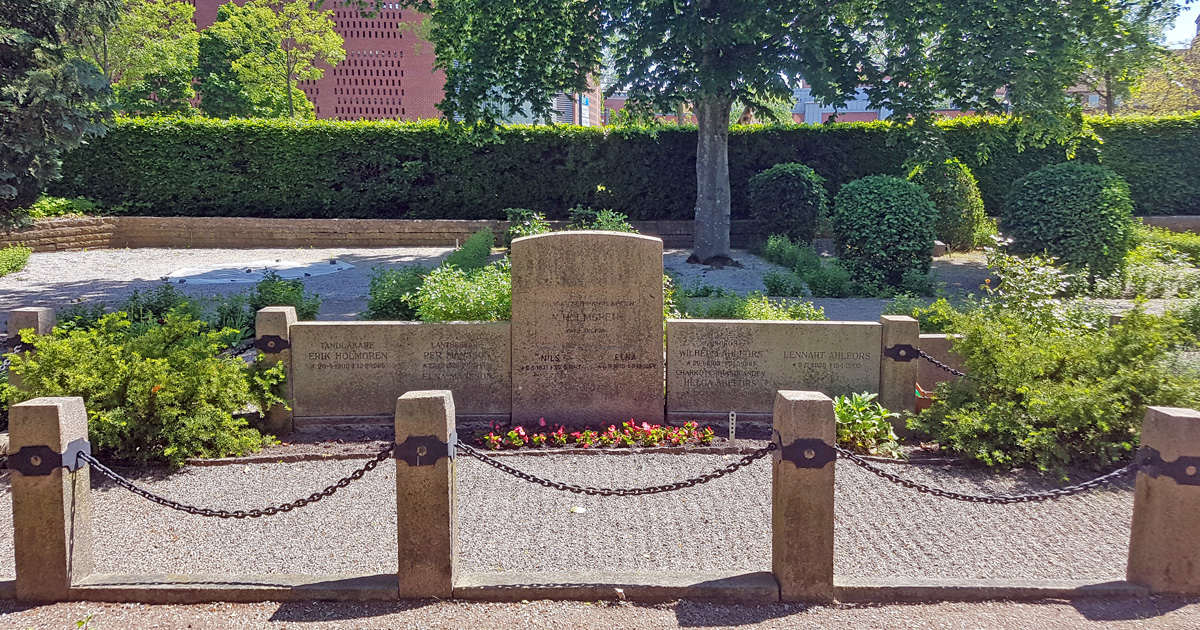 Charcuterie family Holmgren's family grave.
16) Gertrud Serner Petrén
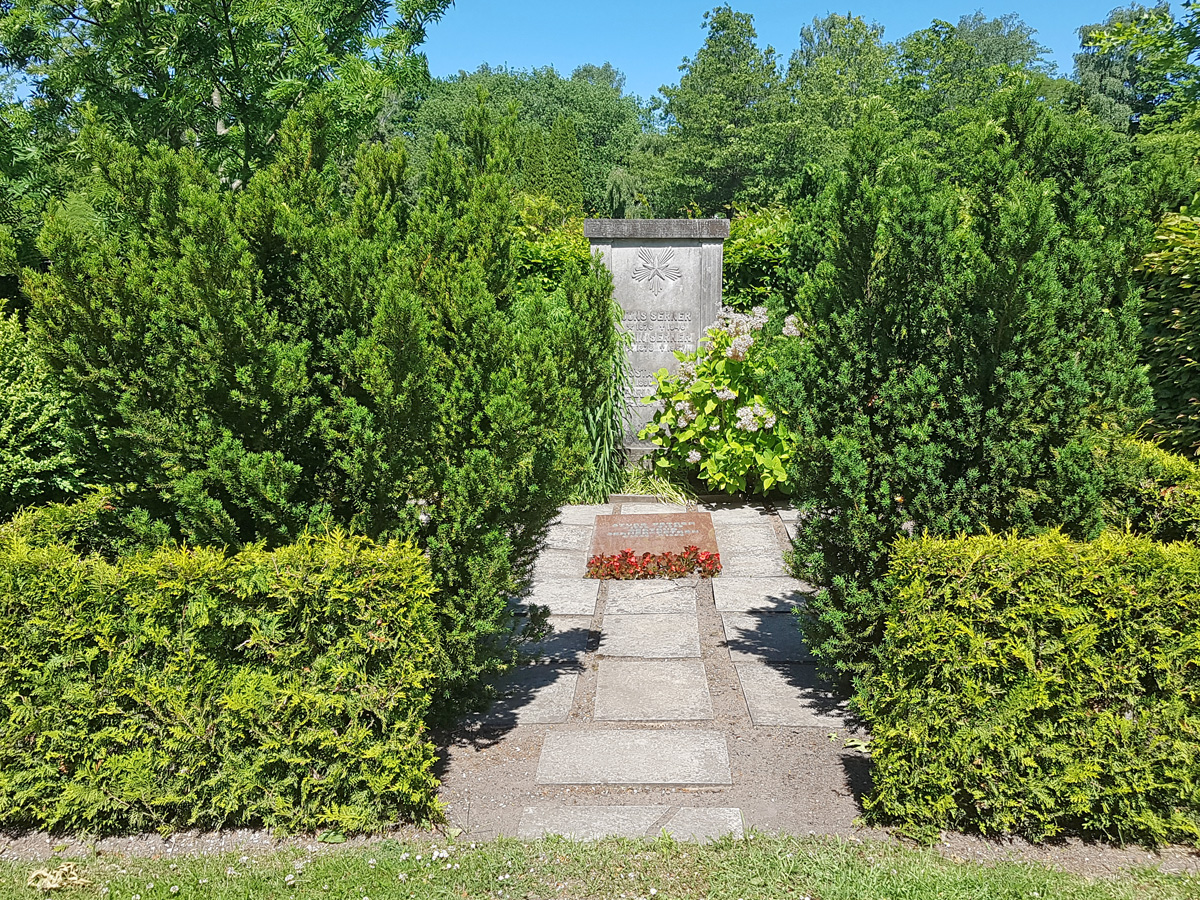 Grave of Gertrud Serner Petrén and her husband Sture Petrén.
Gertrud Serner, whose grave can be found at the eastern end of block 34, was born in Lund
October 6th, 1906, as the daughter of engineer Jöns Jönsson Serner and Elin Åkesson. After
finishing her BA in art history at the university of Lund in 1936, Gertrud Serner was employed
as an assistant at the Swedish national museum (Nationalmuseet) in Stockholm the following
year. There she became a curator and eventually the senior curator in 1949.
Grave of Gertrud Serner Petrén and her husband Sture Petrén.
Gertrud Serner, whose grave can be found at the eastern end of block 34, was born in Lund
October 6th, 1906, as the daughter of engineer Jöns Jönsson Serner and Elin Åkesson. After
finishing her BA in art history at the university of Lund in 1936, Gertrud Serner was employed
as an assistant at the Swedish national museum (Nationalmuseet) in Stockholm the following
year. There she became a curator and eventually the senior curator in 1949.
Gertrud married Sture Petrén on August 22nd, 1942, in Lund. Sture was born on October 3rd, 1908, in Stockholm and started his law studies in Lund 1925. He took his law exams in 1929 and a BA in History while waiting to be authorized as a judge. He then worked as a judge for many years in different contexts until he started working in the Ministry for Foreign Affairs in 1949. Here he, among other things, represented Sweden in the European Council. In 1967 he became a member of the International Court of Justice (ICJ) in The Hague, where he stayed for 10 years.
Sture Petrén died December 13th, 1976, in Geneva and Gertrud Serner Petrén died December 13th, 1996, in Stockholm.
17) Gabi Citron-Tengborg
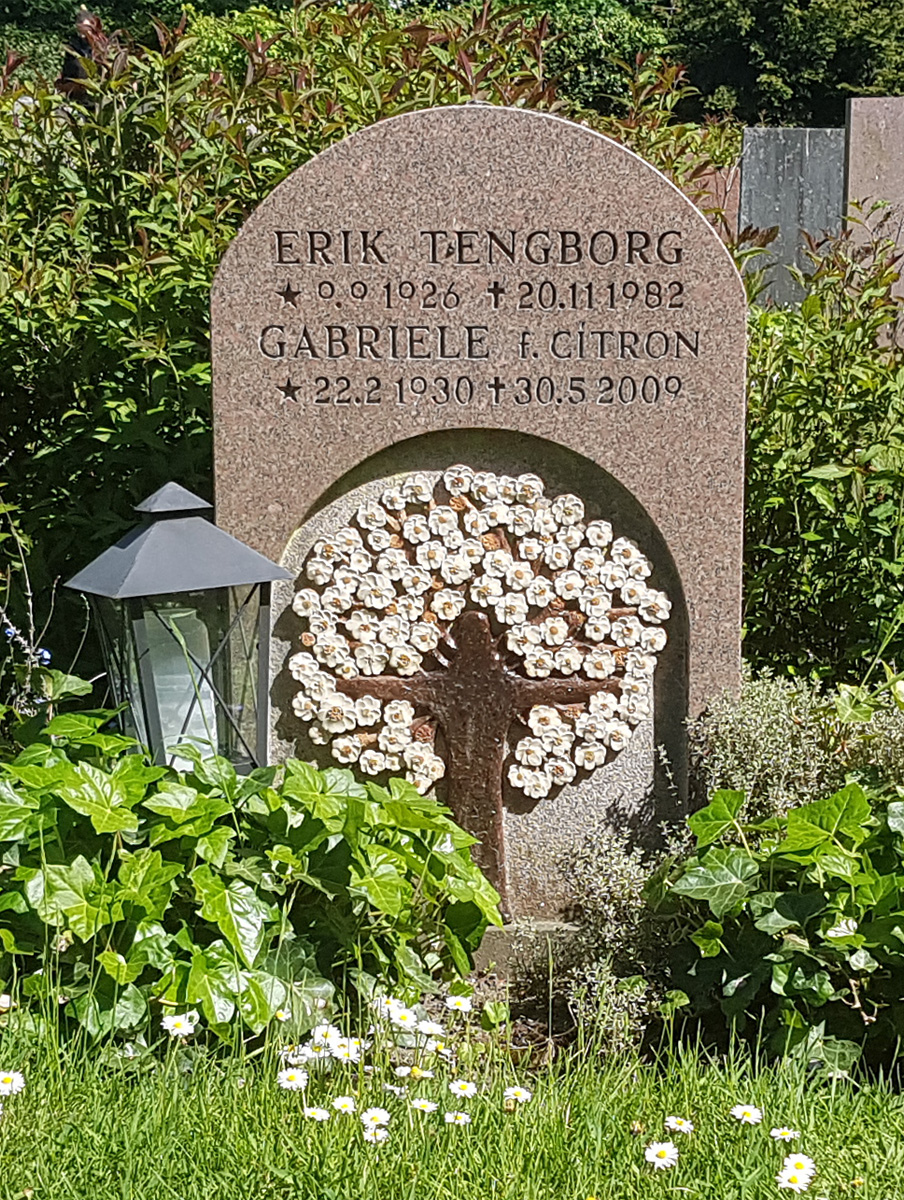 Grave of ceramist and designer Gabrielle Citron.
In block 46 you find the grave of ceramist and designer Gabrielle Citron, or Gabi as she was
mostly known. She was born on February 22nd, 1930, in the free city of Danzig. The city, now
Gdansk in Poland, then had a mainly German speaking population. The family came to Sweden in
1939, and during 1950 to 1954 Gabi studied at University of Arts, Crafts and Design (Konstfack)
in Stockholm.
Grave of ceramist and designer Gabrielle Citron.
In block 46 you find the grave of ceramist and designer Gabrielle Citron, or Gabi as she was
mostly known. She was born on February 22nd, 1930, in the free city of Danzig. The city, now
Gdansk in Poland, then had a mainly German speaking population. The family came to Sweden in
1939, and during 1950 to 1954 Gabi studied at University of Arts, Crafts and Design (Konstfack)
in Stockholm.
In 1954 Gabi married surveyor Erik Tengborg, and at that time she also started working at Gustavsberg porcelain factory, where she remained until 1956 when she had their first baby. In 1964 the family moved to Lund, where Erik started working as a City Engineer. Gabi built a ceramic workshop with a clay oven in their home and resumed her work as a ceramist. She worked mainly with sculptures and reliefs, often intended as public works of art in cities like Lund, Stockholm, Malmö etc. She exhibited in Stockholm, Lund, Höganäs and Visby among other places, and her works are to be found in several museums (e.g., Kulturen in Lund, Helsingborg and Jönköping). Gabi Citron died on May 30th, 2009.
18) The Vipeholm Grave
At the eastern edge of block 46 is a grave where patients from the Vipeholm Hospital were buried between 1935 and 1965. The grave was used to bury the patients who had no relatives who wanted to, or could afford to, bury them. Vipeholm, opened in 1935, was a mental hospital here in Lund for people with various mental disorders, but also deaf people, since they were considered mentally disabled at the time. From the beginning it was only an institution for adult males, but already around 1937 wards for females, and eventually also children, were opened. At the time it was considered shameful having a family member with a mental disorder and they were often abandoned by their relatives.
It was at the Vipeholms hospital that the so called "sugar experiments" took place between 1947 and 1955. A large percentage of the patients were given lots of candy such as chocolate and caramel without the consent from family, relatives or the patients themselves, to investigate its effect on tooth decay, (Caries). The result was of course devastating for the patients and their teeth, that were completely ruined, rotted and extracted. The results of the study led to the launch of a massive campaign for caries prophylactics (eat less sweets and brush your teeth twice a day) in Sweden in 1957. The ethical debate surrounding the study started much later.
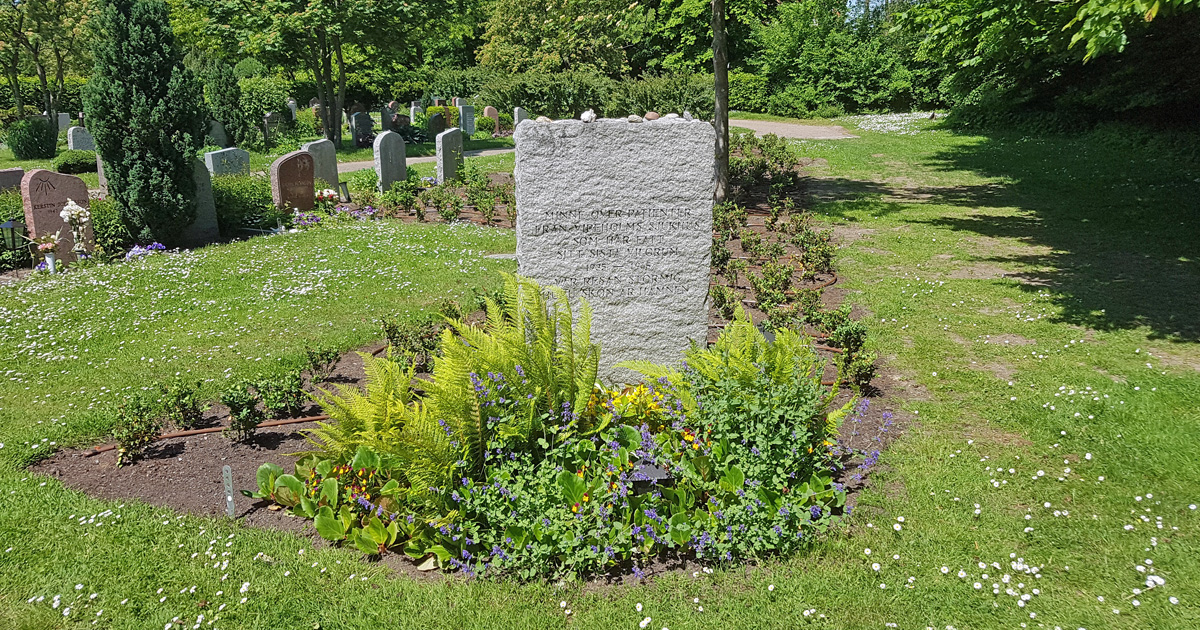 Grave site for patients from Vipeholm hospital.
On the gravestone the inscription "If the crossing was stormy, reaching the harbor is blissful (Var resan stormig huru skön är hamnen)" can be seen. The crossing would quite possibly have been less stormy had the patients not been forced to take part in the sugar experiments. The Vipeholm patients paid the price for the in general quite good dental health in Sweden from the 1950's and on. Vipeholm hospital was closed in 1982. The last patients were moved to smaller care units, often in their own home municipalities.
19) Carl Göran Ljunggren, also known as Kal P Dal
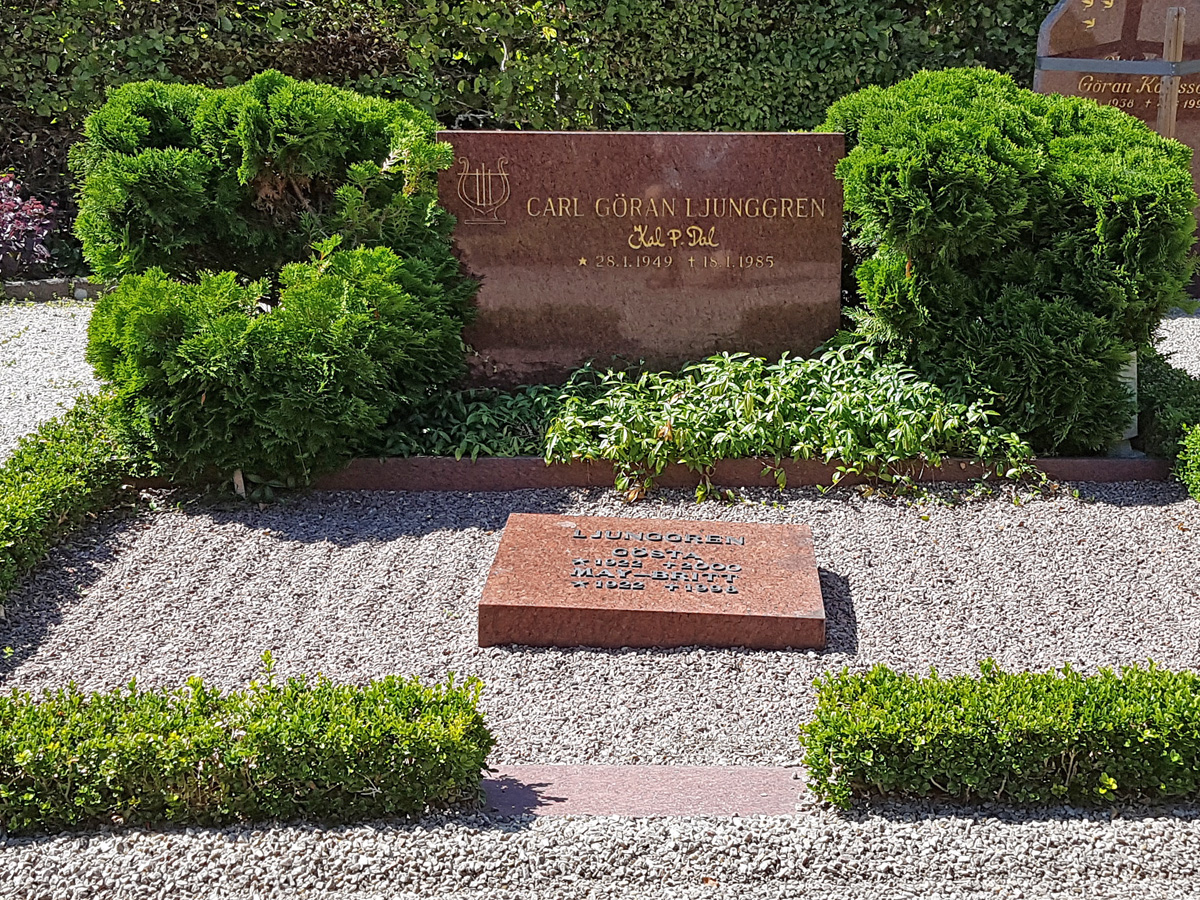 Grave of rock musician Kal P Dal.
Singer, guitar player, song writer and radio host Carl Göran Ljunggren, whose grave is located
on the eastern edge of block 41, was better known under his stage name Kal P Dal. He was born
in Arlöv on January 28th, 1949, and died in Lund on January 18th, 1985.
Grave of rock musician Kal P Dal.
Singer, guitar player, song writer and radio host Carl Göran Ljunggren, whose grave is located
on the eastern edge of block 41, was better known under his stage name Kal P Dal. He was born
in Arlöv on January 28th, 1949, and died in Lund on January 18th, 1985.
Kal P Dal started his musical career as an intermission entertainer, performing his own songs, and covers in different clubs all over Lund at the start of the 70's. He sang his rock tunes in Scanian (local dialect), and at the end of the 70's / beginning of the 80's he was one of Sweden's most popular live artists.
His first LP-record, called Till Mossan! (For Mum!) was recorded live and produced in 1977 by Peps Persson (another famous musician from Scania), who also arranged a record deal for Kal. The record was a great success and sold more than 100000 copies.
20) Romani burial site
In the northeastern corner of block 41 you find the Romani burial site with several large and beautifully decorated sarcophagi.
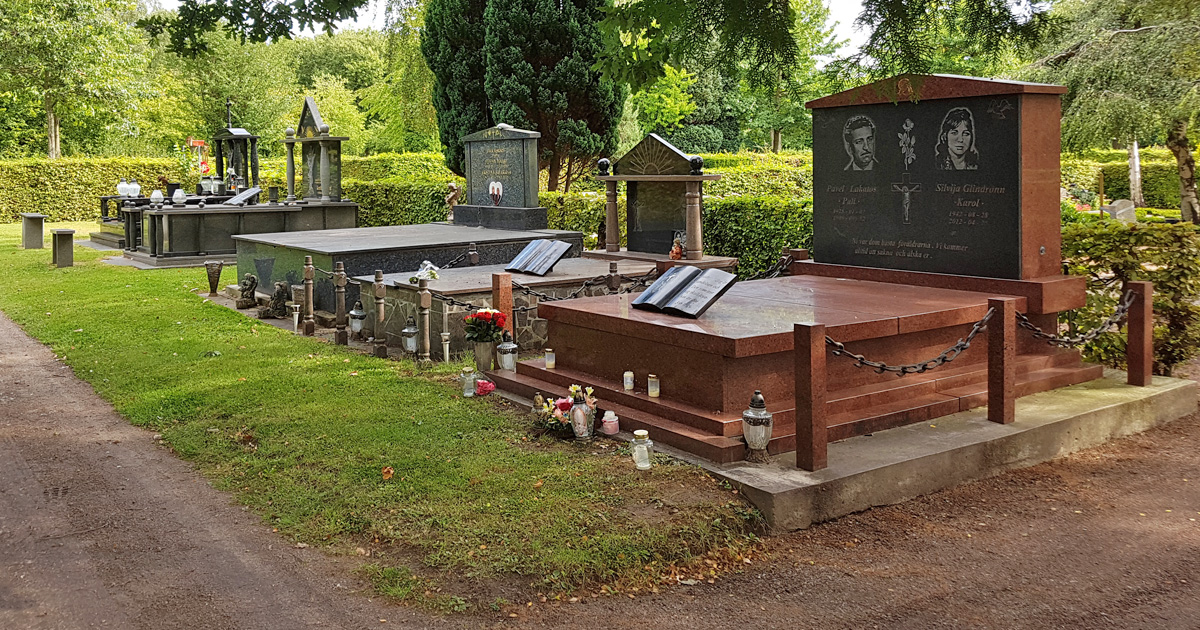 A few of the large and beautifully decorated sarcophagi at the Romani burial site.
21) Mandeian burial site
On the northern side of block 37 you find the Mandeian burial site. Mandeism is a faith with John the Baptist at the center of attention. Believers are called mandeians and mandeism counts about 100000 members, mainly in Iraq and Southern Iran. There is a mandeian congregation in Lund also.
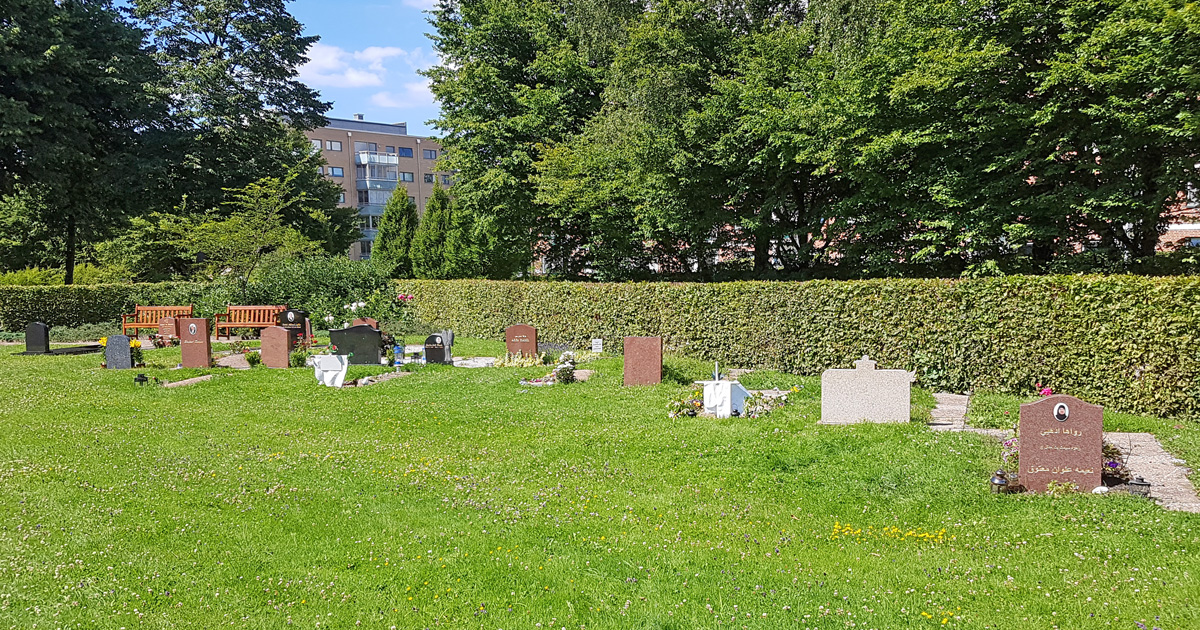 Mandeiska begravningsplatsen.
22) Lund hospital infant graves
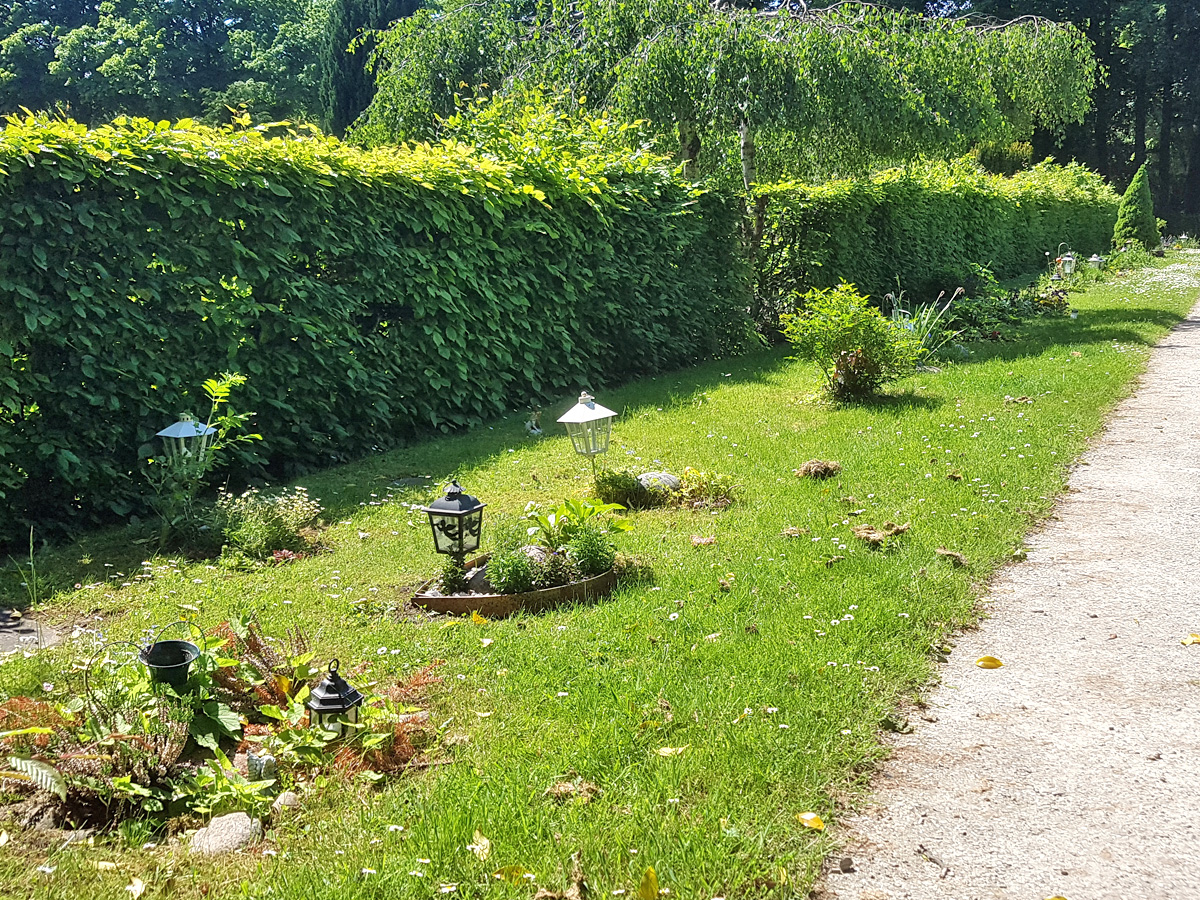 Lund's hospital infant graves.
Just north of block 18 you find the Lund hospital infant graves for those who died before,
during or just after birth.
Lund's hospital infant graves.
Just north of block 18 you find the Lund hospital infant graves for those who died before,
during or just after birth.
It's difficult not to be touched by the beautiful little gravestones on these graves as you walk among them. Many of the stones has only one date, meaning that the infant in the grave was born and died on the same day. A few of the stones has a date of death preceding the date of birth, meaning that the infant died before it was born.
23) Wiwen Nilsson
In the southwestern part of block 37 you find the grave of silversmith and artist Wiwen Nilsson. Together with Gösta Adrian-Nilsson, he is Lund's most well-known representative of Modernism.
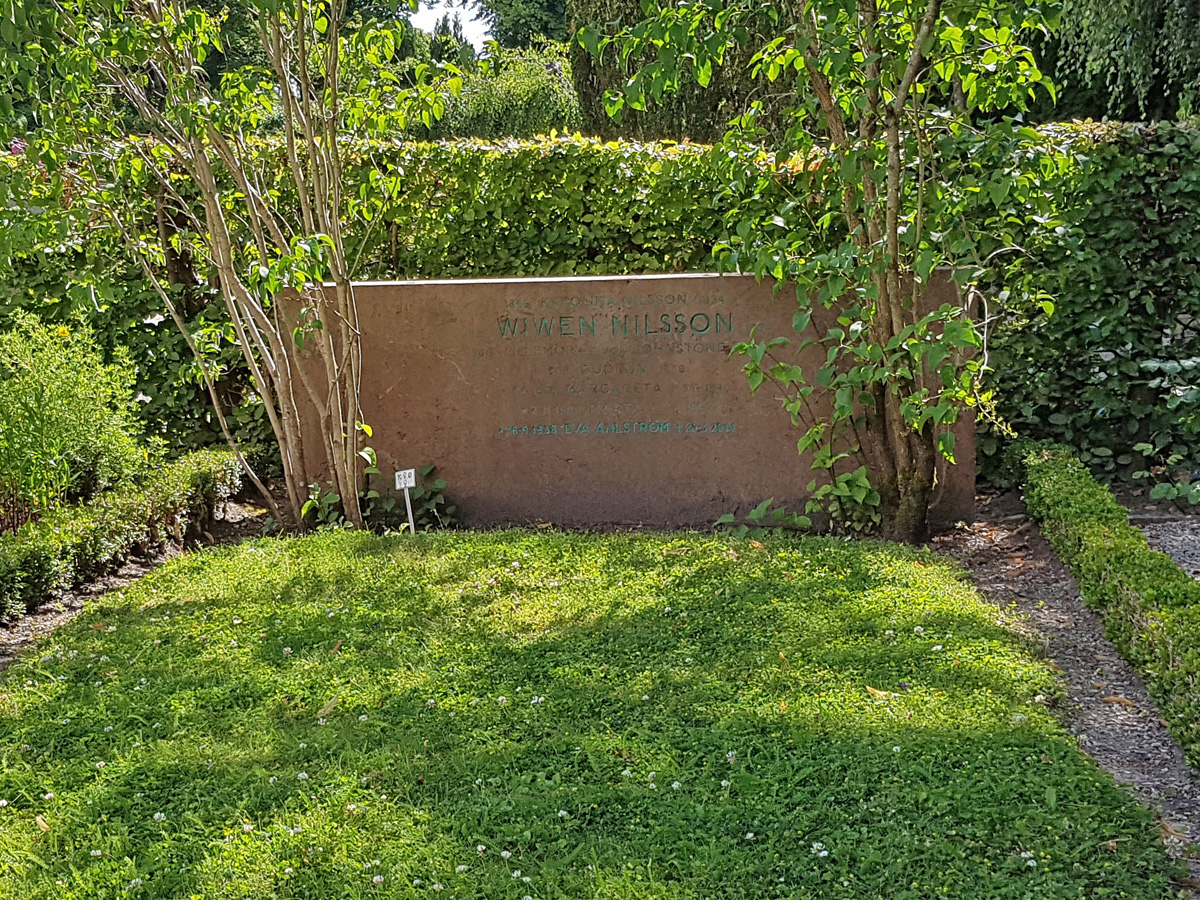 Grave of silver smith and artist Wiwen Nilsson.
Wiwen Nilsson was born on May 19th, 1897, in Copenhagen as Karl Edvin Nilsson but changed his
name to Wiwen Nilsson in 1954. His father Anders Nilsson, who was a jeweler acquired a
jeweler's business in1899 and was appointed as jeweler to the Royal Court of Sweden. Wiwen
took over the business after his father in 1927, but instead of jeweler he called himself
silversmith. He lived in a house on Kyrkogatan 3 in Lund, where the "Kino" cinema is situated
today. His shop faced towards Kyrkogatan and the studio and workshop faced the yard. Wiven
Nilsson and Gösta Adrian-Nilsson were both inspired a lot by each other as early modernists.
Wiwen Nilsson developed a strict geometric design language and was, until he died on January
8th, 1973, an internationally leading representative for Swedish silver and gold smithing.
Grave of silver smith and artist Wiwen Nilsson.
Wiwen Nilsson was born on May 19th, 1897, in Copenhagen as Karl Edvin Nilsson but changed his
name to Wiwen Nilsson in 1954. His father Anders Nilsson, who was a jeweler acquired a
jeweler's business in1899 and was appointed as jeweler to the Royal Court of Sweden. Wiwen
took over the business after his father in 1927, but instead of jeweler he called himself
silversmith. He lived in a house on Kyrkogatan 3 in Lund, where the "Kino" cinema is situated
today. His shop faced towards Kyrkogatan and the studio and workshop faced the yard. Wiven
Nilsson and Gösta Adrian-Nilsson were both inspired a lot by each other as early modernists.
Wiwen Nilsson developed a strict geometric design language and was, until he died on January
8th, 1973, an internationally leading representative for Swedish silver and gold smithing.
24) Per Bagge
In block 33, on the eastern side of the wide main walkway through Northern Cemetery, is the grave of photographer Per Bagge. He was born on January 23rd, 1866, in Övre Ullerud in the Swedish county Värmland. After finishing his training in Stockholm, Per Bagge moved to Lund in 1893, and started working as a photographer in the photographic studio of Lina Jonn which she opened at Bantorget in Lund in 1891.
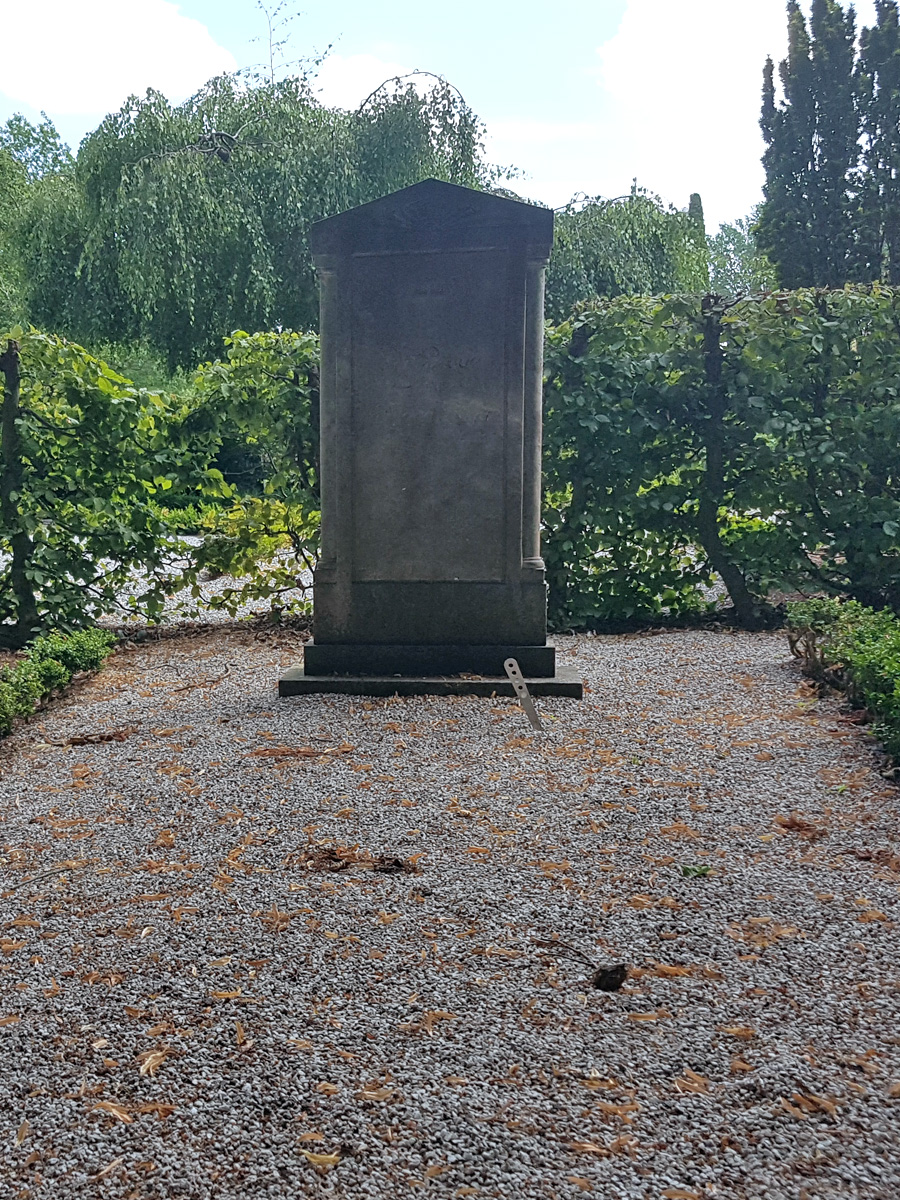 Grave of photographer Per Bagge.
Additionally, Lina Jonn hired a photographer called Albert Wilhelm Rahmn, and Lina's sisters
Maria and Hanna Jonn also worked in the studio. In 1895 Lina married a Norwegian, and
transferred the studio to Maria, who later sold it to Per Bagge. He kept running the studio
under the name "Lina Jonn's successor" until 1903 when he started using his own name.
Grave of photographer Per Bagge.
Additionally, Lina Jonn hired a photographer called Albert Wilhelm Rahmn, and Lina's sisters
Maria and Hanna Jonn also worked in the studio. In 1895 Lina married a Norwegian, and
transferred the studio to Maria, who later sold it to Per Bagge. He kept running the studio
under the name "Lina Jonn's successor" until 1903 when he started using his own name.
Per Bagge, just like Lina Jonn, became a skilled portrait photographer, but both he and Albert Wilhelm Rahmn took lots of pictures of streets and buildings in Lund from the end of the 1800's up until the 1920's. All these photographs, often taken on glass plates with very high quality, have been made available online, for everyone to use, in the Lund University Library database of digital material. This is an unreplaceable cultural treasure trove, not least for our tourist information, showing the culture historical side of Lund through several of these pictures in different contexts.
Per Bagge was one of the persons who started the "association of Swedish Photographers" in 1895, and he was also a member of its board for many years. He married Valborg Wieder in Lund on June 23rd, 1908. Per Bagge died on March 12th, 1936, and Valborg kept the studio open after his death.
25) Carl Alfred Berg (Father Berg)
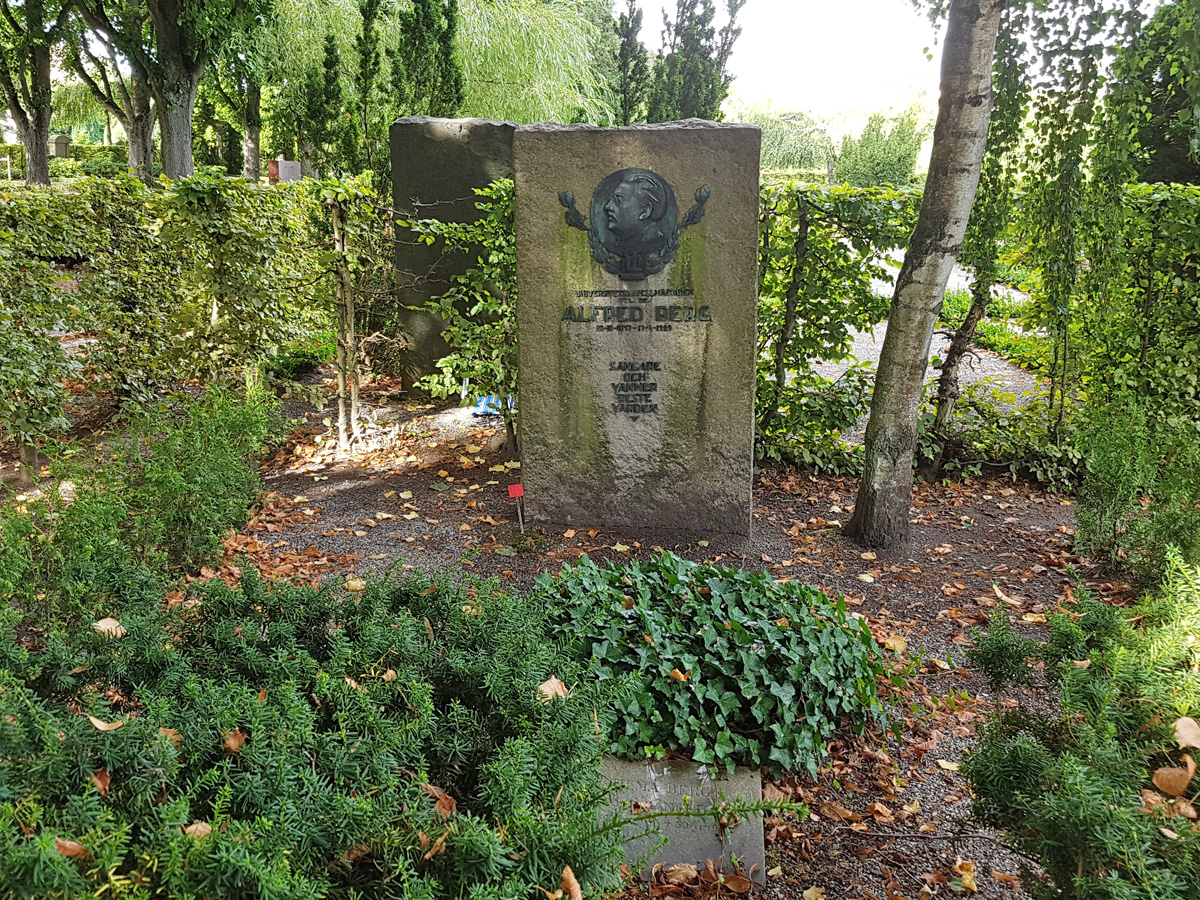 Grave of Carl Alfred Berg, aka Father Berg.
Carl Alfred Berg was a composer, conductor and choir master. His grave is to be found at the
western end of block 34. Carl Alfred Berg was born in Hudiksvall on October 13th, 1857, and
died in Lund on April 17th, 1929.
Grave of Carl Alfred Berg, aka Father Berg.
Carl Alfred Berg was a composer, conductor and choir master. His grave is to be found at the
western end of block 34. Carl Alfred Berg was born in Hudiksvall on October 13th, 1857, and
died in Lund on April 17th, 1929.
Carl Alfred Berg studied natural science in Uppsala at first, but from 1886 he continued his studies in Lund, now focusing on his Bachelor of Arts, which he achieved in 1888. It was during his years as a student that he became involved in music with choirs and orchestras.
Except for a short interruption during music studies at the conservatory in Leipzig 1894-1896, he was the man in charge of the famous "Lunds Studentsångarförening" and its choir from 1891 until 1925. He was often referred to as "Father Berg".
During Carl Alfred Berg's time at the helm, the choir toured extensively in Sweden, as well as abroad in Europe and USA. At the 250th anniversary of Lund University in 1918 he was appointed honorary doctor.
26) Karl Petrén
Karl Petrén, whose grave is to be found at the western end of block 34, was born on December 2nd, 1868, as the son of the local vicar in the little village of Halmstad, just northwest of the village of Svalöv in Scania. He began his studies at the University of Lund in 1885 where he studied to become a physician. He also became a member of the radical group of students known as "the young old men" ("de unga gubbarna"), together with, among others, the author Axel Wallengren (38).
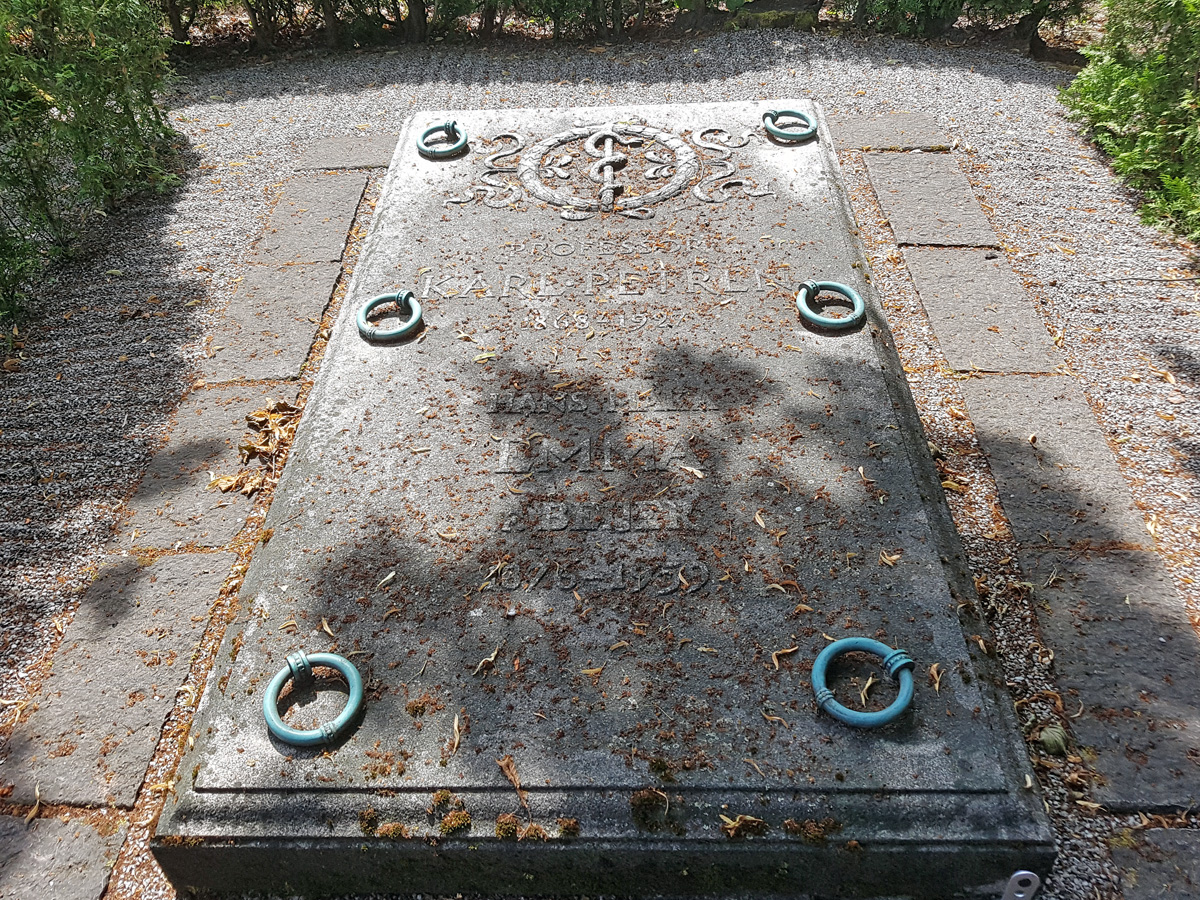 Grave of Professor Karl Petrén.
Karl Petrén defended his doctoral thesis in 1895 and became an associate professor of
practical medicine the following year. Between 1902 and 1910 Karl Petrén was professor of
practical medicine in Uppsala, and from 1910 in Lund, where he also was made chief physician
of the hospital. Between 1911 and 1916 he was a member of the Lund City Council. Karl
Petrén's scientific work mainly focused on illnesses of the nervous system, but he also
researched the importance of diets as a treatment for diabetes. Between 1911 until he died on
October 16th, 1927, he was an inspector of Helsingkrona Nation, the student nation for
Helsingborg and Landskrona.
Grave of Professor Karl Petrén.
Karl Petrén defended his doctoral thesis in 1895 and became an associate professor of
practical medicine the following year. Between 1902 and 1910 Karl Petrén was professor of
practical medicine in Uppsala, and from 1910 in Lund, where he also was made chief physician
of the hospital. Between 1911 and 1916 he was a member of the Lund City Council. Karl
Petrén's scientific work mainly focused on illnesses of the nervous system, but he also
researched the importance of diets as a treatment for diabetes. Between 1911 until he died on
October 16th, 1927, he was an inspector of Helsingkrona Nation, the student nation for
Helsingborg and Landskrona.
When the poet Emil Kléen, who was a friend of August Strindberg, was treated in Lund hospital for, among other things, syphilis and badly managed laryngeal tuberculosis in December of 1898, Karl Petrén was one of his doctors. August Strindberg was there when Emil Kléen died on December 10th, 1898.
27) Preben Nodermann
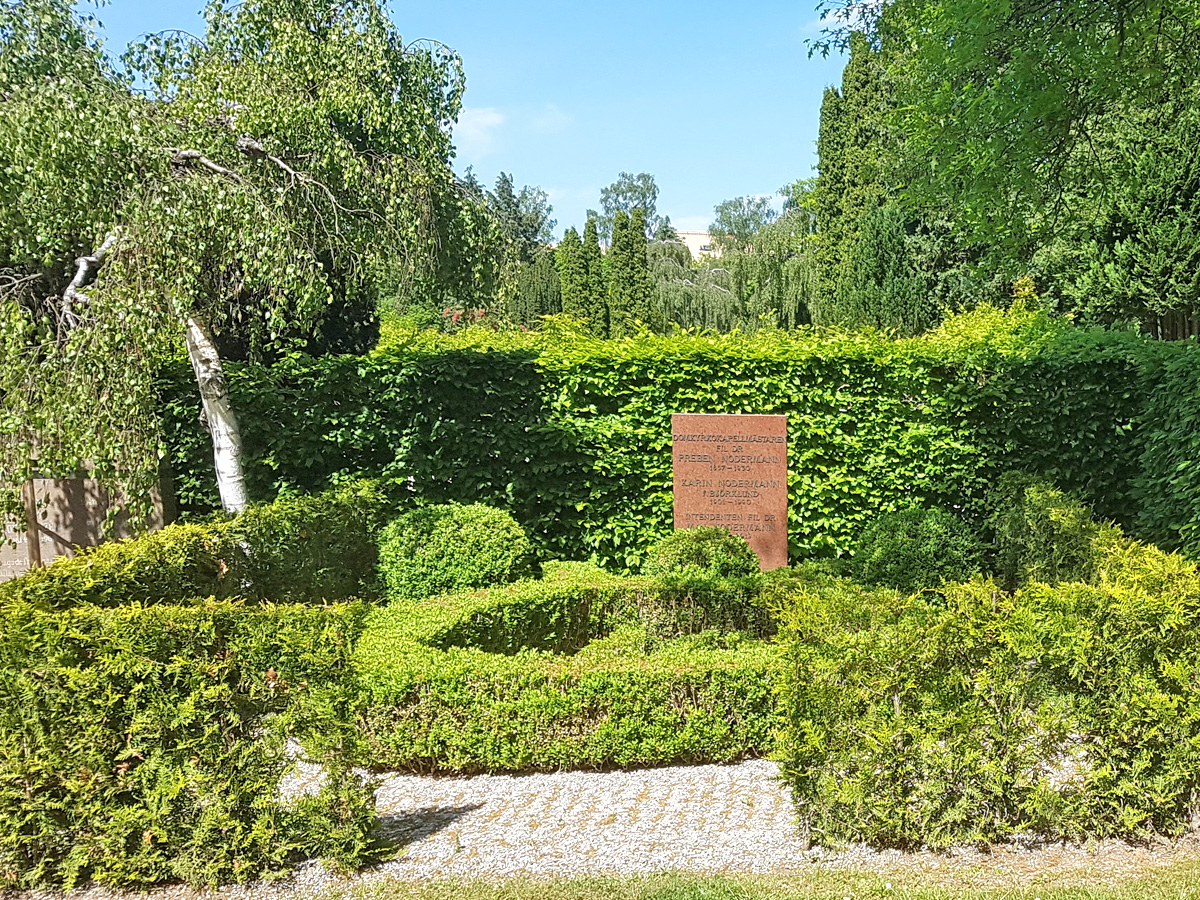 Grave of hymnologist, composer and Cathedral Conductor Preben Nodermann.
The hymnologist, composer and Cathedral Conductor Preben Nodermann is credited with being the
one who started the Lund Cathedral choir. His grave is in the western part of block 34.
Grave of hymnologist, composer and Cathedral Conductor Preben Nodermann.
The hymnologist, composer and Cathedral Conductor Preben Nodermann is credited with being the
one who started the Lund Cathedral choir. His grave is in the western part of block 34.
Preben Nodermann was a student at Lund University and graduated as organist and Licentiate of Philosophy in 1895, and as a church singer the following year. From 1903 until his death, he was Cathedral organ player and conductor at Lund Cathedral. Between 1905 and 1926 he published a collection of Lund Cathedral choir songs that contained both his own works and adaptations of works by other composers. Preben Nodermann was born in Hjørring, Denmark on January 11th, 1867, and died November 14th, 1930.
28) Gunnar Serner
Gunnar Serner was a Swedish author better known under his pseudonym Frank Heller. He was born July 20th, 1886, near Karlskrona in Blekinge county (east of Scania) and died October 14th, 1947, in Malmö. His grave is in the Northwestern part of block 30.
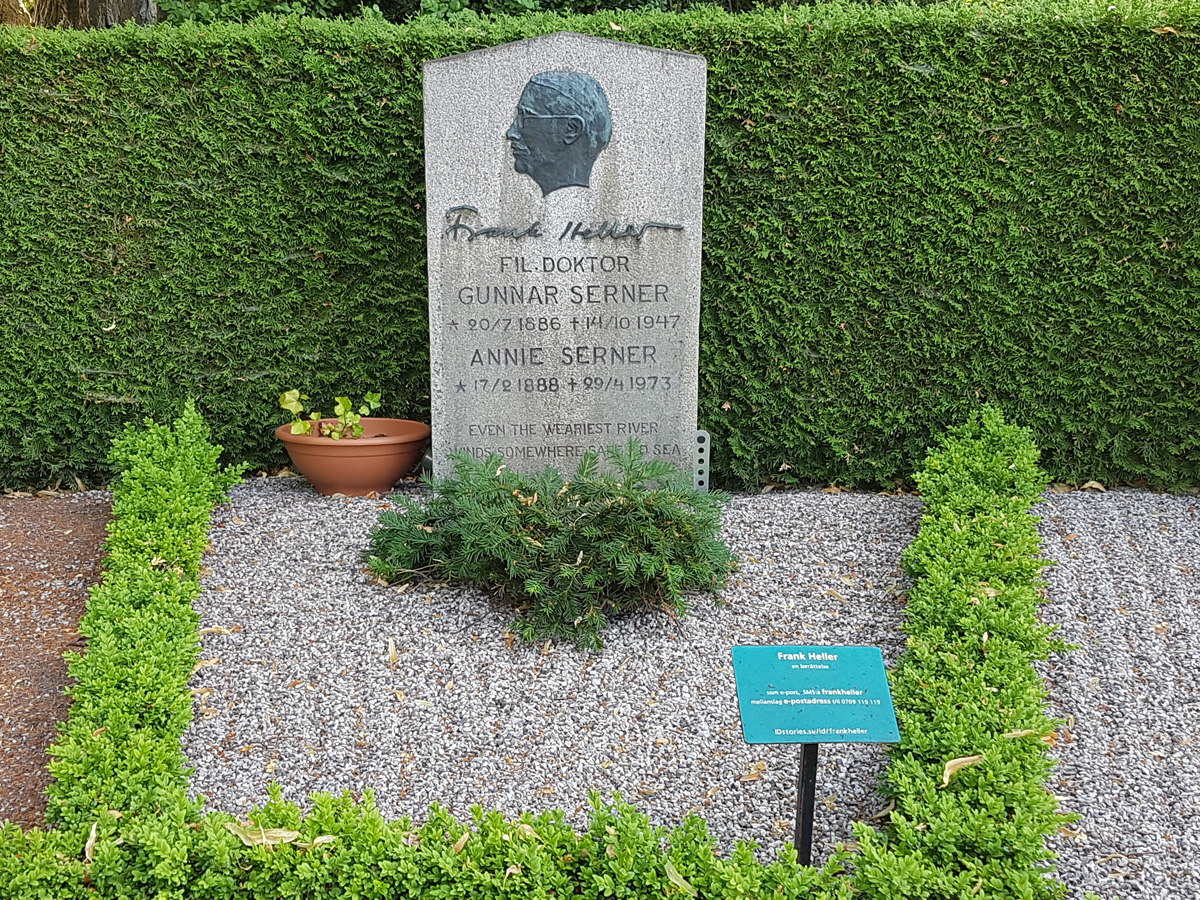 Grave of author Gunnar Serner.
The family moved to Bosarp, (north of Eslöv and Lund). When Gunnar was 15 years old, he
graduated from Cathedral school (Katedralskolan) in Lund. While attending school in Lund, he
stayed with his aunt in Östra Mårtensgatan 20.
Grave of author Gunnar Serner.
The family moved to Bosarp, (north of Eslöv and Lund). When Gunnar was 15 years old, he
graduated from Cathedral school (Katedralskolan) in Lund. While attending school in Lund, he
stayed with his aunt in Östra Mårtensgatan 20.
Gunnar Serner continued his studies at Lund University where he achieved a doctorate in English at the age of 24. Unfortunately, he also ended up in financial problems while spending too much money in bars and restaurants in Copenhagen together with the well-known "eternal" student Sam Ask.
In 1912 the financial situation of Gunnar Serner made him decide to leave the country. He forged some bank drafts and managed to cash in on a couple of them before the teller at one of the banks became suspicious. He left the bank, took the boat to Copenhagen, and from there the train to Hamburg, from where he continued to London.
While abroad Gunnar Serner started writing novels to support himself financially, which got his finances back in order. From 1914 he wrote novels under the pseudonym Frank Heller. For the rest of his life, he remained a prolific writer.
29) The Hildisch family grave
The Hildisch family grave on the western side of the wide main walkway through Northern Cemetery, called the eastern line, has an unusual sculptural gravestone in the shape of a mourning woman seated on a bench. Laid at rest in this grave are Carl Julius Hildisch, his 2-year-younger brother Wilhelm Hildisch and Ingeborg, the wife of Wilhelm and their son Frithiof Hildisch.
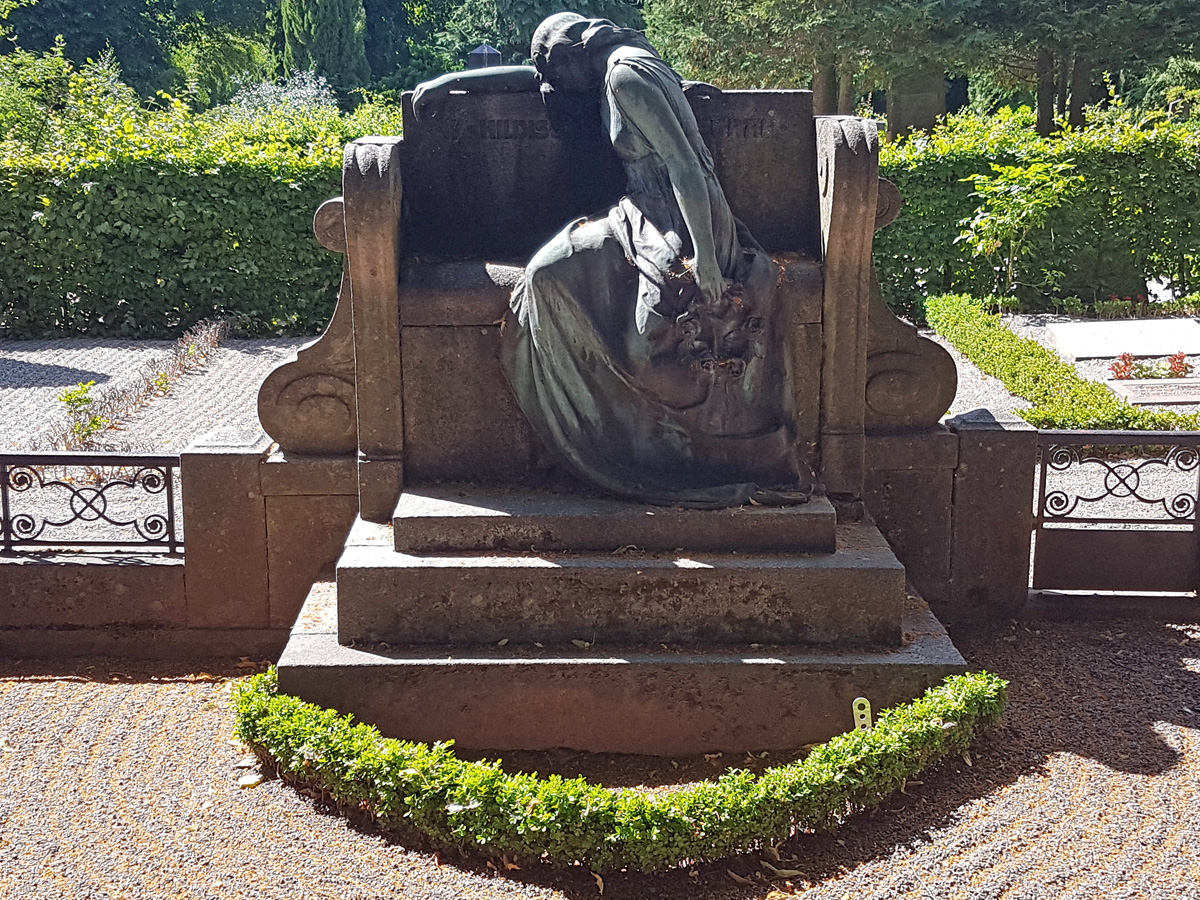 Grave of tannery owner family Hildish.
Carl Hildish, father of the two brothers mentioned above, originated from Germany. He
emigrated to Norway in 1859 and there he started a tannery. In the 1890's he gave his sons the
task of starting a tannery in Sweden. This they did by buying a tannery owned by Carl Theodor
Lundbom situated on Bredgatan in Lund. They rebuilt, modernized and added buildings to the
factory.
Grave of tannery owner family Hildish.
Carl Hildish, father of the two brothers mentioned above, originated from Germany. He
emigrated to Norway in 1859 and there he started a tannery. In the 1890's he gave his sons the
task of starting a tannery in Sweden. This they did by buying a tannery owned by Carl Theodor
Lundbom situated on Bredgatan in Lund. They rebuilt, modernized and added buildings to the
factory.
The Hildisch factory became one of Sweden's biggest tanneries with 50-60 employees and a large export of skins to, among other places, USA, to be used in the automobile industry. In 1907 disaster struck when both main buildings of the factory burned to the ground. But the brothers soon had production up and running again, and after a few years the size of their business was the same as before the fire. When the older of the two brothers, Carl Hildisch, died in 1920 the factory was closed. Ingeborg, wife of younger brother Wilhelm, died only a couple of months later, while Wilhelm didn't die until 1953. The son of Wilhelm and Ingeborg, Frithiof, died already in 1918, only 21 years old.
30) Ola Hansson
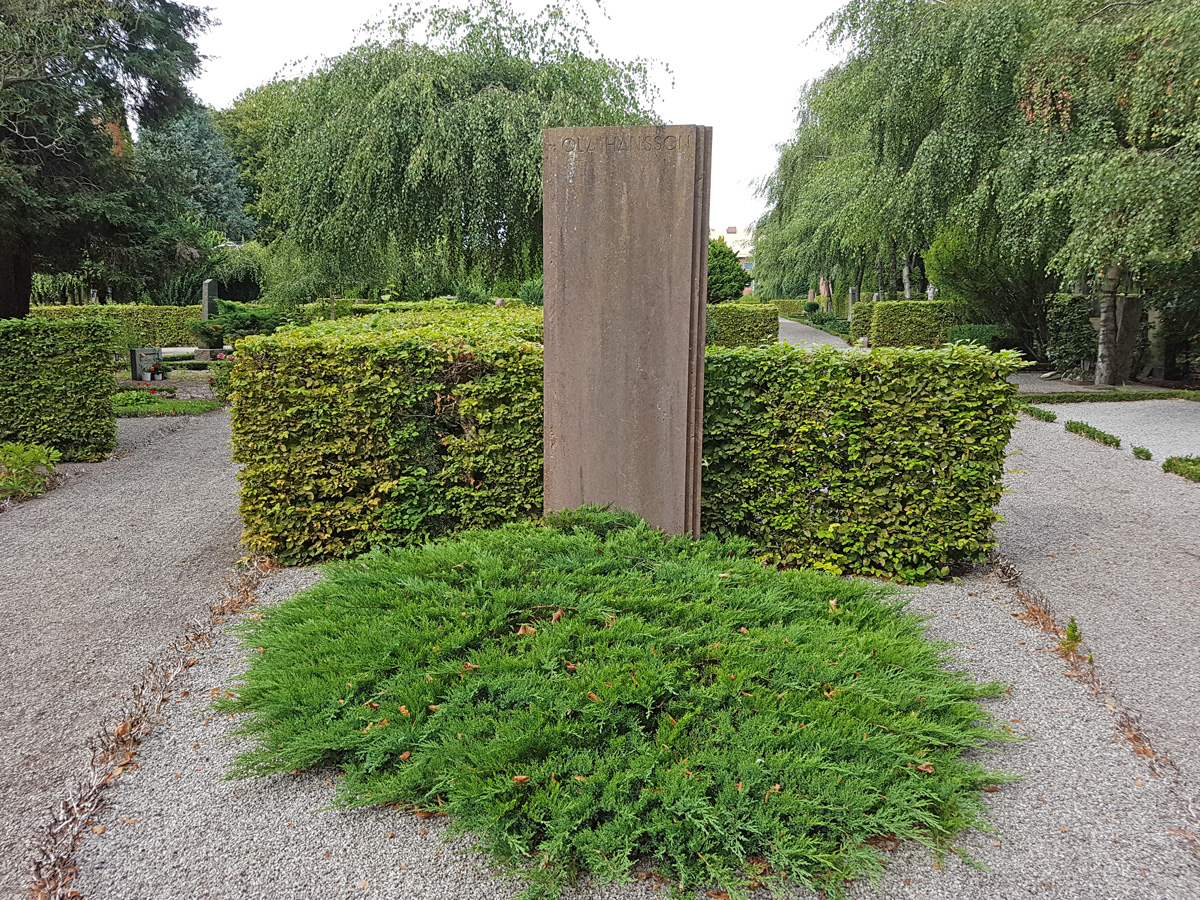 Grave of poet, author, journalist and critic Ola Hansson.
The grave of poet, author, journalist and critic Ola Hansson is in the eastern part of block
12. He was born November 12th, 1860, in Hönsinge north of Trelleborg and died September 26th,
1925, in Büyükdere on the Bosporus in Turkey. He started his studies at Lund University in
1881, and only a year later he finished his Bachelor of Arts degree.
Grave of poet, author, journalist and critic Ola Hansson.
The grave of poet, author, journalist and critic Ola Hansson is in the eastern part of block
12. He was born November 12th, 1860, in Hönsinge north of Trelleborg and died September 26th,
1925, in Büyükdere on the Bosporus in Turkey. He started his studies at Lund University in
1881, and only a year later he finished his Bachelor of Arts degree.
After his death, the remains of Ola Hansson were brought from Turkey to Lund and buried at Northern Cemetery under ceremonial forms on May 28th, 1926. His name is also inscribed on the balcony railing of the big hall in the student building Academy Society (AF-borgen).
31) Carl Wilhelm von Sydow
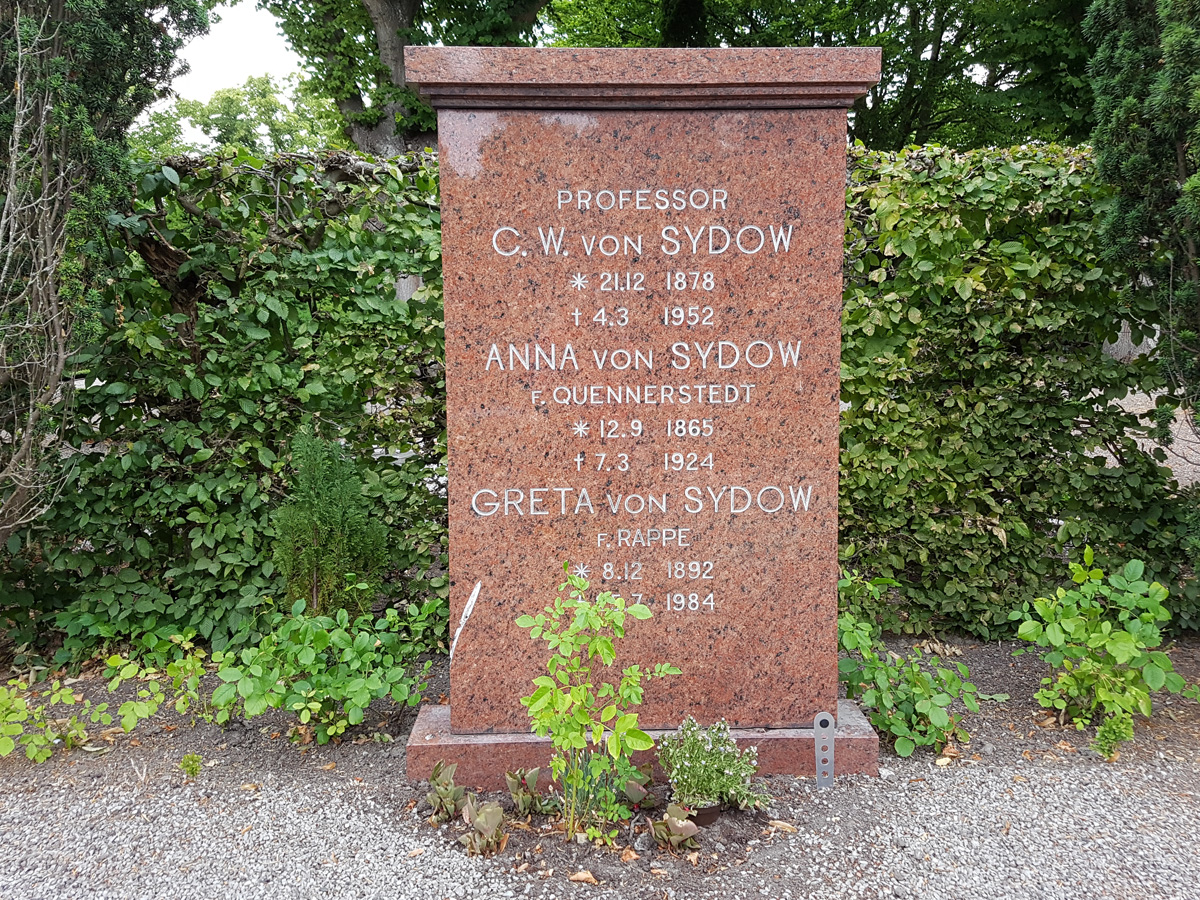 Grave of actor Max von Sydow's parents.
In this grave, at the western part of block 16, lies Carl Wilhelm von Sydow, his 1st wife Anna
Quennerstedt and his 2nd wife Greta Rappe. Carl Wilhelm von Sydow was the first professor at
Lund University in folklore studies. He also founded the Folklore archives.
Grave of actor Max von Sydow's parents.
In this grave, at the western part of block 16, lies Carl Wilhelm von Sydow, his 1st wife Anna
Quennerstedt and his 2nd wife Greta Rappe. Carl Wilhelm von Sydow was the first professor at
Lund University in folklore studies. He also founded the Folklore archives.
Better known to the public is probably the son of Carl and Greta. He changed his first name to Max and became a world-famous actor.
Max von Sydow attended Cathedral school (Katedralskolan) in Lund. He was active in "Scenia", the school theatre group, which he started together with other students on April 5th, 1945, and became its first president. Yvonne Lombard is another well-known Swedish actor who was a part of the first play organized by the group. Max von Sydow died March 8th, 2020, in Provence and is buried there.
32) Grave of the French soldier
In the northwestern part of block 17 you find the grave of French soldier Eugène Vibart who was a German prisoner of war (POW) at the end of World War I (WWI). He was one of several POW's that were to be returned home via Sweden after WWI because of the chaotic situation in Germany at the time. Soldiers from different European countries e.g., France, Italy, Portugal and Belgium came to Sweden. When they arrived, they were quarantined for a week in POW-camps located in Ljungbyhed and Revinghed. In the camps they were fed and given new uniforms before travelling back home. For a month, during the 1918-1919 winter, 8100 POWs were returned home via Sweden in this way. In January 1919 six of these POWs caught the Spanish flu. Eugène Vibart was one of them. He was taken to the hospital in Lund, where he died on Januari 19th, 1919, and then buried in this grave. The text on the gravestone, which is difficult to read now, is in French and means:
Sergeant VIBART Eugène
of the French Army 8th Ranger Battalion
Born September 11th, 1891, in Saint-Léger, Bray Oise.
Died for France Januari 19th, 1919
in the hospital of Southern Scania infantry regiment
Below the text in French is a Swedish text that reads:
Died for the homeland on the way home
from war and captivity in January of 1919
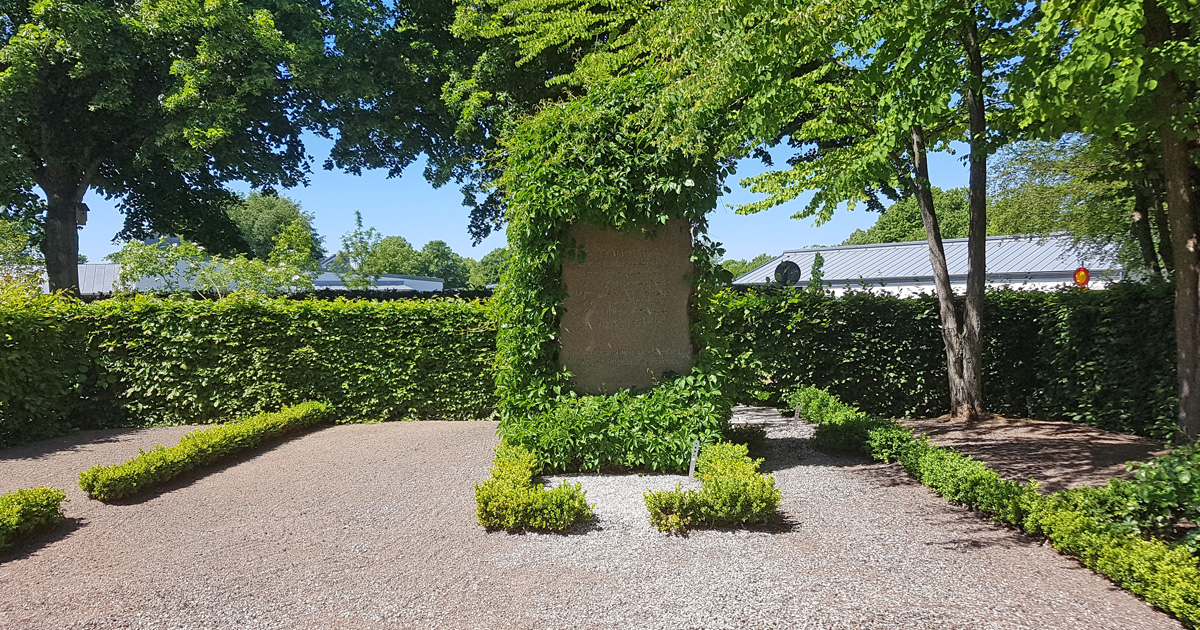 Grave of French soldier Eugène Vibart.
33) Saint Olof and the Resurrection chapel including a crematorium
At the end of 1943 three architects entered a competition for the design of a new chapel and crematorium. Hans Westman was the architect that won, and his suggestion included, among other things, an approximately 30 meters high three-sided pyramid on an island in the bomb crater that was the result of the bombing of Lund earlier the same year, see (34) below. The church council didn't accept this proposal, and in 1945 a new general architecture competition was announced.
Eventually it was the Stockholm architects Sven Backström and Leif Reinius, and their contribution "Ship" that was realized when the chapel and crematorium were built in 1960 at the, then new, northwestern part of the cemetery.
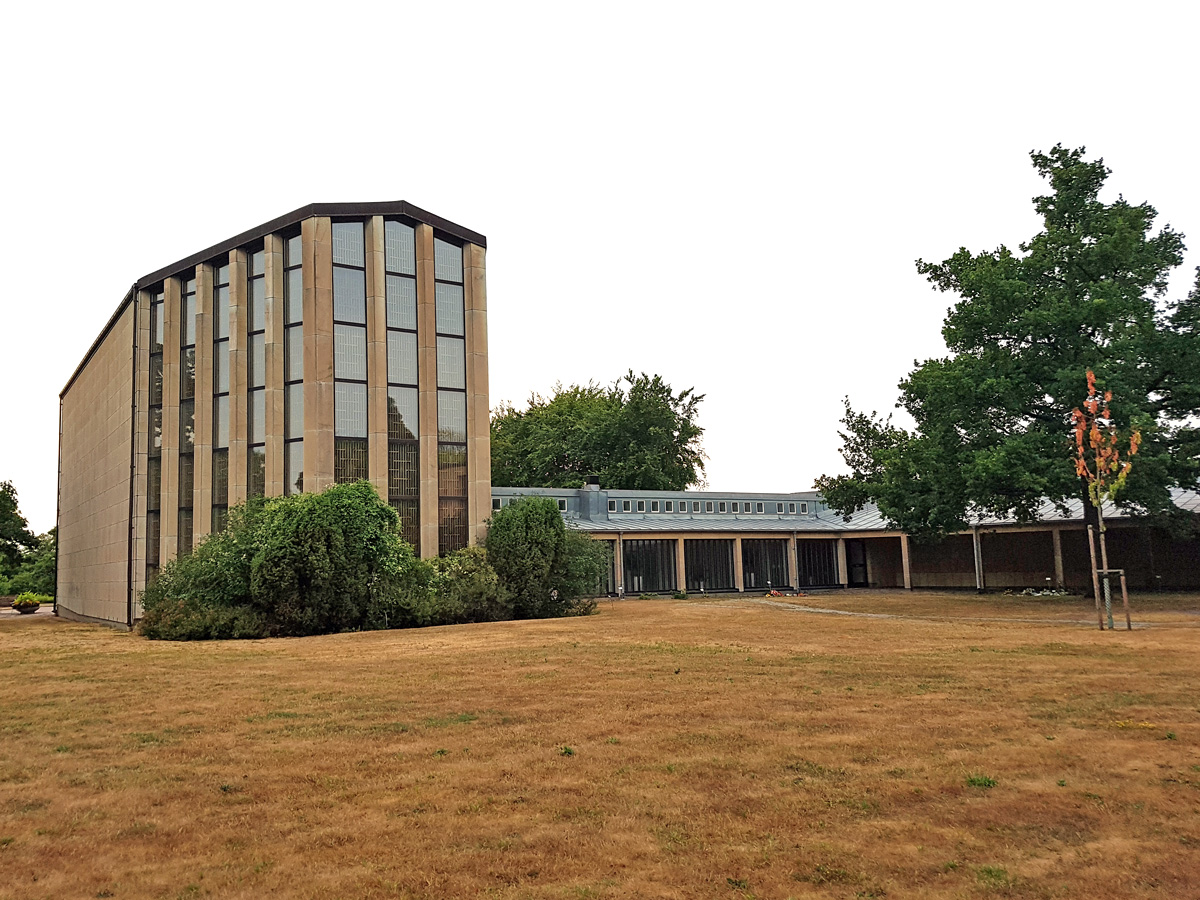
|
|
| Sankt Olofs och Uppståndelsens kapell mot öster. | Sankt Olofs och Uppståndelsens kapell mot väster. |
34) Bombs over Lund 1943
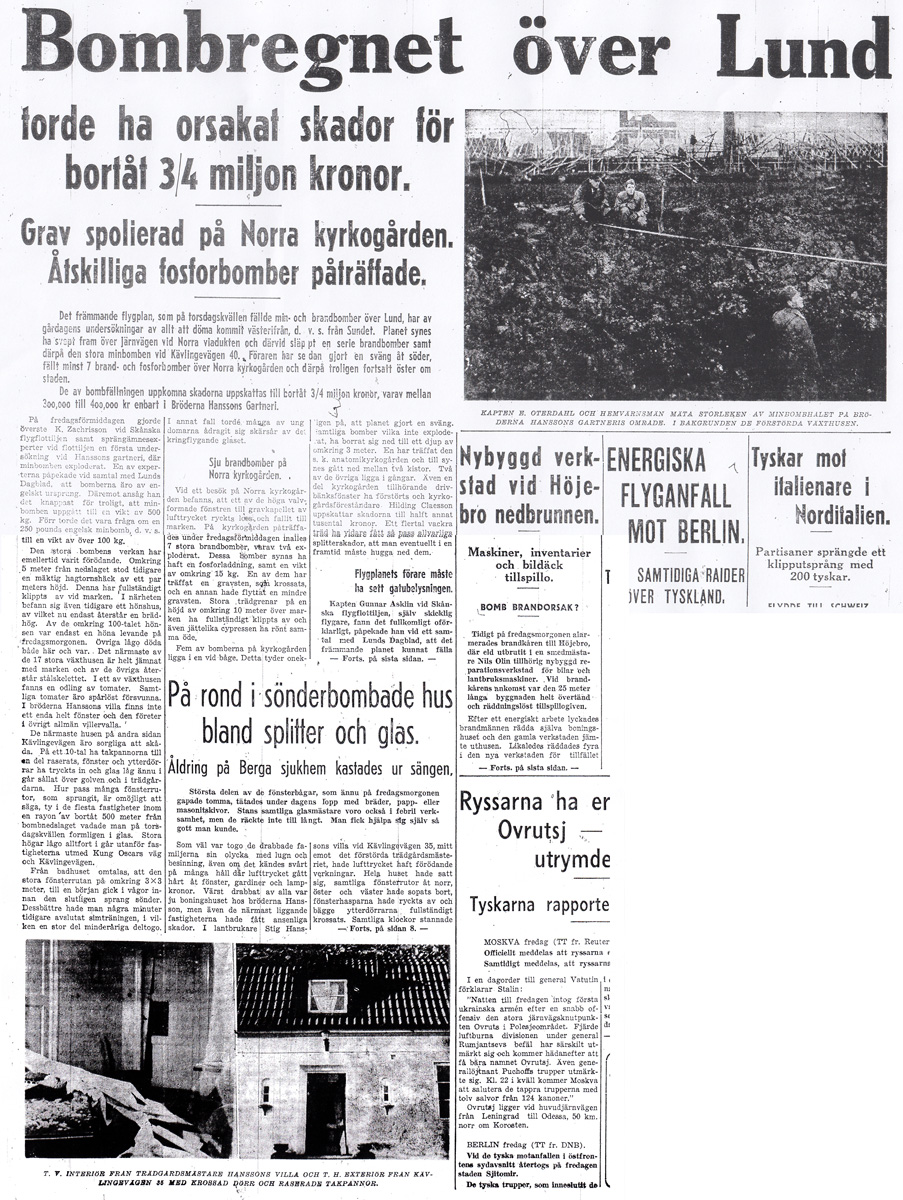
At 21:10 Thursday November 18th, 1943, while World War II was raging all over Europe, Lund was hit by firebombs. On the southwestern side of Saint Olof and the Resurrection chapel, a 500kg heavy mine-bomb was dropped. 7 firebombs containing phosphorous fell over the, then much smaller, Northern Cemetery, damaging several gravestones and trees.
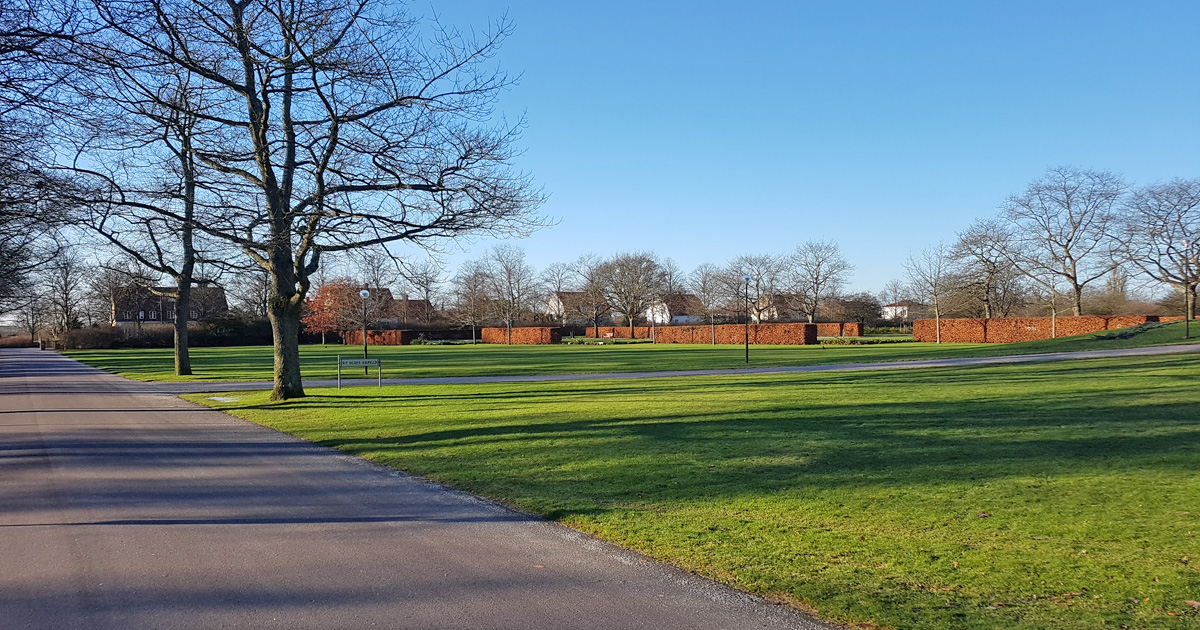 The place where the big mine-bomb was dropped on November 18th, 1943.
In those days the plant nursey of the brothers Hansson, with 17 big glass greenhouses, was in the spot where the mine-bomb impacted. The greenhouse closest to the impact crater was totally gone, and of the remaining 16 only the steel skeletons remained partially standing.
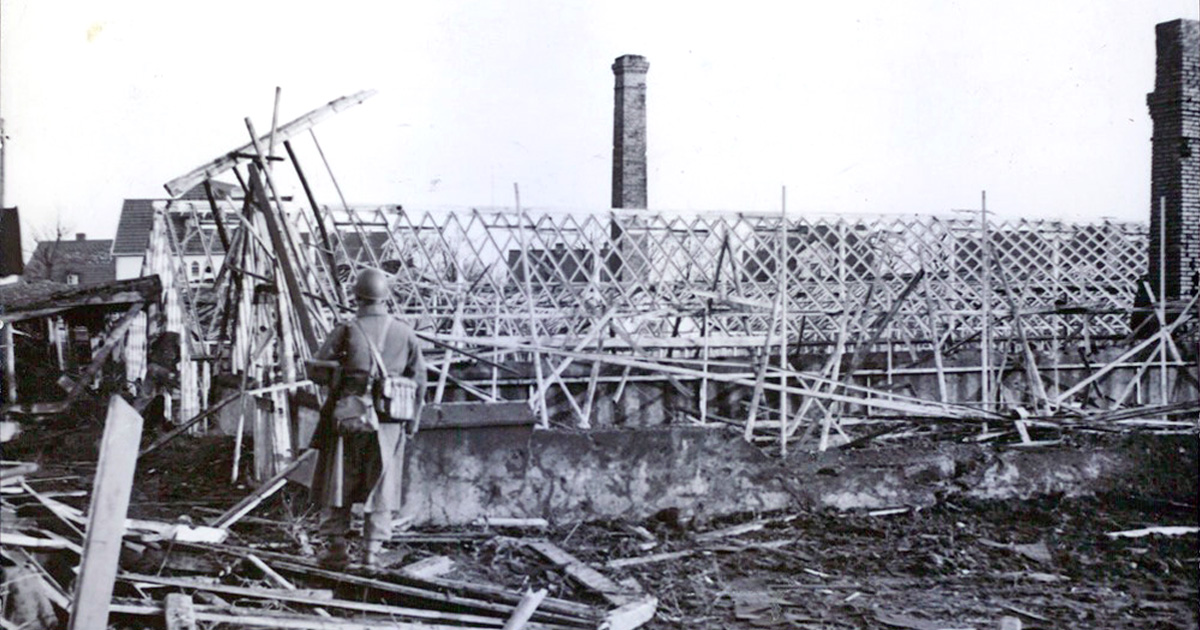 The plant nursey of the brothers Hansson on November 19th, 1943, the day after the bombing of
Lund.
The plant nursey of the brothers Hansson on November 19th, 1943, the day after the bombing of
Lund.
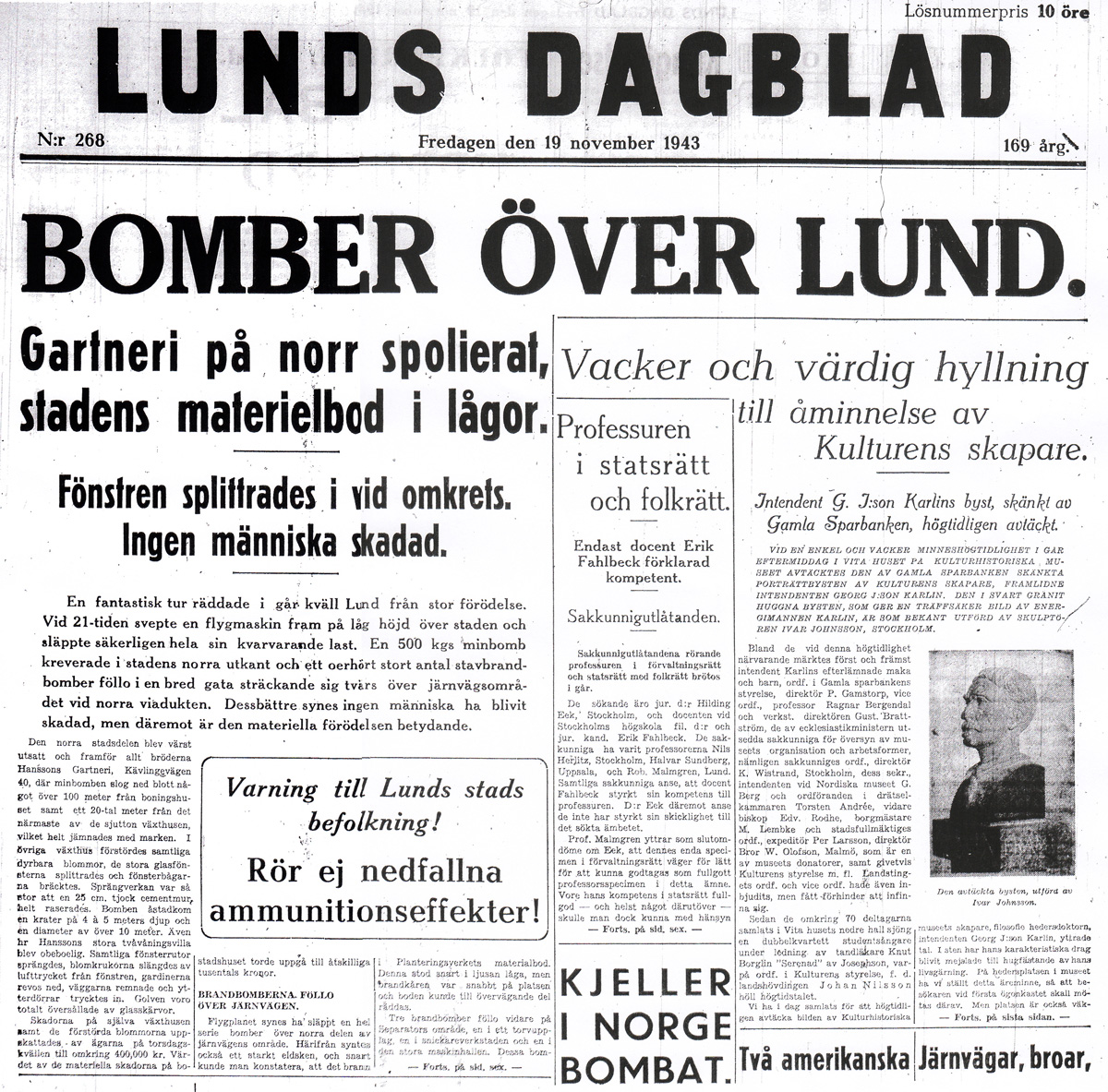
A lot was written in the newspapers about the incident over the following weeks. It turned out to be a British bomber that had dropped its cargo before returning home to base. The glittering glass greenhouses were thought to have made the bomber crew believe they were over water, consequently thinking it was safe to drop their bombs.
|
|
| The newspaper Lunds Dagblad of November 19th and 20th,1943, concerning the bombing of Lund. | |
After WWII British authorities contacted the Hansson Brothers and compensated them for all damages to their plant nursey and greenhouses.
35) Britt G Hallqvist
Britt Gerda Hallqvist, whose grave can be found at the northern end of block 49, was born February 14th, 1914, in Umeå. Her parents got divorced when she was 12 years old. Britt, together with a few of her brothers and their mother, moved to Lund, where her mother's sister lived. Britt attended the Lindeberg school in Lund, the only comprehensive secondary school for girls in town at that time. She then went on to study literature history, philosophy and German at Lund University. It was also in Lund she met Sten Hallqvist, whom she married in 1939. He was ordained at the diocese of Skara, and they lived in Alingsås where Sten worked as an assistant pastor. In 1958 they moved back to Lund when Sten became lecturer at Spyken high school.
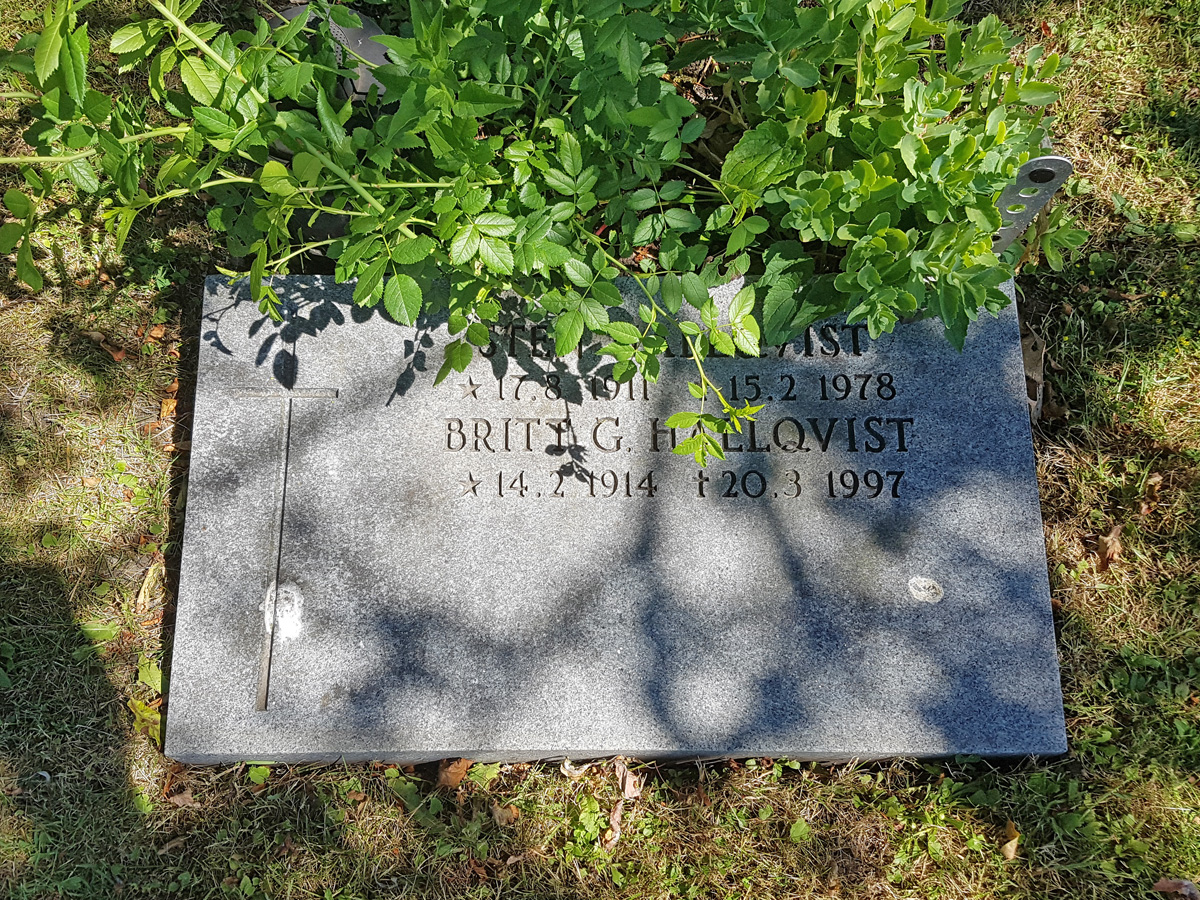 Grave of author and hymn poet Britt G Hallqvist.
Britt G Hallqvist's mother worked as a translator, and at the end of the 1940's Britt also
started with translation work, focusing on children's rhymes from English. In 1950 she debuted
as an author with the children's book "Rappens på Blåsopp", published by Bonniers, since it
had been refused by Astrid Lindgren who worked at Rabén and Sjögren. Later in the same year
Britt G Hallqvist received the newspaper Svenska Dagbladets literature prize for that book. In
the years that followed she published several children's books of her own, but she also
translated children's books, poetry collections and drama. She received more than 20
literature prizes and awards, mainly for her work as a translator. She wrote texts for the
Christmas calendar "Trolltider" on Swedish television 1979.
Grave of author and hymn poet Britt G Hallqvist.
Britt G Hallqvist's mother worked as a translator, and at the end of the 1940's Britt also
started with translation work, focusing on children's rhymes from English. In 1950 she debuted
as an author with the children's book "Rappens på Blåsopp", published by Bonniers, since it
had been refused by Astrid Lindgren who worked at Rabén and Sjögren. Later in the same year
Britt G Hallqvist received the newspaper Svenska Dagbladets literature prize for that book. In
the years that followed she published several children's books of her own, but she also
translated children's books, poetry collections and drama. She received more than 20
literature prizes and awards, mainly for her work as a translator. She wrote texts for the
Christmas calendar "Trolltider" on Swedish television 1979.
It's probably as a poet of hymns that most people think of Britt G Hallqvist. She was the literary language expert during the renewal of the church handbook in 1968 and during the 1970's she contributed with adaptations, translations and newly written hymns. She's accredited with 88 hymns in the hymn book of 1986, having written 17 of these herself.
Sten Hallqvist died February 15th, 1978. Britt G Hallqvist moved to Sankt Annegatan in Lund where she lived until she died March 20th, 1997.
36) Concentration camp prisoners
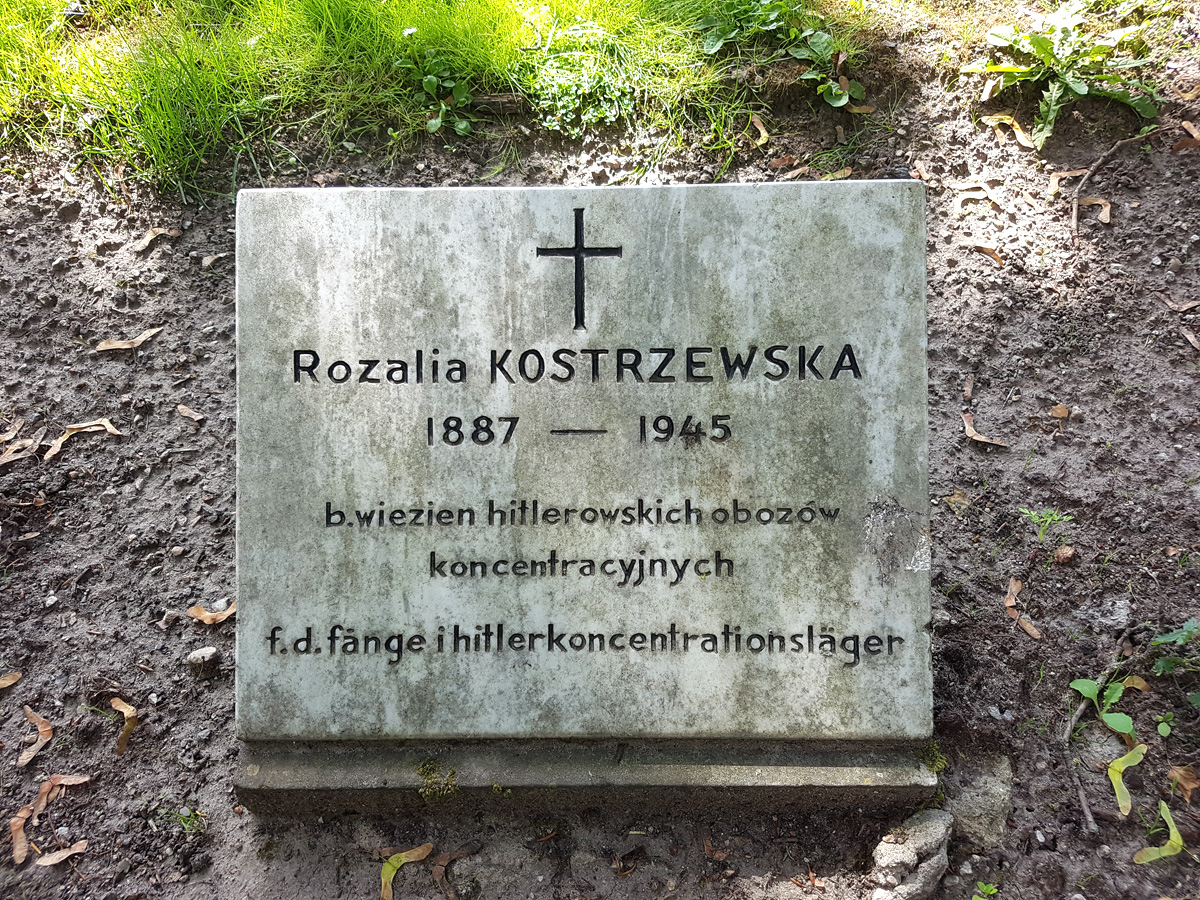
During a week in May 1945, the "White Buses" (organized by Swedish diplomat Folke Bernadotte) brought around 7000 survivors from German concentration camps to Lund. Not all that came here survived for long. Some of those who died were buried in two places along the northern part of the block known as the western line (LSV). On most of the gravestones there is a name of the person in the grave, but a few of the graves are anonymous.
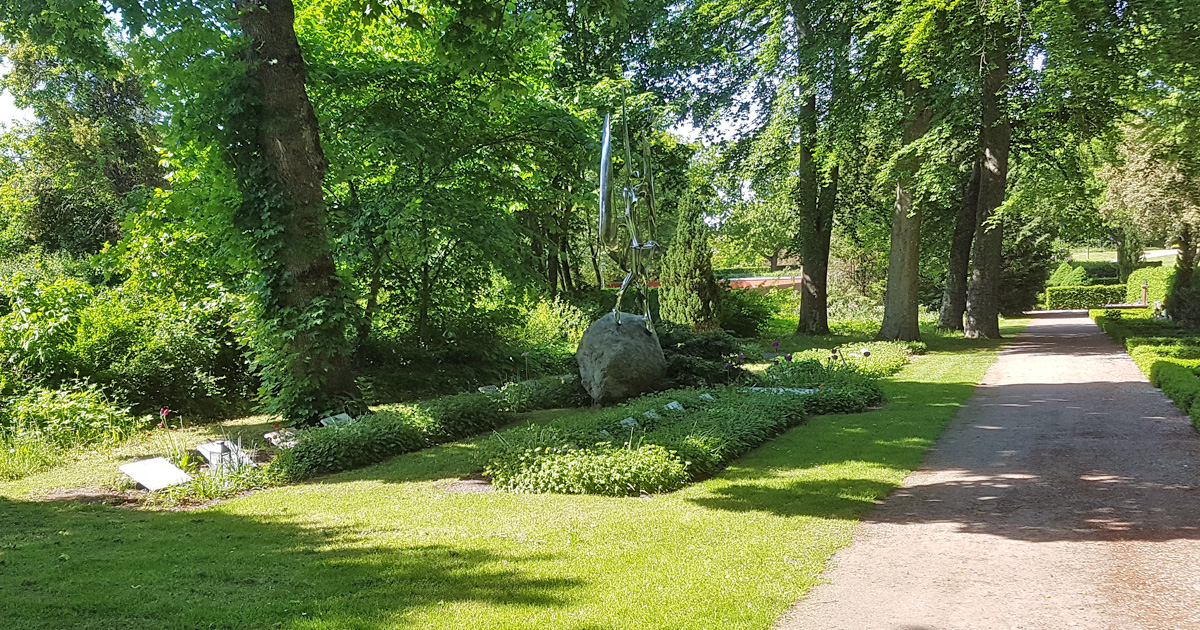 Some of the graves along the northern part of the block known as the western line (LSV).
When walking among the graves, most of them stating the year of death as 1945, the atrocities of WWII feel spookily tangible. Many of those who arrived on the white Buses were women and children from the concentration camp of Ravensbrück north of Berlin. Towards the end of the war, men were also held prisoners in this camp.
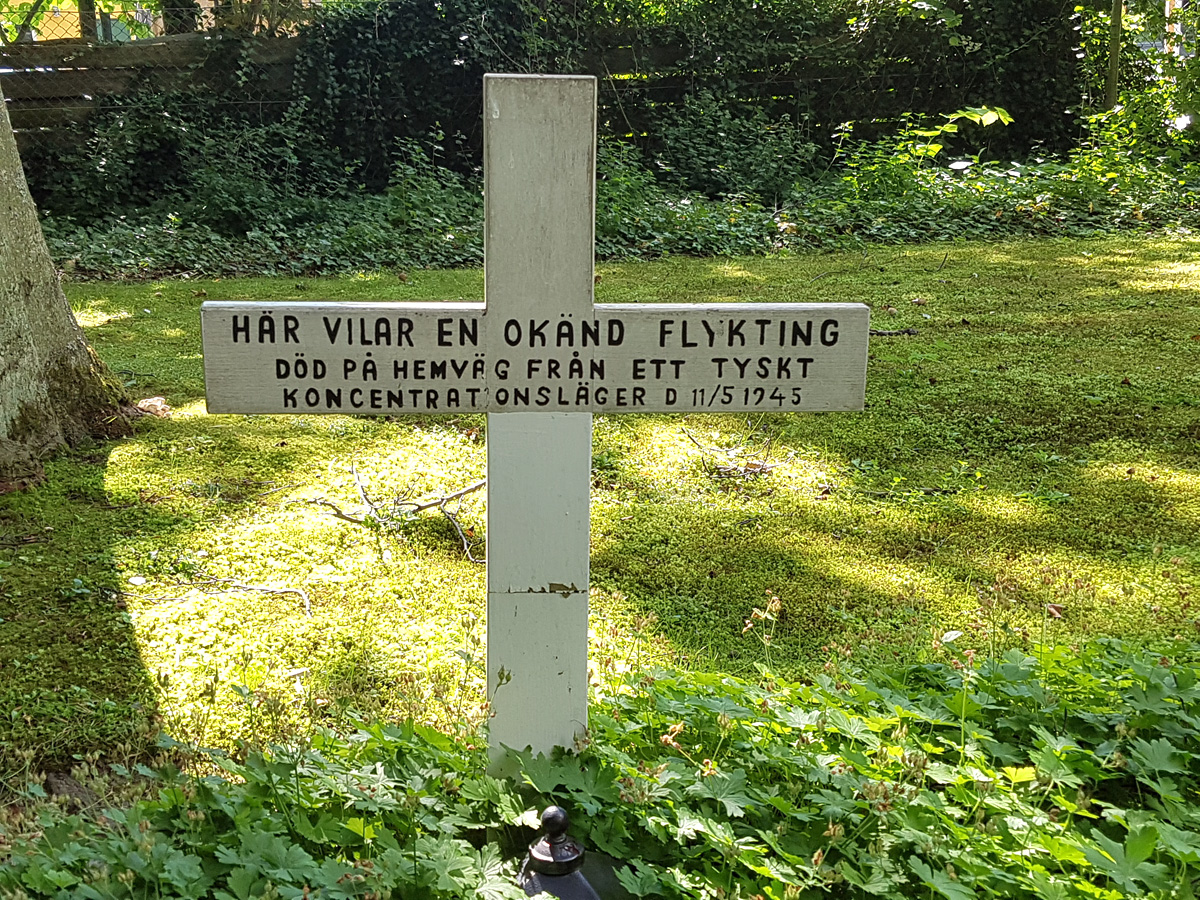
|
|
The white cross in the picture, that mentions an unknown refugee, was raised over an unknown man of French or Polish nationality who died while being transported between Malmö and Lund.
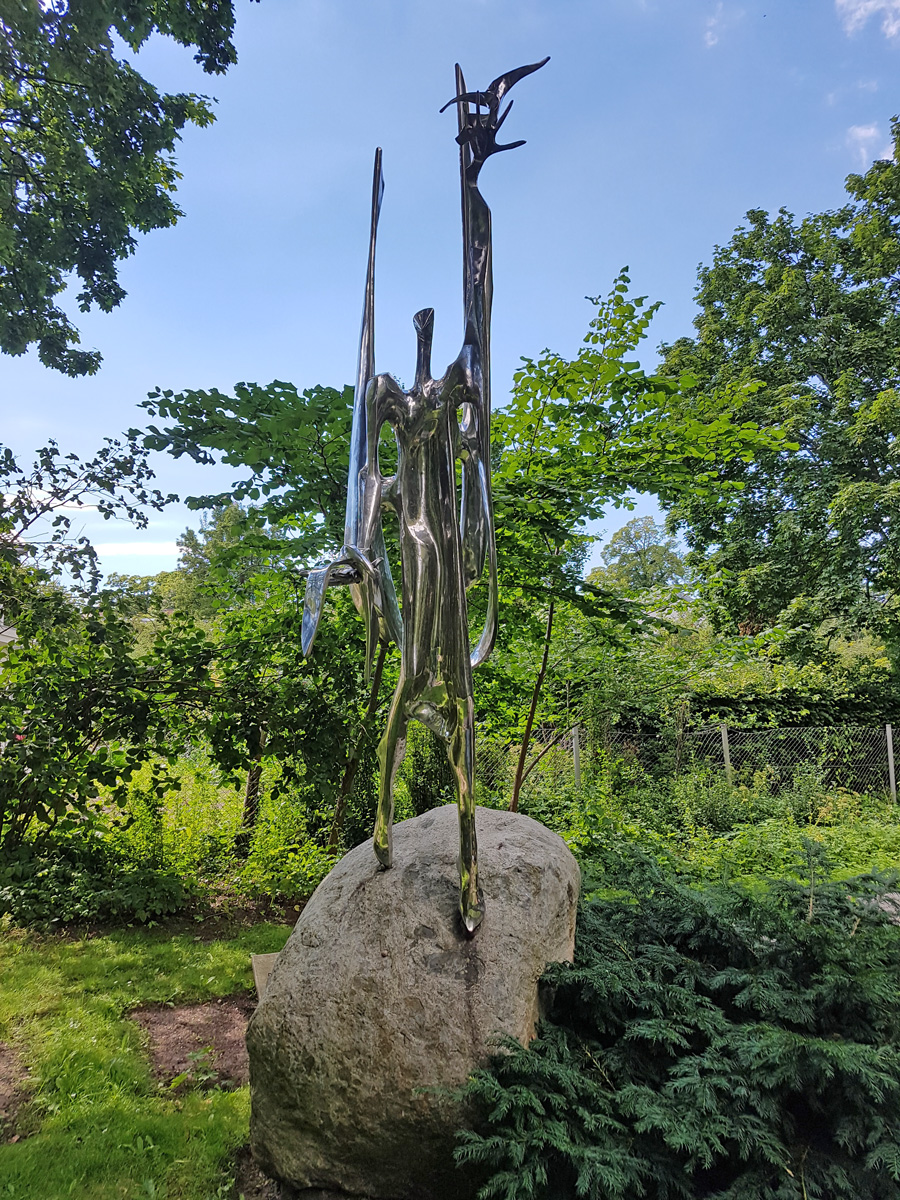 The Angel sculpture
By the graves there is a sculpture made in 1963 by the Hungarian-Swedish-Japanese sculptor
Nándor Wagner. The sculpture, which is cast in stainless steel, depicts an angel. It was
raised in memory of Polish victims and refugees of WWII.
The Angel sculpture
By the graves there is a sculpture made in 1963 by the Hungarian-Swedish-Japanese sculptor
Nándor Wagner. The sculpture, which is cast in stainless steel, depicts an angel. It was
raised in memory of Polish victims and refugees of WWII.
Nándor Wagner, who came to Sweden in 1957, became a Swedish citizen and taught arts at the University of Lund.
On the ground below the sculpture there is a stone commemorating the victims of WWII. On the stone you find an eagle, a part of the Polish coat of arms, and the text "For the victims of the concentration camps – Polish countrymen".
37) Ulf and Birgitta Trotzig
Birgitta Trotzig, whose grave is in block 10, was born September 11th, 1929, in Gothenburg, but grew up in Kristianstad since the family moved there in 1937. Both of her parents taught French, English and Spanish there. Birgitta started her studies in philosophy, literature history and art history at the University of Gothenburg. She met Ulf Trotzig in Gothenburg. He studied at Valand art academy. They were married in 1949. During that period Birgitta was writing her first book, a collection of novels called "Ur de älskandes liv" (From the life of Lovers) that was published in 1951.
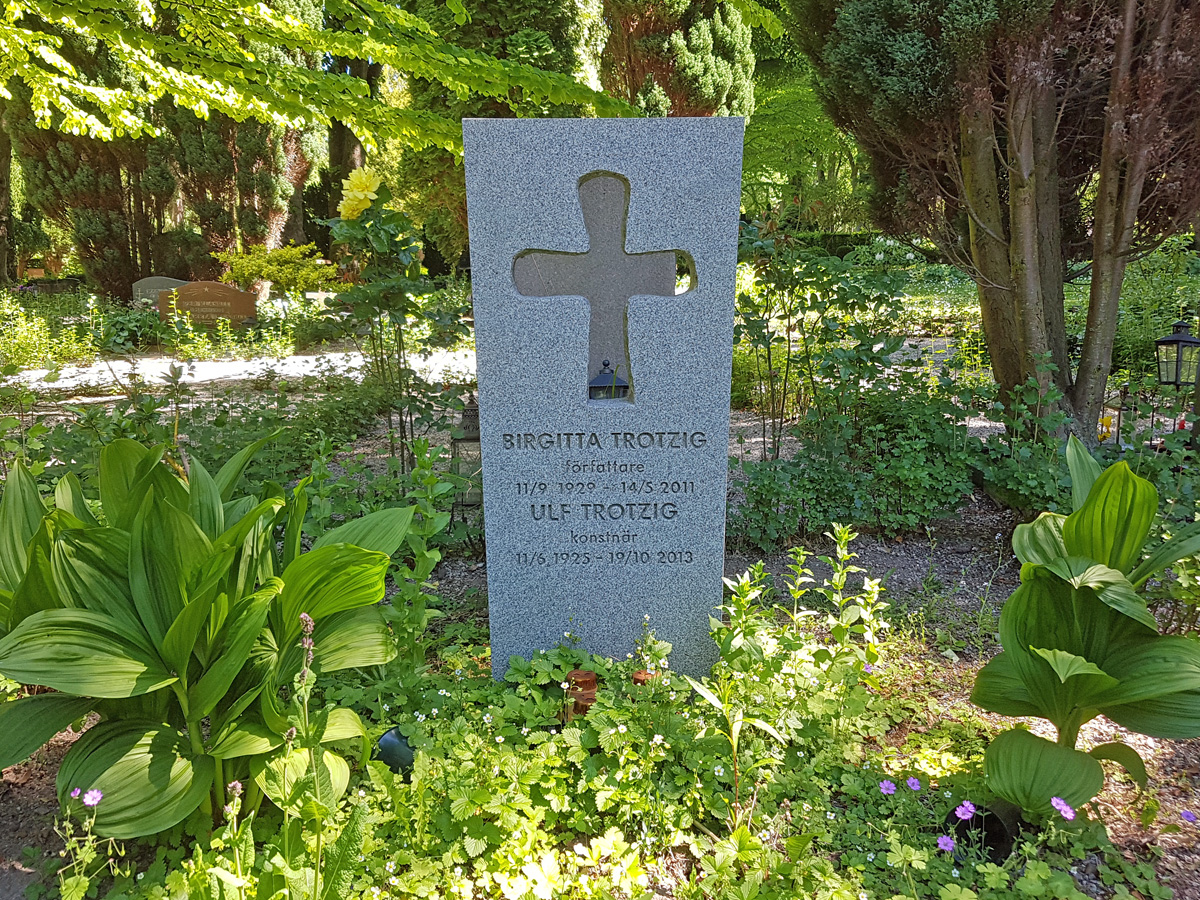 Grave of Ulf and Birgitta Trotzig.
Ulf Trotzig was born June 11th, 1925, in Föllinge north of Östersund. His family also moved to
Kristianstad, since his father started working there as a district physician. When Ulf had
finished his studies at Valand art academy he travelled to Paris together with Birgitta on a
scholarship, and they moved there on a more permanent basis in 1954. In Paris Birgitta came
into closer contact with Catholicism, and eventually she converted.
Grave of Ulf and Birgitta Trotzig.
Ulf Trotzig was born June 11th, 1925, in Föllinge north of Östersund. His family also moved to
Kristianstad, since his father started working there as a district physician. When Ulf had
finished his studies at Valand art academy he travelled to Paris together with Birgitta on a
scholarship, and they moved there on a more permanent basis in 1954. In Paris Birgitta came
into closer contact with Catholicism, and eventually she converted.
At some point in the 70's they moved to Lund, but they also spent a lot of time in a summerhouse on the island of Öland. In 1993 Birgitta Trotzig was elected to chair 6 in the Swedish Academy, a chair she kept until her death on May 14th, 2011. Ulf Trotzig became a multi-talented artist, and he is represented in several museums, the Swedish National Museum and the the Modern Museum among others. He died October 19th, 2013.
38) Axel Wallengren, also known as Falstaff, fakir
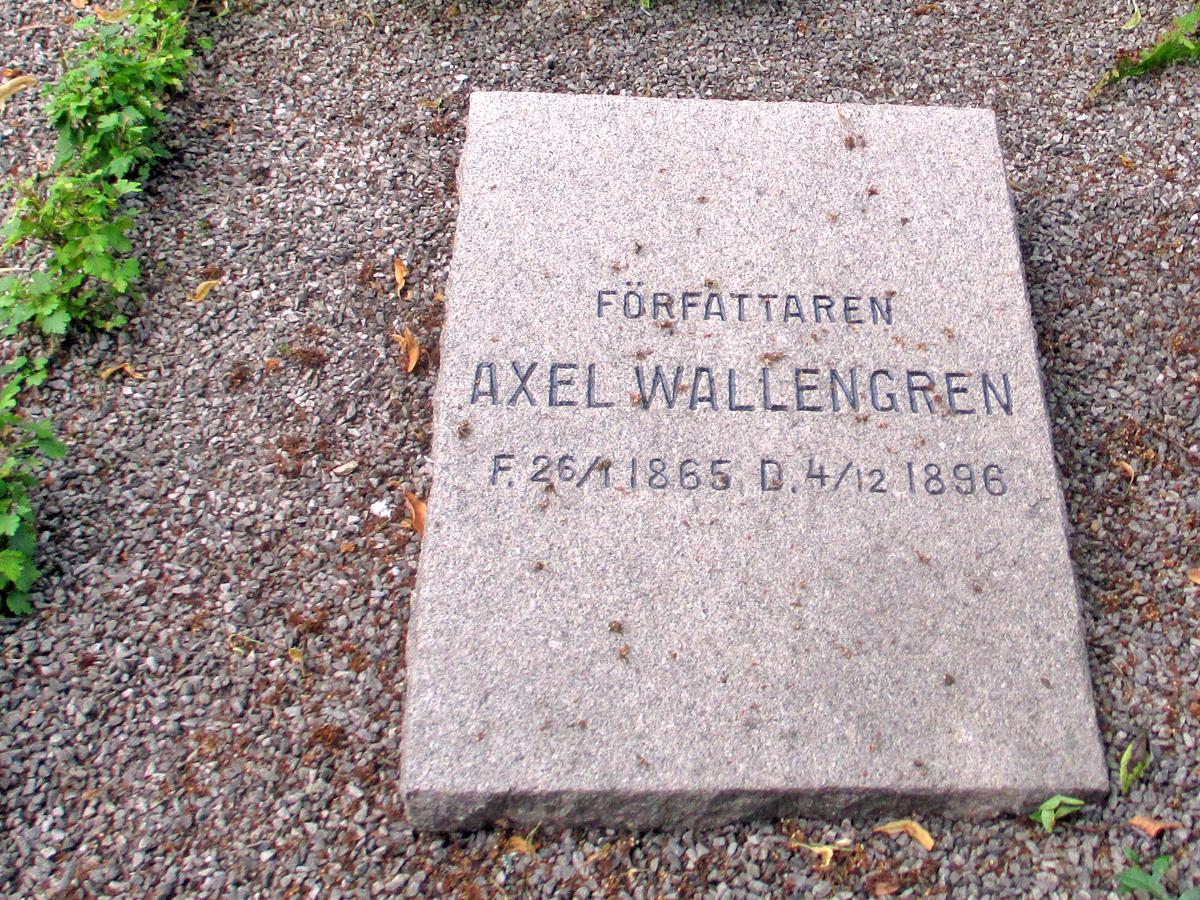 Grave of author Axel Wallengren
In the southwestern part of block six you can find the grave of author, poet, journalist and
one of a kind, style setting, comedian Axel Wallengren, perhaps better known under his
pseudonym Falstaff, fakir. He was born in Lund on January 26th, 1865, and died in Berlin on
December 4th, 1896.
Grave of author Axel Wallengren
In the southwestern part of block six you can find the grave of author, poet, journalist and
one of a kind, style setting, comedian Axel Wallengren, perhaps better known under his
pseudonym Falstaff, fakir. He was born in Lund on January 26th, 1865, and died in Berlin on
December 4th, 1896.
The family resided in Tomegapsgatan 24, where a memorial plaque can be found on the wall of the house stating his residency. During his time as a student at Lund University in the 1880's and beginning of the 1890's, Axel Wallengren was an important member of the radical discussion club "De Unga Gubbarna, DUG" (The young old Men). He had also a leading role in the Lund student carnival committees of 1888, 1890 and 1892.
39) Hildur Sandberg
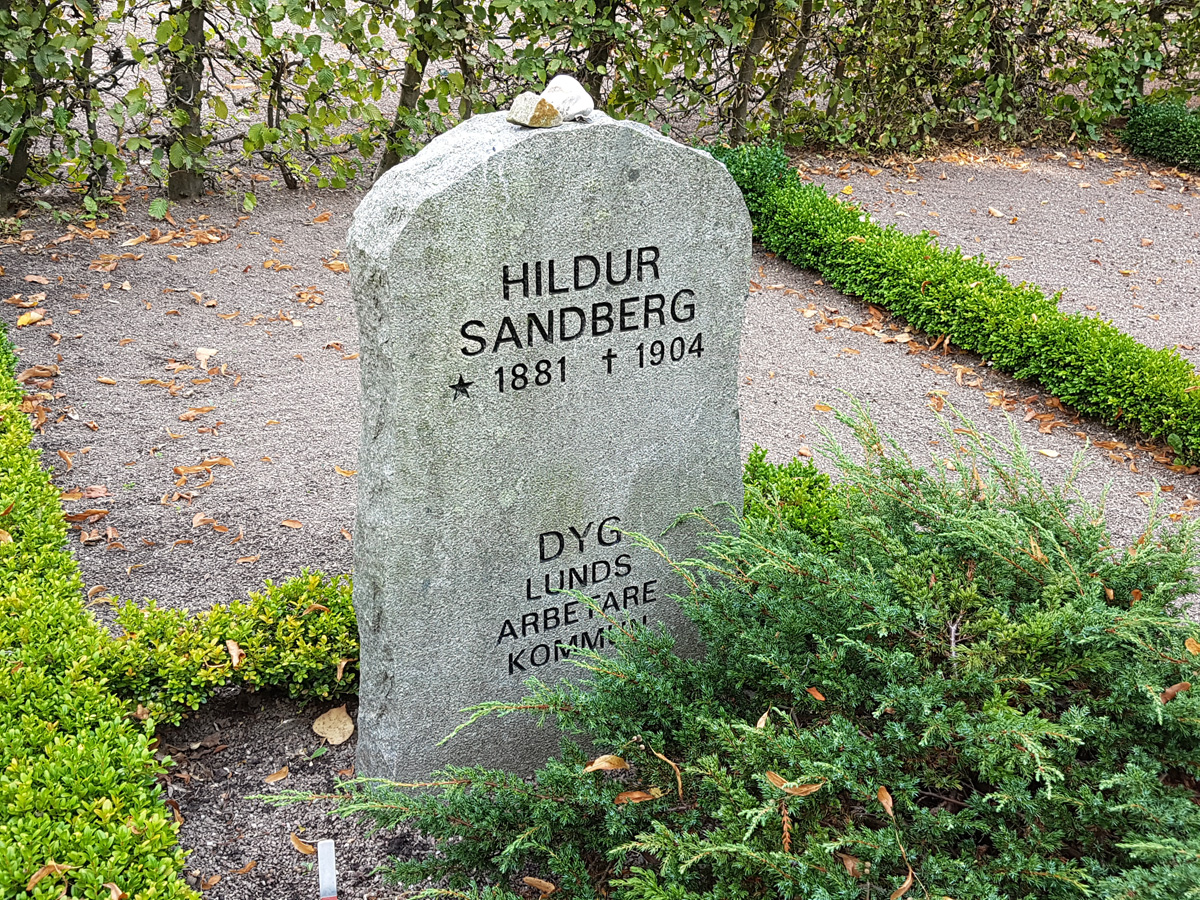 Grave of student politician Hildur Sandberg.
Hildur Sandberg was a student politician, medical student and radical social democrat. She was
born February 18th, 1881, in Ängelholm. In 1895 she started at Rönströmska higher elementary
school for girls, located at Stora Södergatan in Lund.
Grave of student politician Hildur Sandberg.
Hildur Sandberg was a student politician, medical student and radical social democrat. She was
born February 18th, 1881, in Ängelholm. In 1895 she started at Rönströmska higher elementary
school for girls, located at Stora Södergatan in Lund.
When Hildur Sandberg was accepted at Lund University, to study medicine, in 1899, there was a total of 582 students, of which 11 were women. During her time at the university, she was active in the women's student organization, but also in the culture radical student organization known as Den Yngre Gubben, DYG (The younger old Man). She started a Sunday school for working class children and became known as "Lejoninnan från Lund" (The lioness from Lund).
Hildur Sandberg died in Lund on December 22nd, 1904, after being found unconscious. Her grave is in block one.
40) Sten Broman
Sten Broman is one of the people who, perhaps more than anyone else, has personified Lund in modern times. He is buried at the southeast corner of block one.
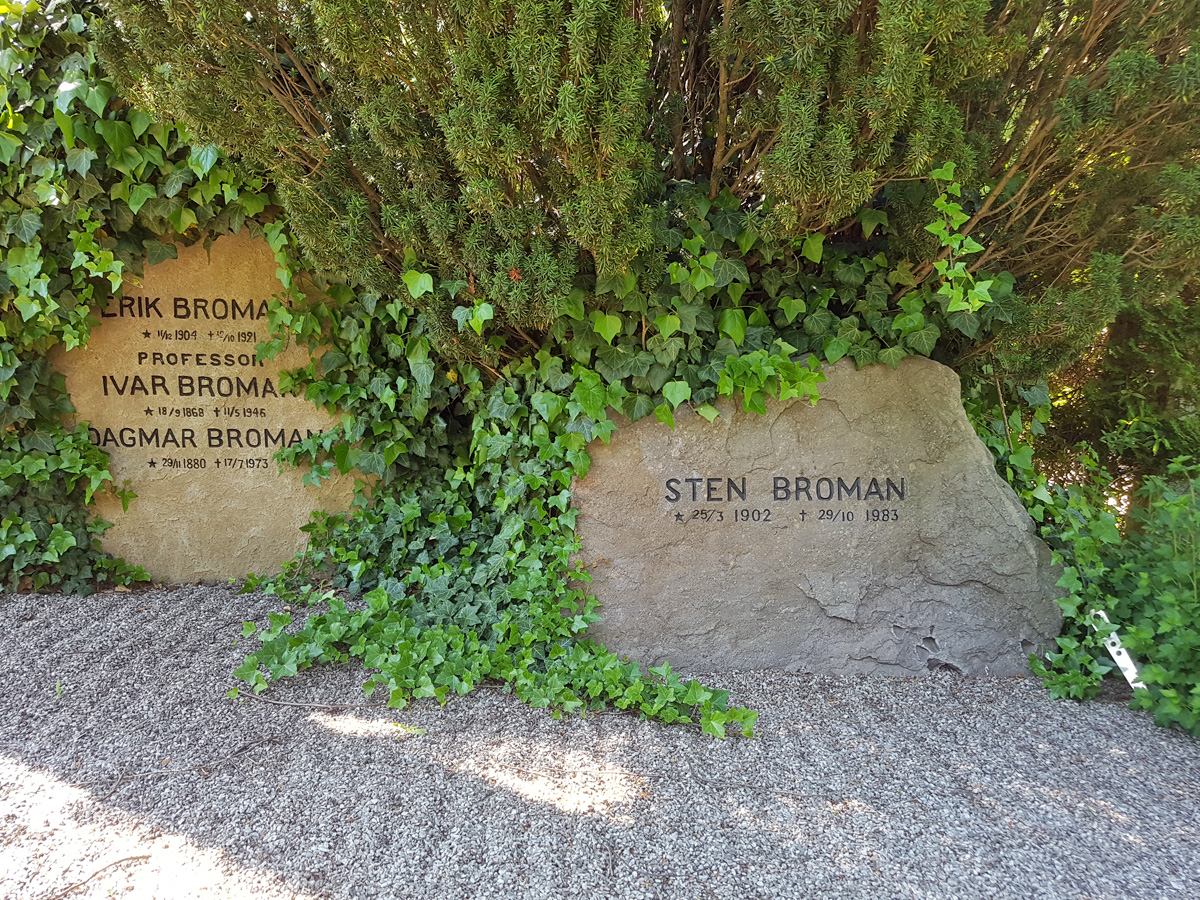 Grave of Sten Broman, his brother Erik and their parents Ivar and Dagmar Broman.
Sten Broman was born in Uppsala March 25th, 1902, and died in Lund October 29th, 1983. Also
laid to rest in this grave is Erik, brother of Sten, and their parents Ivar and Dagmar Broman.
Grave of Sten Broman, his brother Erik and their parents Ivar and Dagmar Broman.
Sten Broman was born in Uppsala March 25th, 1902, and died in Lund October 29th, 1983. Also
laid to rest in this grave is Erik, brother of Sten, and their parents Ivar and Dagmar Broman.
Sten Broman was, among other things, a director of music, a lecturer, a music pedagogue, a music critic, a composer and the TV-show host of Musikfrågan Kontrapunkt (The Music Question Counterpoint) on Swedish Television. You can still see him in some of the public available programs in the Swedish Television open archives.
Ivar Broman, father of Sten, took his student degree in 1890 at the Cathedral school (Katedralskolan) in Lund, became a medical candidate at Lund university in 1895 and defended his thesis in 1899. After some time in Uppsala, he returned to Lund in 1905 and became professor at the anatomical institution. Here in Lund the Broman family resided in the so called Rosenvillan (the Rose villa) on Finngatan 14. Sten Broman himself later lived in Erik Dahlbergsgatan 6 where a memorial plaque can be found on the wall of the house stating his residency.
41) Elof and Hedvig Tegnér
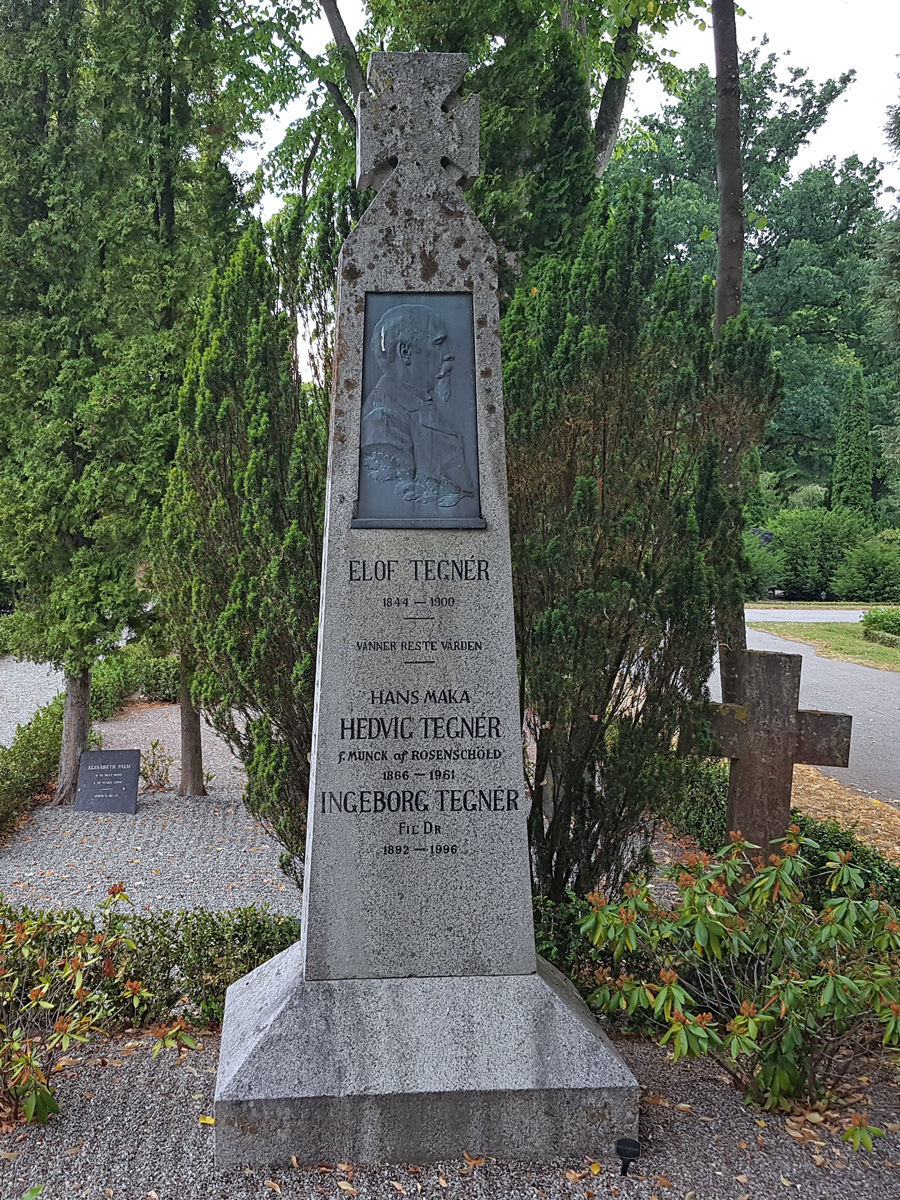 Grave Elof and Hedvig Tegnér.
Poet and Bishop Esaias Tegnér isn't buried at Northern Cemetery, but his grandson Elof Tegnér,
is. His grave can be found in the block called "the southern line" (LSA). Elof Tegner was born
in Källstorp parish near Trelleborg on June 30th, 1844. After finishing his studies in Lund,
he became an extraordinary assistant at Lund University Library (UB) in 1865. From 1870 until
1883 he worked at the Royal Library in Stockholm, and then he returned to UB as a librarian.
Elof Tegner married Hedvig Munck af Rosenschöld on September 9th, 1891.
Grave Elof and Hedvig Tegnér.
Poet and Bishop Esaias Tegnér isn't buried at Northern Cemetery, but his grandson Elof Tegnér,
is. His grave can be found in the block called "the southern line" (LSA). Elof Tegner was born
in Källstorp parish near Trelleborg on June 30th, 1844. After finishing his studies in Lund,
he became an extraordinary assistant at Lund University Library (UB) in 1865. From 1870 until
1883 he worked at the Royal Library in Stockholm, and then he returned to UB as a librarian.
Elof Tegner married Hedvig Munck af Rosenschöld on September 9th, 1891.
Hedvig Munck af Rosenschöld was born August 10th, 1866, in Kristianstad as the daughter of the president of the court of appeal and member of the Swedish Parliament Tomas Munck af Rosenschöld.
Elof died February 26th, 1900, just over 8 years after they were married, leaving Hedvig and their 8-year-old daughter Ingeborg behind. After the death of her husband, Hedvig left her daughter with relatives and took up art studies. She travelled to Paris between 1902 and 1903, and later painted elsewhere in France, Italy and England. She participated with her art in many exhibitions, including the Association of Swedish Female Artists (Föreningen Svenska Konstnärinnor) exhibition at the Royal Swedish Academy of Fine Arts in 1911, and almost annually in the Scania Art Society's autumn salons in Malmö between 1914 and 1953. Hedvig died in Lund April 9th, 1961.