![[Bild]](/common/img/default.png)
Lund's oldest viking age history
Information
The Viking age Lund
See also
• The sources to the new
information about Lund
Information from the chronicle "Gesta Wulinensis ecclesiae pontificum", which can be
translated as the history of the Wolin bishops, has rewritten Lund's oldest viking age history
in a way that has never happened before. This information cannot be obtained through
archaeological findings. This means that there is now much more detailed knowledge about
Lund's oldest history, but it has also made history much more complex. Here we tell, in
chronological order and broad strokes, about the oldest history of the viking age Lund, up to
around the year 990, as we know it today. It also tells very much of the then viking age
Denmark history, because there are so many points of contact with events and people in other
parts of viking age Denmark.
This information describes the historical background in much more detail, and chronologically as far as possible. This should be seen as a complement to the visitor guides about the viking age Lund. Relevant years have been formatted in bold to make it easier to search for a specific period in history.
The sources of this historical description
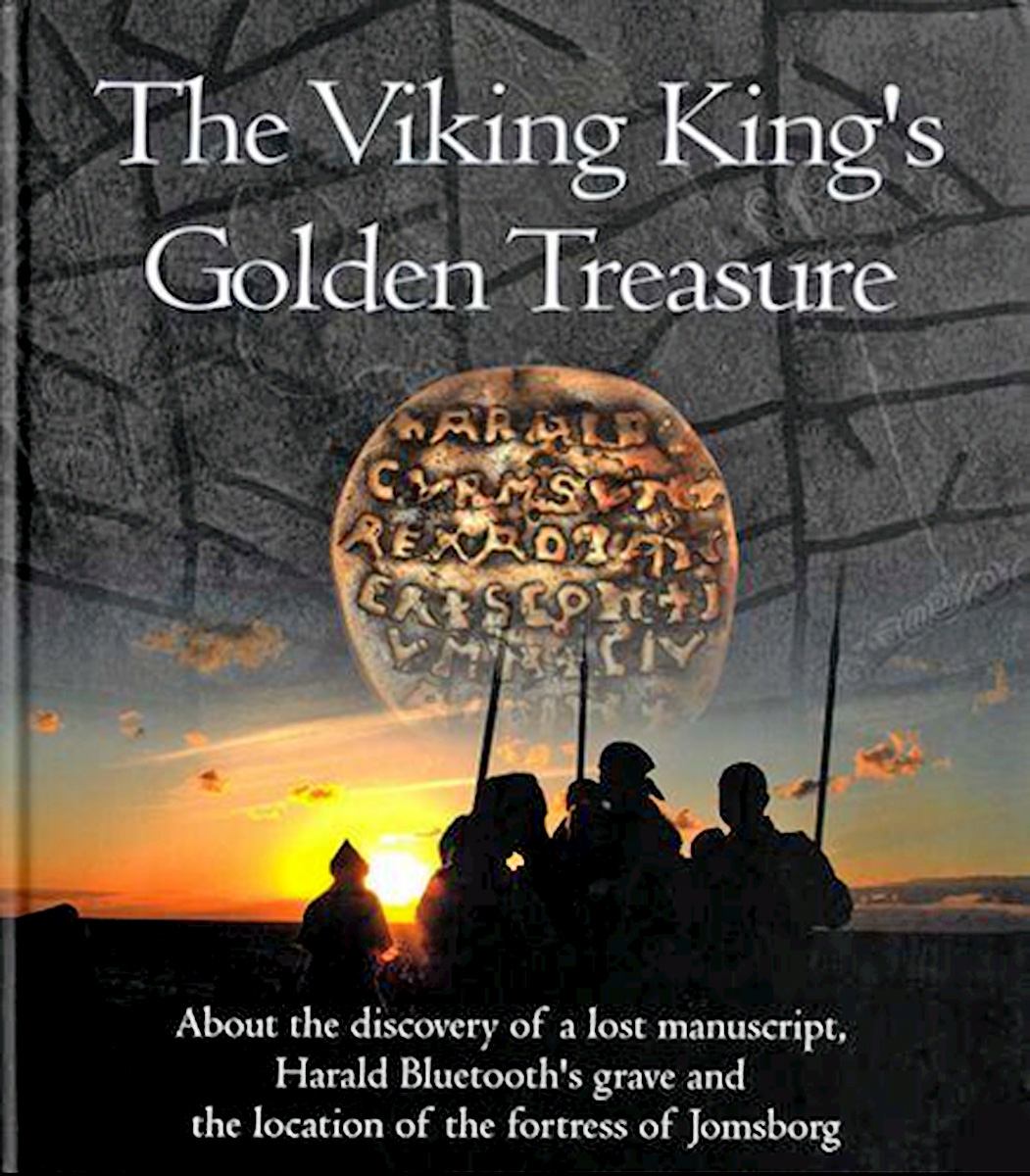
The information comes from the sources reported on the page "The sources to the new information about the viking age Lund" and is based on information presented by Sven Rosborn, who has more than 50 years of experience as an archaeologist and author. The information consists mainly of excerpts from the chronicle "Gesta Wulinensis ecclesiae pontificum" which has been published in the book "The Viking King's Gold Treasure" and in several documents with additional information, mostly written in Swedish.
 Sven Rosborn and Tomas Sielski are still working on the new information. Tomas is the grandson
of Antonina Chmielinska, who translated the original Chronicle from Latin into Polish, in
collaboration with the then director of the National Museum of Poland in Warsaw, Professor
Stanislaw Lorentz.
Sven Rosborn and Tomas Sielski are still working on the new information. Tomas is the grandson
of Antonina Chmielinska, who translated the original Chronicle from Latin into Polish, in
collaboration with the then director of the National Museum of Poland in Warsaw, Professor
Stanislaw Lorentz.
This historical description is based on the new information from the above-mentioned Chronicle, which so far concerns the period up to about 990. As more is published from the ongoing work, this historical description will be updated and expanded with that new information.
What makes the information from the Chronicle so unique is that it is a contemporary written source. The Chronicle's narrator, the priest Avico, who for many years served as a priest for Harald Bluetooth and his family, has written about things he himself has seen and experienced. Some of what the Chronicle tell about has later been proven archaeologically in whole or in part, and more of it may be proven archaeologically in the future.
Of course, the sources tell not only about Lund, but also much else about Denmark's viking age history. This historical description mainly deals with what affects Lund directly or indirectly.
Family tree of Harald Bluetooth's closest relatives
This family tree shows several of the most important persons mentioned in this historical description, which will make it easier to see how they relate to each other.
Open the family tree in a new tab to view it in a larger format.
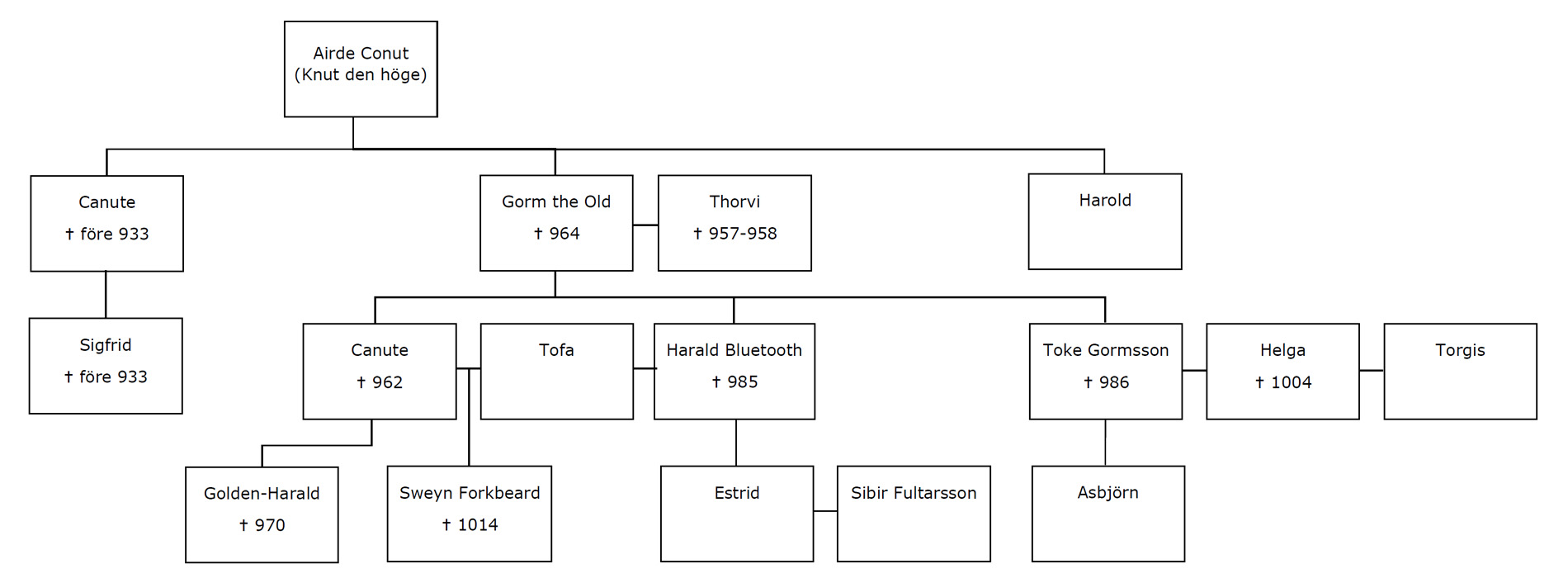 Family tree with several of the most important persons mentioned in this historical description.
Denmark before Lund
The place we call Uppåkra today was a large urban area and pagan power center until well into the 10th century. However, Christianity had begun to be established in Denmark. That was an important reason when Uppåkra lost its importance and was replaced with the new city Lund. Therefore, it is also good to know something about the development in Denmark before Lund was established.
Gorm, Harald Bluetooth's father, had an older brother named Canute, but both Canute and his son Sigfrid died sometime before 933. In 937, Gorm asked for help from Prince Herman Billung of Saxony in the fight for the throne against his nephew Harold, who was king of the island of Funen. Gorm then had to leave his sons Harald and Canute hostage. Therefore, Harald and Canute were baptized by Archbishop Adaldag, who had been appointed archbishop of Hamburg-Bremen that year. They were raised as Christians, first at the palace in Merseburg and later at the palace in Quidlinburg. Gorm succeeded in exiling his nephew Harold, who went to Normandy to help his minor relative Richard I. Tukki Normandy, who had served under Harold, accompanied him.
When Gorm in 948 wanted to fulfill his elder brother Canute's earlier promise to the German king Henry I to allow the Christians to establish themselves in Denmark, he got help to contact Archbishop Aaeldag in Hamburg-Bremen by Herman Billung of Saxony. In 949, Tukki Normandy was commissioned by Gorm to recruit new soldiers for Gorm's son Canute, and in 953 Tukki Normandy led those soldiers when they beat down a pagan rebellion in the area around Wolin in what today is northwestern Poland. In return, Canute and his soldiers were allowed to build fortifications east of Wolin, which came to be called Jomsborg, and Tukki Normandy was appointed leader.
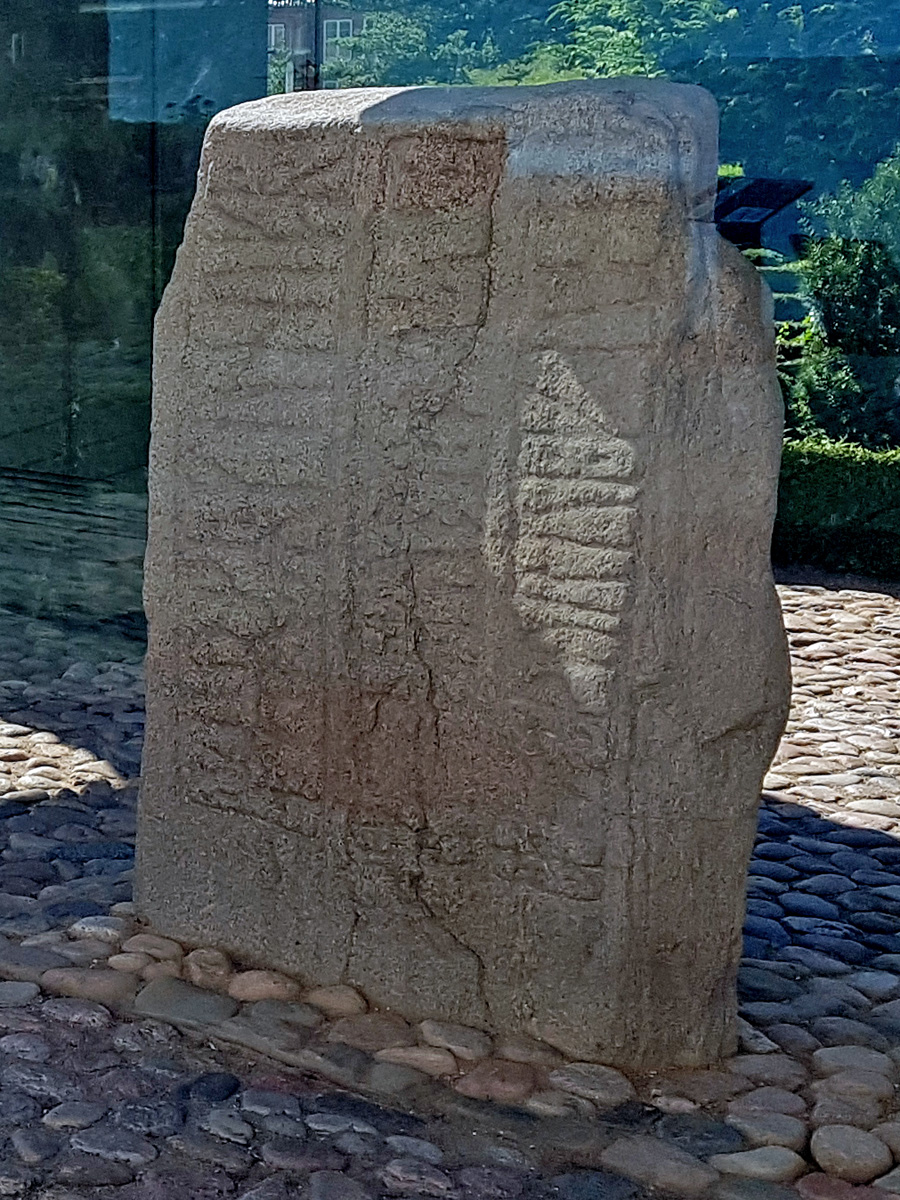 King Gorm's runestone in Jelling in Denmark.
Gorm's wife Thorvi, also called Thyra, who was Harald Bluetooth's mother, died around
957-958 and was buried according to Christian custom. Gorm raised a runestone after her
in Jelling in Jutland with the text "King Gorm made these kumler (cf. letters) after Thorvi
his wife, Denmark's shed". Harald Bluetooth's older brother Canute died 962, in a major
battle in Ireland. Gorm took his son's death so hard so he abandoned his Christian faith and
returned to pagan rituals. Canute was buried under a burial mound where the church in Jelling
is now. Thorvi's remains were taken up and buried in the large mound on the north side of the
church.
King Gorm's runestone in Jelling in Denmark.
Gorm's wife Thorvi, also called Thyra, who was Harald Bluetooth's mother, died around
957-958 and was buried according to Christian custom. Gorm raised a runestone after her
in Jelling in Jutland with the text "King Gorm made these kumler (cf. letters) after Thorvi
his wife, Denmark's shed". Harald Bluetooth's older brother Canute died 962, in a major
battle in Ireland. Gorm took his son's death so hard so he abandoned his Christian faith and
returned to pagan rituals. Canute was buried under a burial mound where the church in Jelling
is now. Thorvi's remains were taken up and buried in the large mound on the north side of the
church.
After Canute's death, Tukki Normandy joined Canute's son Harald, called Goldenharald due to a golden helmet he was wearing which he had received as a gift during one of the expeditions deep into the land of the Slavic people. Canute's wife Tofa was pregnant when he died, but when the son, who was named Sweyn and became Sweyn Forkbeard, was born, she already had married Harald Bluetooth.
The loss of his firstborn son Canute and the grief after his wife Thorvi led Gorm to commit suicide in 964 by sailing out to sea. Harald Bluetooth then became the new king of Denmark. In 965, he renewed his Christian faith by being blessed by Bishop Poppon near Schleswig to show that Denmark was now a Christian country. He removed the mound above Canute's grave and built a wooden church over the grave so that the grave ended up under the church's choir. He also took his mother Thorvi's remains and buried them in the church as well.
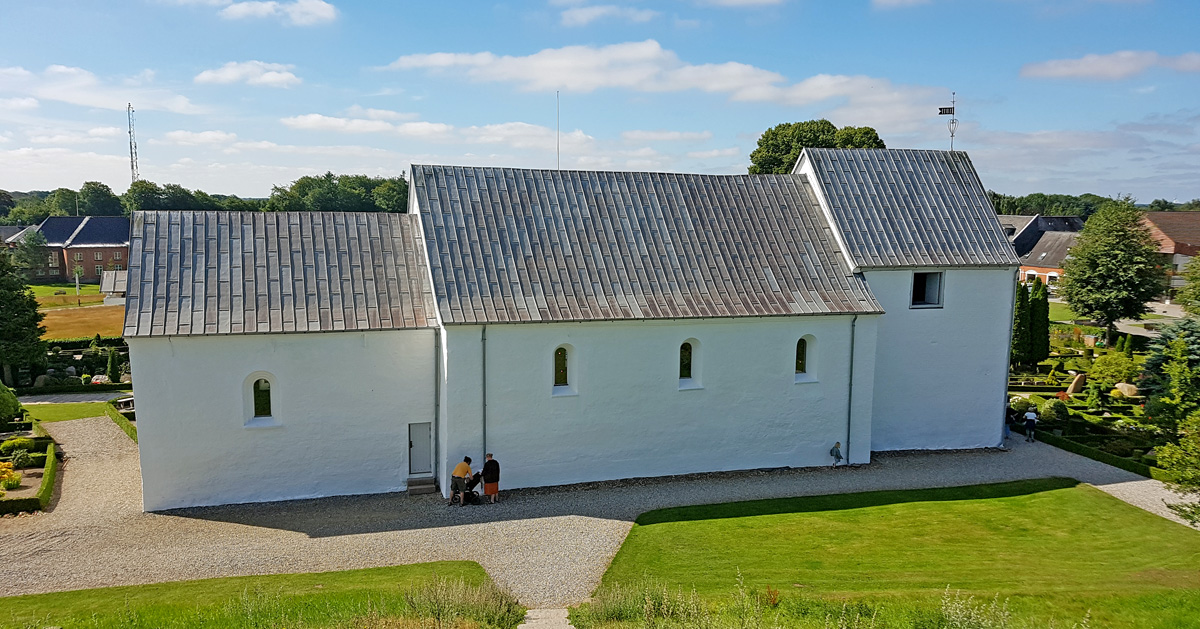 The church in Jelling in Jutland, Denmark, to the south with the choir to the left.
Lund before Lund
Thanks to the chronicle "Gesta Wulinensis ecclesiae pontificum" we now know much more about Denmark's history for the time before Lund. The Chronicle, on the other hand, contains almost nothing about the place today called Uppåkra, and there are not many archaeological findings providing information about Uppåkra's viking age history. The top archaeological cultural layer, or plough layer as it is usually called, is so shallow in Uppåkra that it has largely been destroyed when the land has been cultivated.
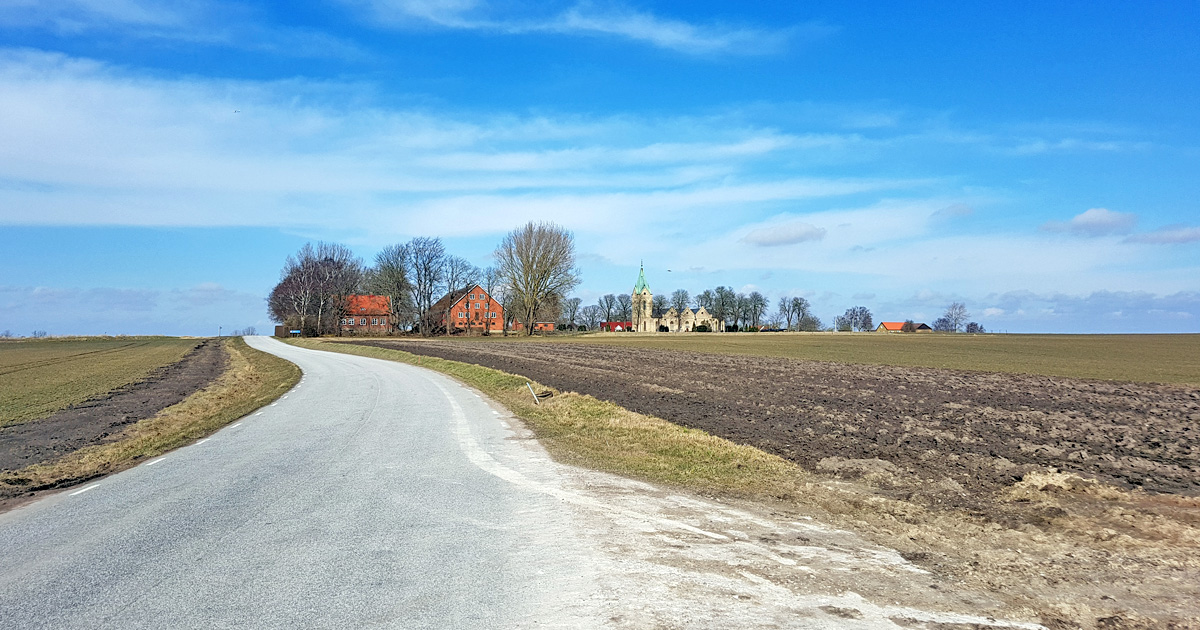 The place where the large urban area was located in today's Uppåkra, which preceded today's
Lund, is mostly an agricultural landscape.
The place where the large urban area was located in today's Uppåkra, which preceded today's
Lund, is mostly an agricultural landscape.
The sacrificial grove that gave the city of Lund its name
The discovery of a house in Uppåkra, which has been interpreted as a house of pagan rituals, and lots of bones of both humans and animals that have been found around the house, indicate that those who lived there have sacrificed people and animals to the gods. This makes the paragraph below from the Chronicle particularly interesting.
Tuca and the rest of the faithful then found shelter at the site of the dead, which has been consecrated to pagan gods for centuries, and promised that in this place a temple will be built for the Lord if they all saved their lives. It also happened, and Tuca ordered that a temple should be built and I sanctified the cornerstone. On it were carved the holy signs that it was Tuca who ordered this temple of the Lord in the city of Lvntarumn to be built.
The mentioned Tuca was Harald Bluetooth's younger brother Toke Gormsson, who was the tributary king of Scania in 974, that this passage from the Chronicle tell about. The question is how to interpret where "the place of the dead, consecrated to pagan gods for centuries" was. It could be what now is called Uppåkra, archaeological finds show that sacrifices were made to pagan gods there. If, on the other hand, it was at the place where the church was built it must have been where Lund is now, because we know where that church was built. This is how we interpret it in our visitor guides as long as there's nothing to say it can't be true. It is also said that there was a fortress at the place where they took shelter, and that fortress was probably where Lund is now. This is the oldest known mention of the city of Lund.
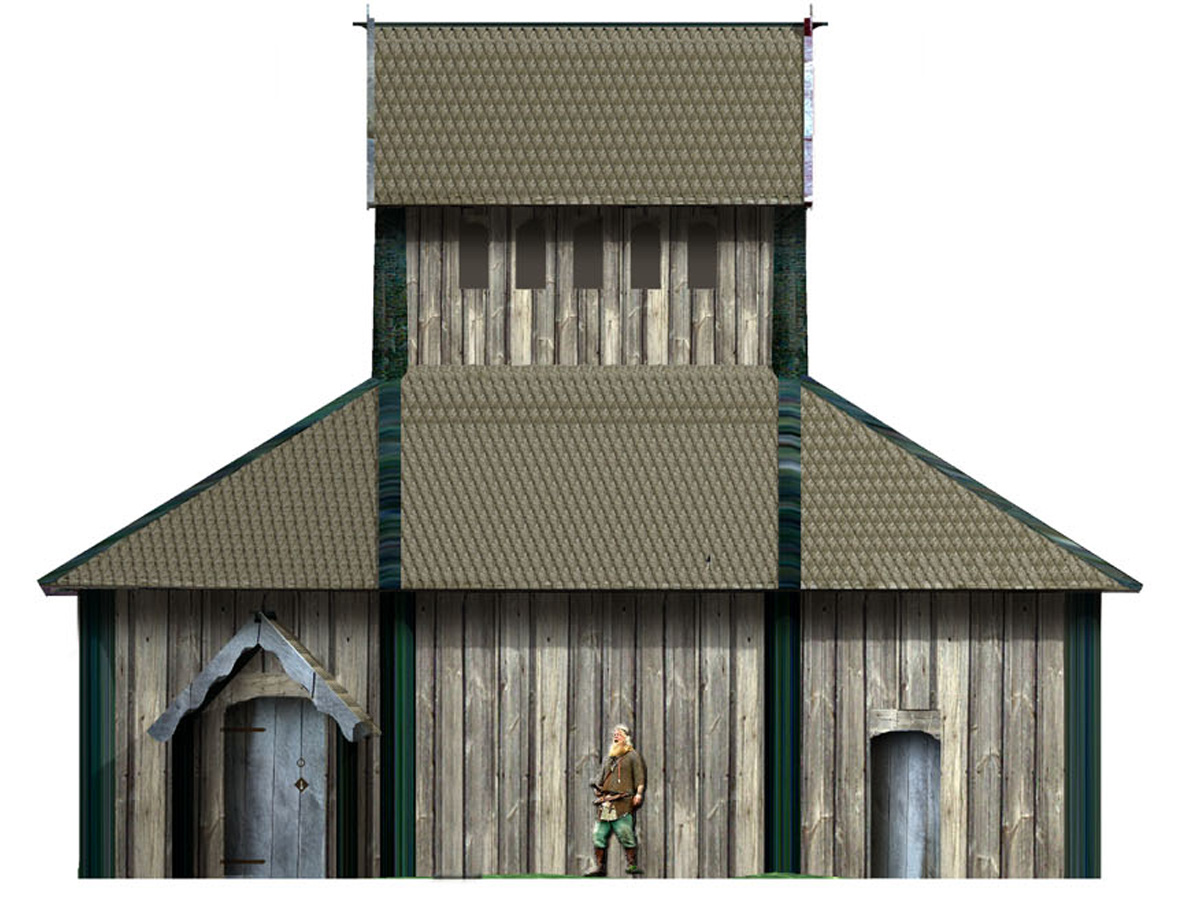 A reconstruction by Sven Rosborn showing what the pagan ritual building in Uppåkra may have
looked like.
What "the place of the dead, who have been consecrated to pagan gods for centuries" in the
paragraph above from the Chronicle means, is unfortunately not specified in more detail, so it
must be interpreted as best as possible. If the place where Lund is now has been a "place for
the dead, who have been consecrated to pagan gods for centuries", it could perhaps have been
that as far back as around the year 200 AD, when the pagan ritual house in Uppåkra was built,
or even earlier.
A reconstruction by Sven Rosborn showing what the pagan ritual building in Uppåkra may have
looked like.
What "the place of the dead, who have been consecrated to pagan gods for centuries" in the
paragraph above from the Chronicle means, is unfortunately not specified in more detail, so it
must be interpreted as best as possible. If the place where Lund is now has been a "place for
the dead, who have been consecrated to pagan gods for centuries", it could perhaps have been
that as far back as around the year 200 AD, when the pagan ritual house in Uppåkra was built,
or even earlier.
It could also indicate that the presumed sacrificial grove, that gave the city of Lund its name, may have been located where the center of Lund is now. It may have been a pagan sacrificial grove that was used by the people who lived in the large urban area where Uppåkra is located, four kilometers south of today's Lund. This means that the urban area where Uppåkra is now may have been called Lund and got that name because of the sacrificial grove that existed where Lund is now.
The reason why the new Christian Lund was built on the site where Lund is now located in sloping terrain, instead of where the urban area of Uppåkra already existed for a thousand years, may then have been to stop the pagan rituals by making the site of the pagan sacrificial grove a Christian place. At the same time, the new city took over the old urban area's name Lund. This is one way of interpreting what is said in the passage from the Chronicle, but it will probably never be possible to prove it with archaeological findings.
The Scania King Björn Jarl
The Chronicle tell that Harald Bluetooth's nephew Goldenharald took control of the southwestern parts of Scania in 964. At the latest then, the new urban area for Lund must have been established, but perhaps it happened even earlier. The Chronicle mention a Björn Jarl who is said to have been the king of Scania. He is the man mentioned on the runestone Lundagårdsstenen. Unfortunately, very little is told about him which leaves many questions unanswered. The Chronicle tell that Björn Jarl was allowed to return as a palatine, a kind of royal official, twelve years later, in 976. This could be interpreted as he was some kind of tributary king in Scania until the year 964.
Later events that the Chronicle tell about indicate that Björn Jarl was the leader of a large and powerful family in Scania, but it is unclear which area the family controlled. Björn Jarl sent warriors to his cousin Richard I of Normandy in 961, when he needed help in the war against the French king. When Richard needed help again the following year, Bjorn Jarl sent more warriors to him. It was then, when the defense of the western parts of Scania was weakened, that Goldenharald took the opportunity to conquer and take control of the area. Björn Jarl had to flee to the southeastern parts of Scania.
In connection with these events, which are recounted in the Chronicle, it is said that the magnates from Zealand did not respect the previously established border that divided Scania into two parts. This indicates that some kind of settlement was made in connection with Goldenharald's conquest of Scania; the magnates from Zealand controlled the western part while Björn Jarl and his family controlled the eastern part. However, there is no information about which area in western Scania that Björn Jarl had controlled earlier.
When Björn Jarl died in 984, he was buried according to Christian custom, so at least then he was a Christian, while it is known that the people in the old area of Uppåkra were pagan. It is a question whether Björn Jarl had already taken control of Uppåkra, or if that happened in connection with Goldenharald's conquest of Scania. Could the Christian Björn Jarl really have controlled an area, and perhaps had his seat where Lund is now, at the same time as there was a large and powerful pagan urban area in Uppåkra? There is no information about it in the Chronicle, but if Björn Jarl had some kind of seat where Lund is now, it means that Lund's origin can be dated to before the year 964.
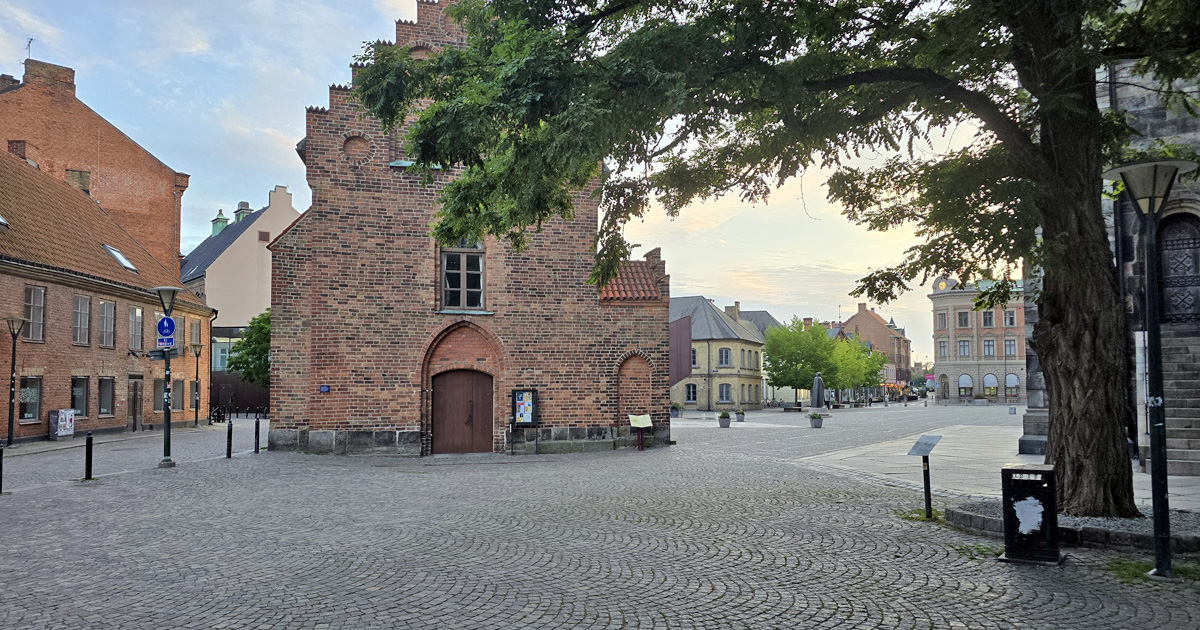 Lund was perhaps established at the place where the city is today even earlier than the year
964.
Lund was perhaps established at the place where the city is today even earlier than the year
964.
A people called Kuitis
When Harald Bluetooth's nephew Goldenharald was commissioned to conquer the western parts of Scania in 964, it was to protect the eastern part of the strait from attacks from hostile people called Kuitis. The question is whether this could be a mention of the pagan people who lived in the pagan urban area in today's Uppåkra. There is no mention in the Chronicle of what kind of people the Kuitis were or what area they controlled.
Harald Knutsson, Goldenharald, as tributary king of Scania
As mentioned above, Harald Knutsson, or Goldenharald as he was called, who was the son of Harald Bluetooth's older brother Canute who was dead, was given the task of conquering the western parts of Scania in 964 to protect the eastern part of the strait from attack by an unknown and hostile people called Kuitis.
The conquest of Scania in 964
Goldenharald got help to conquer the western parts of Scania by Tukki Normandy and his soldiers, who probably came from Jomsborg, located in what is now northwestern Poland. Björn Jarl, who is mentioned as king of Scania, was expelled to the southeastern parts of Scania. Some kind of deal was made, possibly in connection with this, which was that the magnates from Zealand would control the western part, with Goldenharald as Harald Bluetooth's tributary king, while Björn Jarl and his family would control the eastern part.
The first royal estate in Lund
The chronicle tell that Goldenharald had St. Clement's Church built near "the prince's palace". It is not assumed to refer to any kind of castle, but to what must have been the first royal estate in Lund. This can be interpreted as the royal estate already existed when the church was built. If it was Goldenharald who established the first royal estate, it may have happened as early as 964 when the Danish vikings took control of the place where Lund is now. When the urban area of Lund was later laid out with blocks, plots and streets, may the area on the west side of the Cathedral, today the park Lundagård and the place where Lund Cathedral is, have been included in the royal estate. The entire northern part of the block on the south side of Cloister street (Klostergatan), east of Large Greyfriars street (Stora Gråbrödersgatan), is also assumed to have belonged to the royal estate's area, as it was there that St. Clemens church was built. The first royal estate then, may have been in the southern part of the block on the west side of the Cathedral, or on the east side of St. Clemens church, but very little is known about the royal estate in Lund.
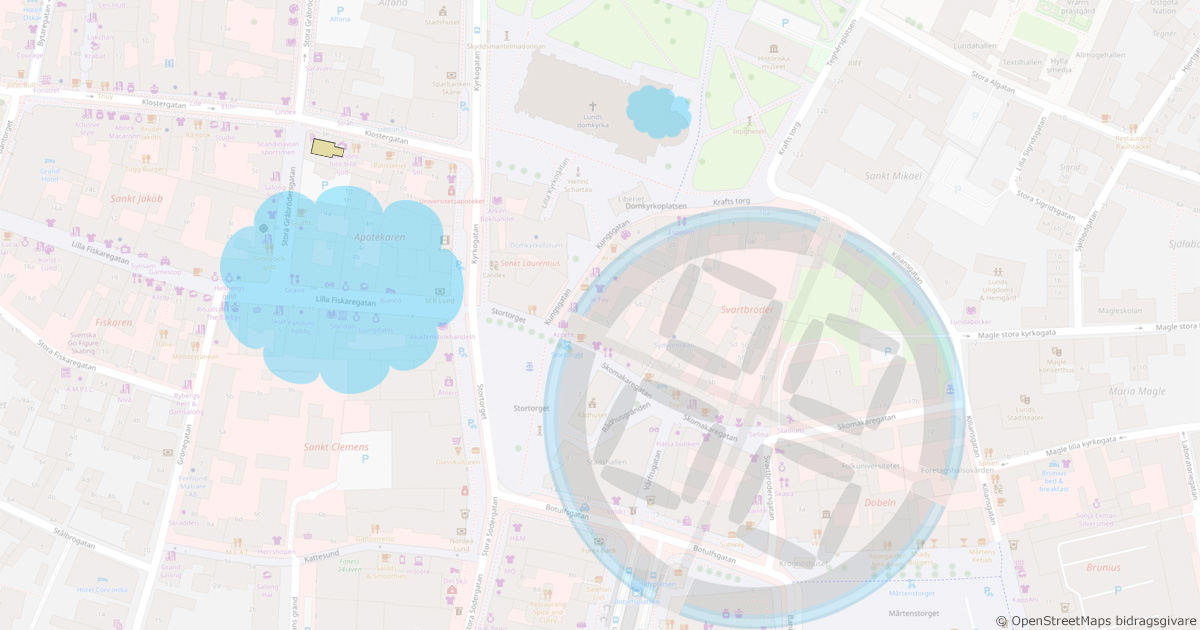
 The oldest royal estate may have been in the block to the left. St. Clement's church was in
the block to the right
The oldest royal estate may have been in the block to the left. St. Clement's church was in
the block to the right
Lund's first church St. Clemens
The wooden church St. Clemens, which was the first church in Lund, was built by Goldenharald on the area south of today's Cloister street (Klostergatan) and east side of Large Greyfriars street (Stora Gråbrödersgatan). This could have happened in 964 at the earliest. Since the Chronicle tell that the church was built near the "prince's palace", the royal estate may already have existed. The church must have been built no later than 970 because Goldenharald died that year. It is archaeologically proven that there was a larger pond south of the church. That may have been the reason why the church was built there, with access to water for baptisms.
The wooden church was later replaced with a stone church, probably on the initiative of King Canute the Great in the 1020s. That church was excavated archaeologically in 1932 and 1935. At the excavation, eight staves and one round corner post for a building that was located on the south side of the church were also found, which was assumed to have been the eastern part of the north longhouse wall of a previous wooden church. In that case, the wooden church was located next to the south side of the church of stone.
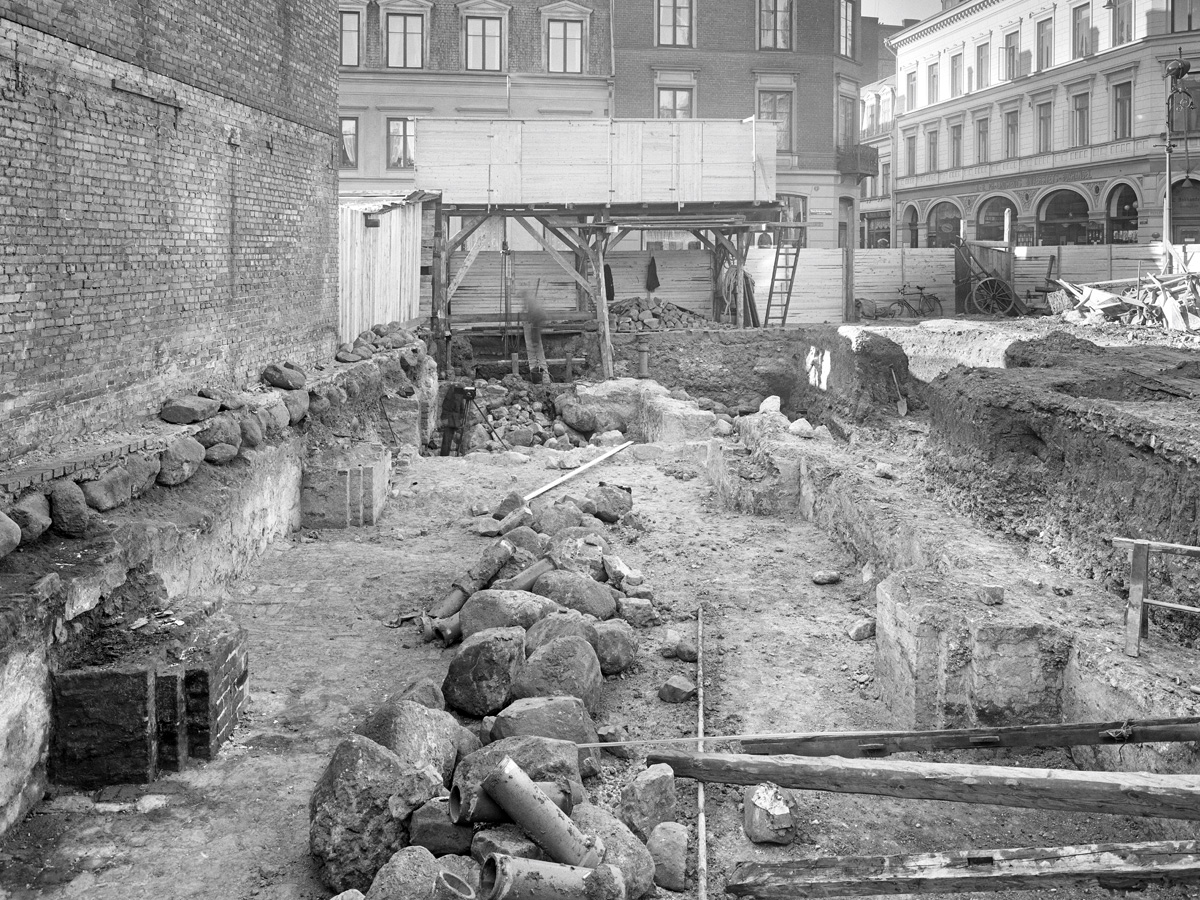 The archaeological excavation in 1932 with Cloister street (Klostergatan) to the right. The
houses straight ahead and to the right are still there. The area with the house to the left in
the picture will be built with a new house within a few years.
The archaeological excavation in 1932 with Cloister street (Klostergatan) to the right. The
houses straight ahead and to the right are still there. The area with the house to the left in
the picture will be built with a new house within a few years.
There are plans to build an apartment building on the area on the south side of the house built after the archaeological excavation of St. Clement's Church in 1932. Demolition permission for the outbuilding, a garage building from 1898, has already been granted. In the archaeological investigation that must precede the new construction, it can be expected to find archaeological remains of the wooden church. If it is possible to date wood from the church, the Chronicle's claim that the church was built in the late 960s could be proven archaeologically.
Goldenharald's death
In 970, Goldenharald called for a meeting where he tried to convince the Norwegian king Harald Gråfäll to assassinate Harald Bluetooth. When that failed, Goldenharald murdered Harald Gråfäll instead, hoping that Harald Bluetooth would not find out about his plans. But Harald Bluetooth found out, and Goldenharald then demanded the right to the Danish throne, which he believed he should have inherited from his father Canute, who as a firstborn son would have become Denmark's next king. Instead, Goldenharald was brought to a council called "the elders" who sentenced him to death for trying to assassinate the king.
Toke Gormsson as tributary king of Scania
After Goldenharald's death, Harald Bluetooth appointed Hakon Jarl as the new tributary king of Norway, and in 971 he appointed his younger brother Toke Gormsson as tributary king of the western part of Scania, the area that Goldenharald had previously ruled. Toke Gormsson swore allegiance to Harald Bluetooth.
The fortress (trelleborgen) in Lund
According to the Chronicle, there was a fortress in Lund, built by Toke Gormsson probably sometime between 971 and 973, but no later than 974. The Chronicle's narrator, the priest Avico, tells that it was in that fortress that Toke hid from Hakon Jarl's attack on Lund in 974, which you can read about in a section further down this page.
The fortress must have been located in the block on the south side of the semicircular stretch of Kings street (Kungsgatan) and Killians street (Kiliansgatan), although there is no direct archaeological evidence of its existence. The streets must have been laid out in connection with the construction of the city, which, according to the Chronicle, was done around 987. At that time, the walls of the fortress had been demolished while the moat remained. The fortress was built as a so-called trelleborg with a diameter of 160 to 180 meters.
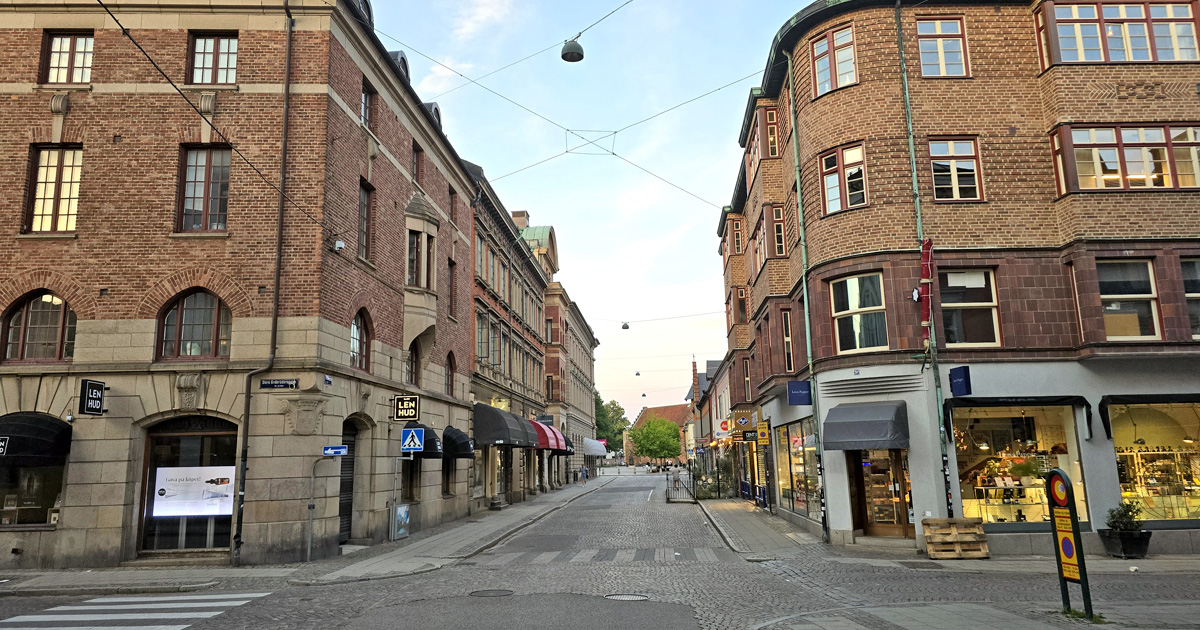
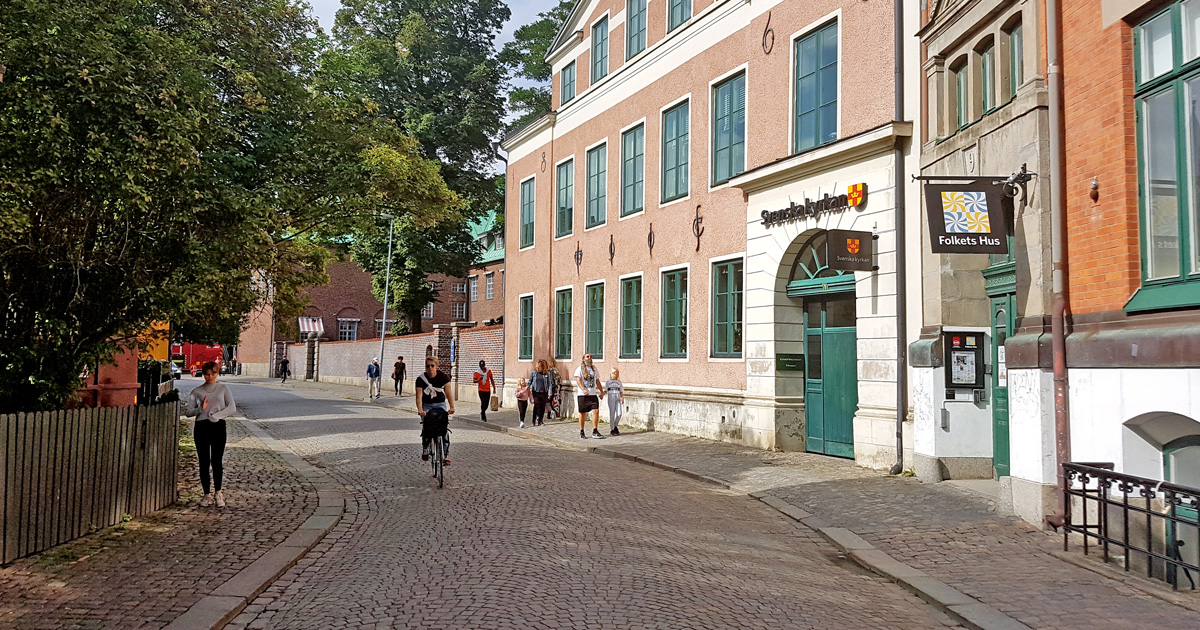 Killians street (Kiliansgatan), which continues with Kings street (Kungsgatan) further away in
the picture, was laid out around 987 as a semicircle around the fortress's moat, to the left
in the picture, which was still there at that time.
Killians street (Kiliansgatan), which continues with Kings street (Kungsgatan) further away in
the picture, was laid out around 987 as a semicircle around the fortress's moat, to the left
in the picture, which was still there at that time.
Harald Bluetooth's conflict with Otto II
Harald Bluetooth's tributary king in Norway, Hakon Jarl, attacked Lund, where Toke Gormsson had his seat as Harald Bluetooth's tributary king over the western parts of Scania. To understand why, you need to know a bit about Harald Bluetooth's conflict with the German Roman Emperor Otto II.
After the death of Otto I in 973, when his then 18-year-old son had succeeded him as Otto II, the truce between the Empire and the Danes was not respected. Duke Bernhard, who was advisor to Otto II, and the local Count Dietrich ravaged Danes territory and plundered the people with Archbishop Adaldag's approval. Harald Bluetooth wanted to negotiate with the archbishop to restore peace, but he refused if he was not allowed to appoint his own bishops in Jutland, something Harald Bluetooth did not agree to.
Harald Bluetooth ordered Hakon Jarl and his forces to go to Hedeby to guard it until Harald Bluetooth could get there with his own forces. Harald Bluetooth's intention was to restore peace, but instead of waiting for Harald Bluetooth's forces, Hakon Jarl and his forces began to ravage and plunder the people of Hedeby and the surrounding area, which risked escalating into a war with Otto II. Hakon Jarl was a pagan and mocked Christianity by murdering priests before leaving the area. Then he went to Wolin , in today northwestern Poland, to sell his booty in exchanged for soldiers, slaves and salt. They had three monastic brothers with them as prisoners.
The Chronicle mentions that some kind of peace agreement was reached between Harald Bluetooth and the new emperor Otto II, but it is not clear what the agreement was about.
Hakon Jarl's attack on Lund
Harald Bluetooth's tributary king in Norway Hakon Jarl and his forces returned home to Norway in 974, after selling their booty in exchanged for soldiers, slaves, and salt in Wolin, in today's northwestern Poland. When they passed through the strait, they also took the opportunity to ravage and plunder on both sides, burning fortresses and murdering people. The three monastic brothers they had brought with them as prisoners were burned to death somewhere in Scania because they refused to deny their Christian faith. The Chronicle mentions Hakon Jarl's attack on Lund in this paragraph, which also was reproduced earlier.
Tuca and the rest of the faithful found shelter at the place of the dead, which has been devoted to pagan gods for centuries, and promised that in this place a temple will be built for the Lord if they all saved their lives.
In a note of the year 984, the Chronicle narrator, the priest Avico, tells that "Tukka's seat, which was a fortress built on the site of the dead, where, if I remember correctly, Tukki hid from jarl Hakan's wrath ten years earlier". The place described as "the place of the dead which were devoted to pagan gods" could be interpreted as the place where Uppåkra is now, but since it is known where the mentioned church was built, and they took shelter in a fortress at that place, it is more likely the place where Lund is now that is meant.
 Map of Lund as it may have looked during Hakon Jarl's attack in 974 with St. Clement's church
and a fortress (trelleborg).
Map of Lund as it may have looked during Hakon Jarl's attack in 974 with St. Clement's church
and a fortress (trelleborg).
Hakon Jarl's ravages in Hedeby, and then on both sides of the strait, which was followed by an attack on Lund, led to an enmity which caused Harald Bluetooth to lose his dominion over Norway.
Lund's second church sacred to John the Baptist
When Hakon Jarl and his forces attacked Lund, Toke Gormsson, Harald Bluetooth's younger brother and tributary king in western Scania, promised that a temple would be built for the Lord if they all survived, and so it was, according to the Chronicle.
It also happened and Tuca ordered that a temple of God would be built and I sanctified the cornerstone and on it were carved the holy signs that it was Tuca who ordered this temple of the Lord in the city of Lvntarumn to be built.
In a note for the year 975, the year after the attack, the Chronicle tells that "in the year of the Lord 975, Tuca, the youngest son of King Gurmd, ordered to strengthen the walls of the fortress that he had built". Lund is referred to in the chronicle as "Luntarumn", the Latin name, and this is the oldest known mention of Lund.
The mentioned cornerstone is a runestone that was found in the 1790s in a fence at Large Cross street (Stora Tvärgatan) here in Lund. In 1829, the then bishop of Lund, Wilhelm Faxe, donated the stone to Bishop Friederich Münter in Copenhagen, where it is now walled into the doorway of the bishop's house , where the diocesan administration of the Diocese of Copenhagen is located. Part of the runestone is missing, but the text that is left means "Toke had the church made and ...".
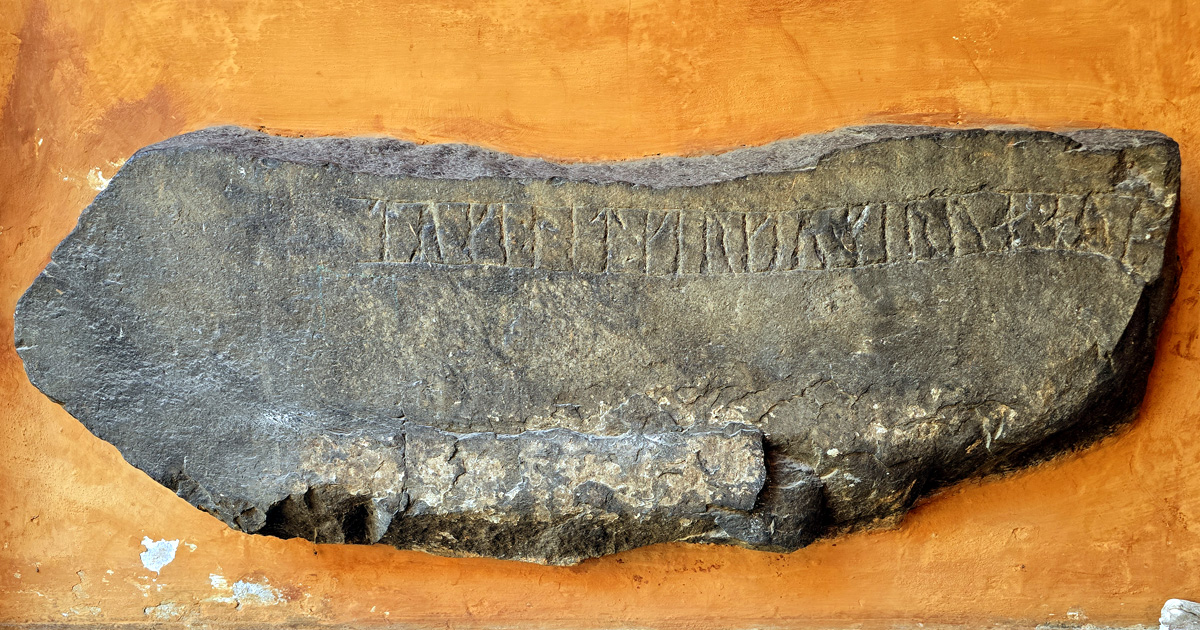 The runestone found in Lund that tells about the church Toke Gormsson had built in 975.
Some of the graves from the cemetery around the church have been found. The oldest of them dated to the winter of 979-980. The Chronicler's narrator, the priest Avico, tells that the church was sacred to John the Baptist.
In order to baptize this pagan people, and to receive help from heaven to accomplish this noble deed, St. John the Baptist was chosen as the patron of Our Lord's temple, and according to the will of the archbishop, three brothers from the bishopric of Hamburgensis, whose names I do not remember, were sent to Lvntarumn to spread the word of God.
Baptism was likely a central part of this church's activities, and there was probably a small pond on the south side from which water for baptism was brought. That may have been the reason why the church was built on that place.
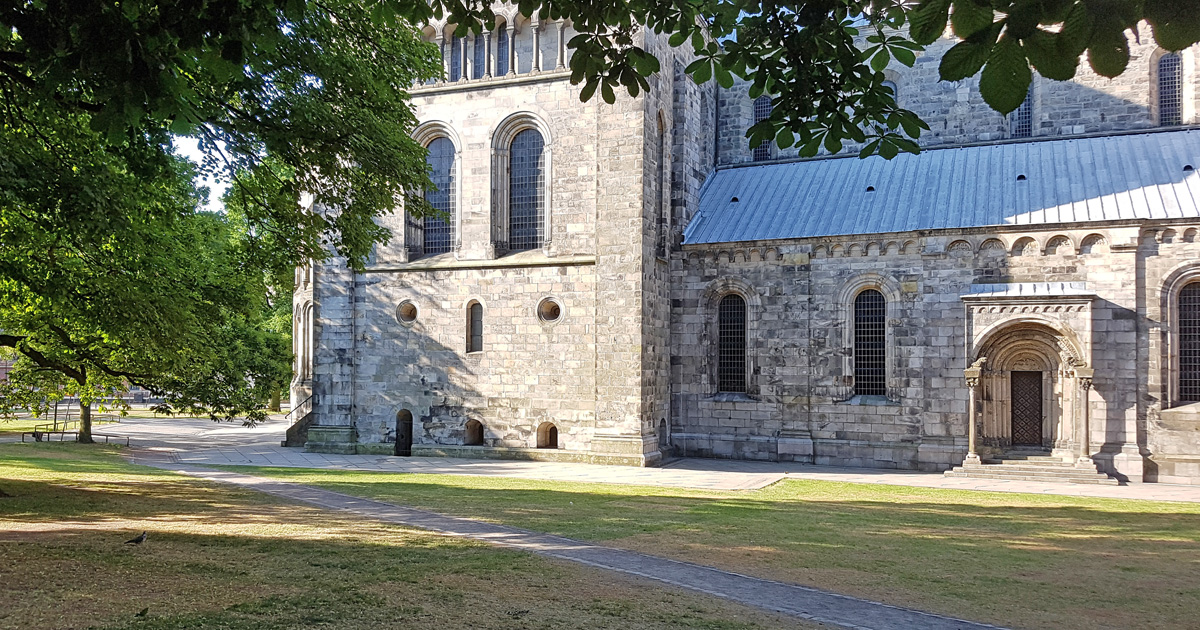 The place on the north side of Lund Cathedral where St. John the Baptist's church was built in
975.
The place on the north side of Lund Cathedral where St. John the Baptist's church was built in
975.
In the Lund Cathedral crypt there is a well containing water. This may be a remnant of the pond that is believed to have been there before the Cathedral was built. The Cathedral's well is believed to have been used as a baptismal well from the beginning and was probably built on top of a spring from which the pond may also have received its water.
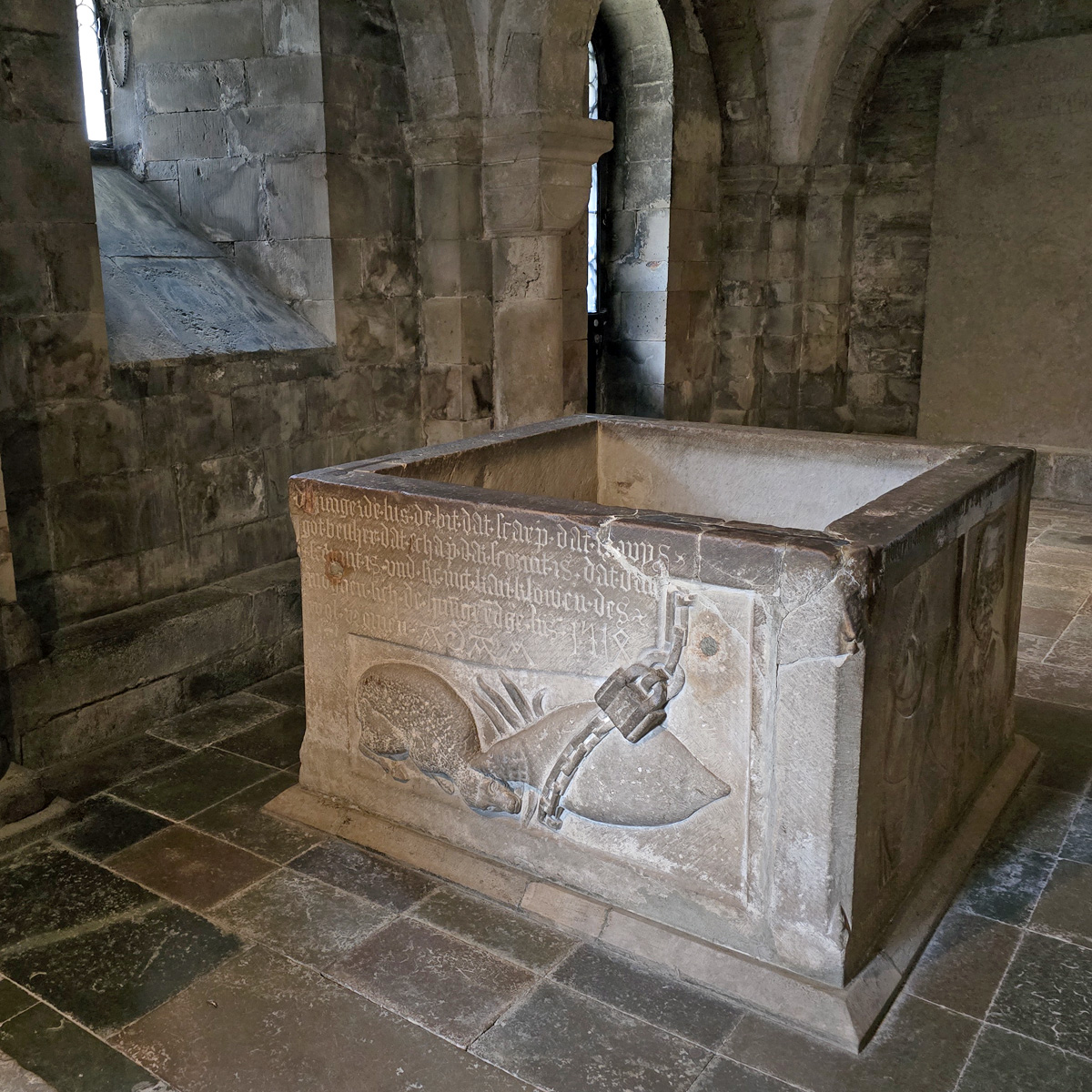 The well in the crypt of Lund Cathedral.
The spring possibly comes from underground streams running from the
Vanninga pond , which remains as a small pond near the place where the All-Saints Monastery was in
the Middle Ages. At that time, the Vanninga pond was much larger than it is today.
The well in the crypt of Lund Cathedral.
The spring possibly comes from underground streams running from the
Vanninga pond , which remains as a small pond near the place where the All-Saints Monastery was in
the Middle Ages. At that time, the Vanninga pond was much larger than it is today.
In connection with the inauguration of the church, three priests were sent from Hamburg to do missionary work in Lund, at the request of the archbishop. An interesting question is which pagan people is being referred to. One interpretation could be that it refers to the people in the old city area, today Uppåkra , that they have been forced to move to the new city, located where Lund is now, and they were forced to be baptized to become Christians. This could explain why an urban area as large as 84 hectares, or more, was laid out from the start. It is about 1.75 times the size of the area in Uppåkra, which was almost 50-hectare. If people were forced to move to what is Lund now, there was a need for a large area from the beginning, but it will probably never be possible to prove whether that was what happened.
Princess Helga from Kyjiv
An excerpt from the Chronicle, which was published in 2023, reveals completely new and sensational information about a previously completely unknown princess from Kyjiv in today's Ukraine, who came to Lund and then ruled the city for 27 years.
Prince Waldemar of Kyjiv ask Harald Bluetooth for help
The Chronicle tells that Harald Bluetooth was visited by Prince Waldemar from Kyiv sometime in early spring 977. He was the son of the former ruler, Sviatoslav I of Kyjiv, who died in 972. Their kingdom stretched from eastern Poland, Belarus, and Ukraine to southwestern Russia. After the death of Sviatoslav I, the eldest brother, Yaropolk I of Kyiv, fought against his second eldest brother Oleg, who died in 977.
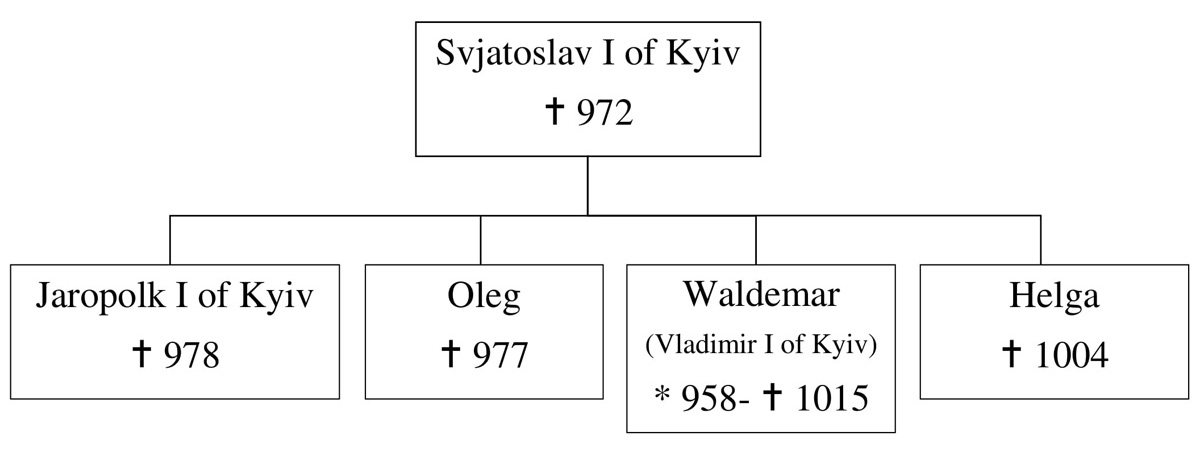 Family tree of the persons from Kyjiv mentioned in this section.
Waldemar fled from today Novgorod to Harold Bluetooth, asking for help with ships and warriors so he could regain his lost kingdom. Harald Bluetooth was kind to Waldemar but said that he could not help him as he was preparing another military campaign. Harald Bluetooth suggested that Waldemar should seek help from Hakon Jarl in Norway and promised that all Hakon Jarl's and Waldemar's ships would be allowed to pass through the strait, if they kept a proper distance from land.
Princess Helga's marriage to Toke Gormsson
 An illustration of Princess Helga from Kyiv, as AI suggests that she could have looked like.
Harald Bluetooth did not offer Prince Waldemar help with ships and warriors, but in order to
allow Hakon Jarl's and Waldemar's ships to pass through the strait, he demanded that
Waldemar's sister, Princess Helga, described as a woman of rare beauty, should marry Toke
Gormsson, Harald Bluetooth's younger brother and tributary king in Scania, to determine their
agreement. Helga was a Christian, unlike Waldemar who became Christian later. Instead of
obeying her brother's request to marry Toke Gormsson, she put a knife to her chest and said
that she would rather end her life than become the mistress of a man who was not a Christian.
When she heard that Toke Gormsson was a Christian, she changed her mind. Perhaps so she not
have to go with Waldemar to Hakon Jarl and risk being given in married to someone who was not
a Christian. In 977, Toke Gormsson married Princess Helga of Kyiv, and according to the
Chronicle, she became the most influential woman and ruled over Lund.
An illustration of Princess Helga from Kyiv, as AI suggests that she could have looked like.
Harald Bluetooth did not offer Prince Waldemar help with ships and warriors, but in order to
allow Hakon Jarl's and Waldemar's ships to pass through the strait, he demanded that
Waldemar's sister, Princess Helga, described as a woman of rare beauty, should marry Toke
Gormsson, Harald Bluetooth's younger brother and tributary king in Scania, to determine their
agreement. Helga was a Christian, unlike Waldemar who became Christian later. Instead of
obeying her brother's request to marry Toke Gormsson, she put a knife to her chest and said
that she would rather end her life than become the mistress of a man who was not a Christian.
When she heard that Toke Gormsson was a Christian, she changed her mind. Perhaps so she not
have to go with Waldemar to Hakon Jarl and risk being given in married to someone who was not
a Christian. In 977, Toke Gormsson married Princess Helga of Kyiv, and according to the
Chronicle, she became the most influential woman and ruled over Lund.
An interesting question is why Harald Bluetooth so kindly allowed Waldemar to seek help from Hakon Jarl, considering the enmity that had prevailed between them since the war against the German emperor in 974. The military campaign Harald Bluetooth was preparing was probably to try to retake Norway, and this would be facilitated if Hakon Jarl had sent ships and soldiers away. Apparently, Waldemar was helped by Hakon Jarl, because his eldest brother Yaropolk I Kyjiv died in 978 and Waldemar became Vladimir I of Kyjiv.
A relic of St. Clement to St. Clement's Church in Lund
Princess Helga from Kyjiv brought St. Clement's lower jaw with her as a relic, and she donated it to St. Clement's Church, which Goldenharald had built in Lund during the time he was Harald Bluetooth's tributary king in Scania. The relic came from the ancient city of Chersonesos , which was in the northern part of what is now the city of Sevastopol in Crimea. St. Clemens, or Clement Romanus as he was named, became the third pope, after Peter, as Clement I around year 91. Emperor Trajan banished him to Chersonesus where he was put to work in a quarry. After converting his fellow prisoners and many others to Christianity, he was punished by get drowned in the Black Sea by being thrown from a boat chained to an anchor. This means that St. Clement is seen as the patron saint of seafarers and stonemasons.
Harald Bluetooth heard about St. Clement already as young and saw him as the protector of skilled warriors and sailors. Harald Bluetooth wanted his soldiers to receive St. Clement's blessing and protection. Therefore, he ordered that a church dedicated to St. Clement should be built at each of the fortresses, usually called trelleborg. The relic, which probably consisted of the teeth, divided into twelve parts, and laid down in the altars of the churches. One of them was laid down in the St. Clement's church here in Lund. Hereby, the Chronicle states that there were twelve fortresses in Denmark around the year 977.
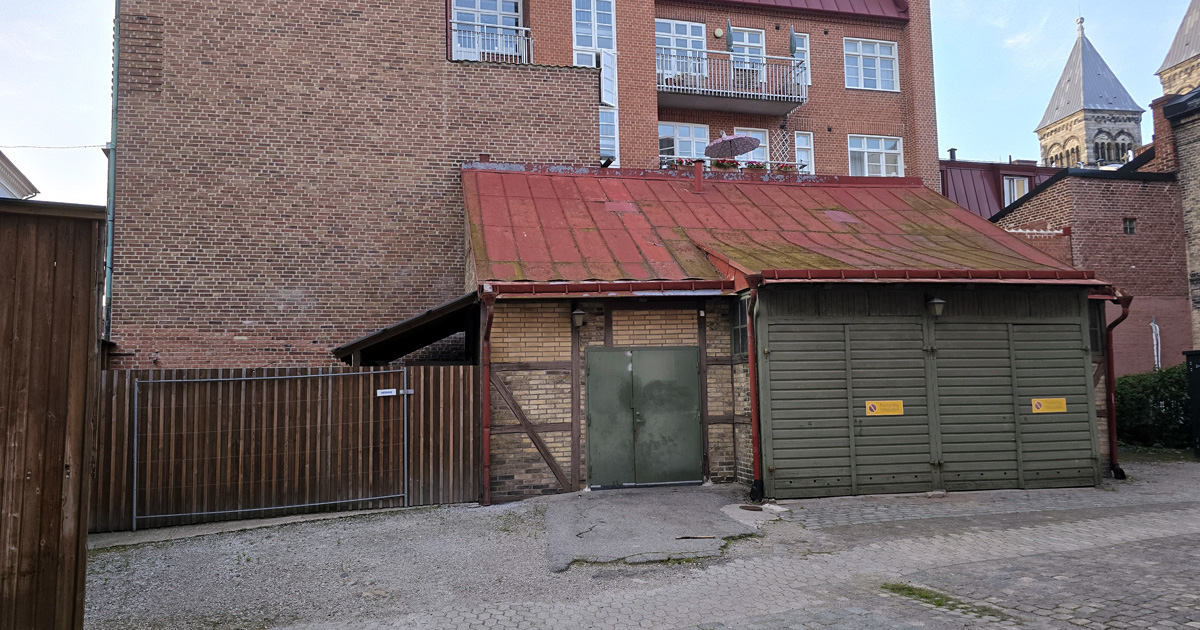 St. Clemens church of wood was located where the outbuilding at Large Greyfriars street (Stora
Gråbrödersgatan), as you can see in the picture, is now.
St. Clemens church of wood was located where the outbuilding at Large Greyfriars street (Stora
Gråbrödersgatan), as you can see in the picture, is now.
The Church of John the Baptist is destroyed and rebuilt
Unrest arose in Lund, that led to the three priests from Hamburg, who had been sent to Lund in connection with the inauguration of Toke Gormssons church in 975, were harassed and murdered by infidel non-Christian persons because of their Christian faith. The church was also destroyed, but Toke punished the rebels and built a new church. It is not stated in the Chronicle when this happened, but it must have been after year 975, when the church was built, but before year 986, when Toke Gormsson died. Probably it was before year 983 when events led to Toke Gormsson being deposed as Harald Bluetooth's tributary king over Scania.
Harald Bluetooth's conflict with Sweyn Forkbeard
The years preceding Harald Bluetooth's death were a troubled time with several events that later had consequences for Lund.
The large Slavic revolt in Germany
The German emperor Otto II lost a major battle against Muslims in Sicily in 982, and he fled to Rome. The following year, a major revolt broke out among Slavic people against several German bishoprics. At the same time, Harald Bluetooth attacked the fortifications of Duke Bernhard and the local Count Dietrich because they had violated the peace agreement that was made between Otto II and Harald Bluetooth after the disturbance in 973. Harald Bluetooth did not support the attacks on the German bishoprics. Bishop Wago, therefore, fled from Oldenburg to the Danes for protection, because they held on to Christianity.
Harald Bluetooth's combat against Sweyn Forkbeard in Roskilde
Harald Bluetooth's stepson Sweyn Forkbeard had allied himself with Mistovoy, Duke of the Obodrites in Germany, and together they attacked and plundered Hamburg. However, Sweyn Forkbeard did not want to clash with Harald Bluetooth, so he fled to Tukki Normandy who was married to Sweyn Forkbeard's aunt. From there, Sweyn Forkbeard made two war expeditions to Hedeby together with Erik, who was a cousin on his mother's side. He also began to conspire against Harald Bluetooth. Sweyn Forkbeard believed that, as the son of Harald Bluetooth's elder brother Canute, who died two years before his father Gorm, he had a legitimate right to the throne. When Harald Bluetooth heard about it, he wanted the council of elders to judge between him and his stepson Sweyn Forkbeard.
Harald Bluetooth had no intention of abandoning the throne and did everything he could to avoid meeting Sweyn Forkbeard in an armed conflict, but in 983 their forces clashed outside Roskilde. The battle was soon interrupted, but Sweyn Forkbeard challenged his stepfather Harald Bluetooth to a duel that ended with Harald Bluetooth knocking the sword out of Sweyn Forkbeard's hand and then throwing him to the ground. Then he asked the soldiers from Scania if anyone else dared to take a duel against him, but no one wanted to try. Toke Gormsson swore allegiance to Harald Bluetooth for the second time, saying that it had only been Sweyn Forkbeard who had caused confusion.
Harald Bluetooth is injured by a misdirected arrow
Ulf, who had served for the Jomsvikings for a long time and was the son of a magnate named Glibir in Scania, wanted to revenge on the injustices he had been subjected to by one of Harald Bluetooth's allies. Incited by Toke Gormsson, he lay down in an ambush with the intention of taking revenge on his opponent, but instead his arrow happened to hit Harald Bluetooth at the knee on the back of his thigh. It caused a heavy bleeding that almost killed Harald Bluetooth. The priest Poppon managed to stop the bleeding by burning the wound with glowing coals that he had learned from monks with medical training. Soon Harald Bluetooth regained his strength and Ulf asked for a quick and merciful death for injuring the king, but Harald Bluetooth instead handed him over to serve for Sweyn Forkbeard.
The combat for power over Scania
Toke is replaced by Björn Jarl as tributary king of Scania
The coincidences in Roskilde caused Toke Gormsson to fall out of favor with Harald Bluetooth. He was therefore replaced by Björn Jarl as tributary king in the western part of Scania. As described in the Chronicle, Björn Jarl was allowed to return as a palatine, a kind of royal official, in 976, twelve years after he was banished by Goldenharald in 964. After Toke was disposed, he spent his time in exile in Borgeby near Löddeköpinge where he had a fortress of the type usually called trelleborg. The fortress was located northwest of Luntarumn, which refers to Lund, where Toke's ship guarded the entrance to the marketplace called Luntertumn, which probably refers to Lomma, which served as Lund's harbor. At the same time, Harald Bluetooth handed over the regency of Denmark, Jutland and Zealand to Sibir Fultarsson, who was married to Harald Bluetooth's daughter Estrid.
Toke Gormsson is reinstated as tributary king of Scania
Toke Gormsson's son Asbjörn went to Sibir Fultarsson on Zealand, probably at Roskilde, in 984 and pleaded for his father to be allowed to return as tributary king of Scania and rule from Lund, where he had built several churches. It is not clear which other churches Toke Gormsson would have built in Lund. The only one that has been mentioned is the one built for John the Baptist and that church was rebuilt after it was destroyed. Sibir Fultarsson accepted Asbjörn's appeal and released many men from Scania from their service so that they could return and support Toke Gormsson. At the same time, there was disturbances because Björn Jarl, who surrounded himself with men from England, robbed and plundered instead of building fortifications at Halör as Harald Bluetooth had ordered.
Toke Gormsson defeats Björn Jarl
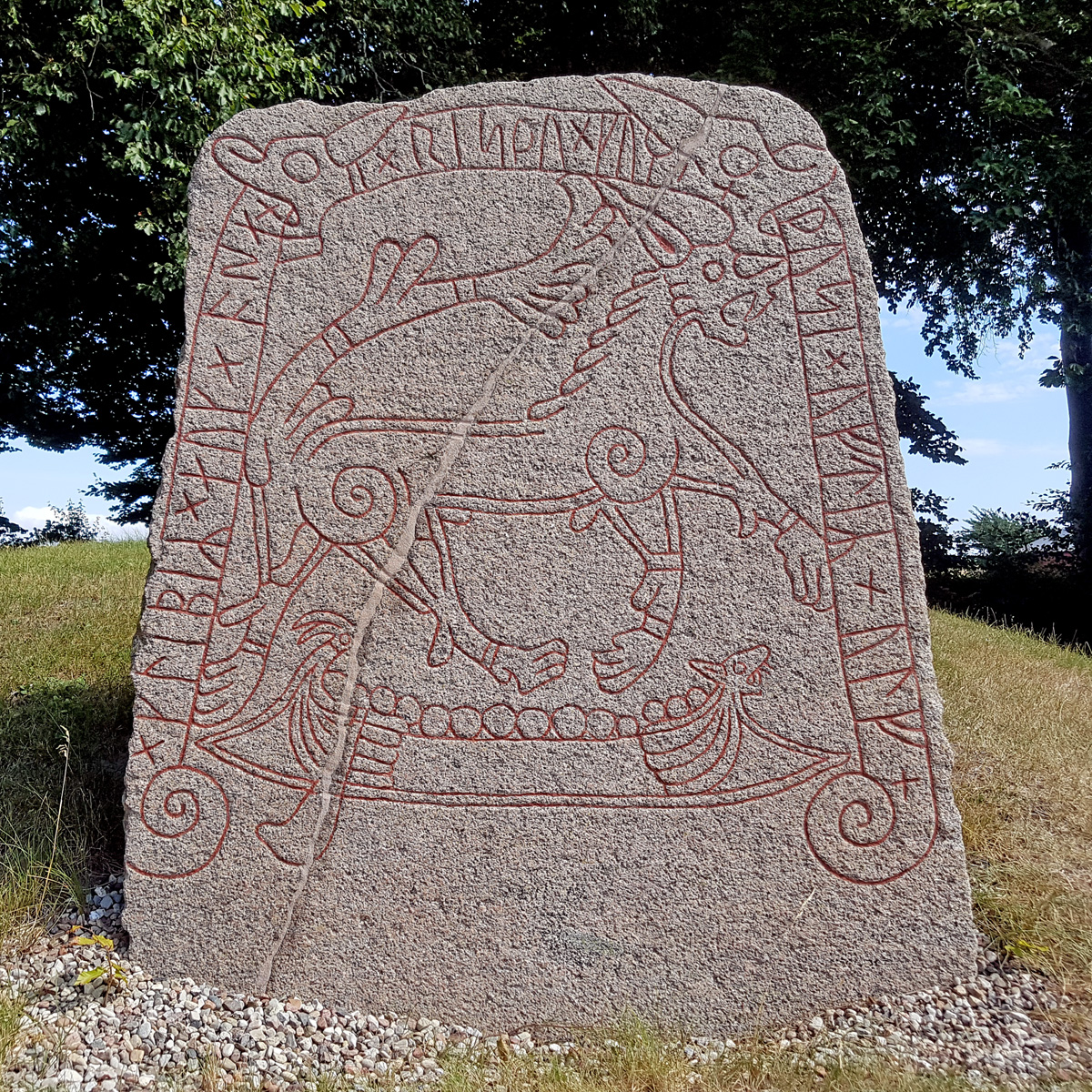 The runestone in Tullstorp where Ulf is mentioned
When Björn Jarl heard that Toke Gormsson was reinstated as tributary king of Scania, and the
many men he had with him on his way to Lund, Björn Jarl withdrew with his men to Halör to meet
Toke Gormsson's forces there. At the same time, he sent a message to Sibir Fultarsson with the
hope of getting a peace negotiation, but Toke Gormsson did not plan for any negotiations.
Instead, Toke Gormsson and his forces went straight to attack when they arrived in Halör. It
was a battle in which Toke Gormsson was victorious, but lost many men, including Ulf, who shot
the misguided arrow that wounded Harald Bluetooth in 983. Ulf is mentioned on the runestone
called the Tullstorp stone , which was raised by Glibir and Åsa, who were
probably his parents. Another of Toke's men was Tumar who is mentioned on a runestone standing
in the cemetery at Baldringe church .
The runestone in Tullstorp where Ulf is mentioned
When Björn Jarl heard that Toke Gormsson was reinstated as tributary king of Scania, and the
many men he had with him on his way to Lund, Björn Jarl withdrew with his men to Halör to meet
Toke Gormsson's forces there. At the same time, he sent a message to Sibir Fultarsson with the
hope of getting a peace negotiation, but Toke Gormsson did not plan for any negotiations.
Instead, Toke Gormsson and his forces went straight to attack when they arrived in Halör. It
was a battle in which Toke Gormsson was victorious, but lost many men, including Ulf, who shot
the misguided arrow that wounded Harald Bluetooth in 983. Ulf is mentioned on the runestone
called the Tullstorp stone , which was raised by Glibir and Åsa, who were
probably his parents. Another of Toke's men was Tumar who is mentioned on a runestone standing
in the cemetery at Baldringe church .
Björn Jarl did not surrender, but when he was left alone on the battlefield surrounded by Toke Gormsson's men, he threw himself on his sword. He was given a Christian funeral in Lund so that the people would not be offended, but it is not clear where in Lund he was buried. The churches from that time that are known are St. Clement's Church, which was built by Harald Bluetooth's nephew Goldenharald, and John the Baptist's Church, which Toke Gormsson had built. A started but not completed fortress (trelleborg) has been found at Halör, at what today is called Little Hammar's isthmus (Lilla Hammars näs) at Höllviken. It was probably there that the battle between Toke Gormsson's and Björn Jarl's forces took place.
Björn Jarl's family is exterminated
After defeating Björn Jarl and his forces, Toke Gormsson ordered that all male descendants of Björn Jarl should be executed or castrated so that no one from his family could claim power over Scania again. Not even the two young brothers Olof and Ottar were spared, even though they had never posed any threat to Toke Gormsson. The two brothers are mentioned on the tall runestone Lundagårdsstenen, which stands in the entrance hall to the University library in Lund. The only one who was spared was their half-brother Torgis who was only eight years old. He was the son of Björn Jarl's son Esge and his mother was the daughter of a brother of the ruler of that today is Poland, called Mieszko. Both Esge and Björn Jarl are also mentioned on Lundagårdsstenen, which was later raised by Torgis. Torgis was sent to Sibir Fultarsson to be taught and to learn to respect his benefactors.
Thus, Toke Gormsson had eliminated anyone who could compete with him about the power over Scania. These events had consequences for Lund a few years later.
Denmark's new king
The death of Harald Bluetooth
Bishop Wago, who had fled the Slavic rebellion to the Danes in 983, accompanied Harald Bluetooth when he travelled to Quedlinburg to meet Prince Henric sometime at Easter in 984. The Chronicle's narrator Avico, who served as Bishop Wago's chaplain, was on the trip. Because Harald Bluetooth fell ill on the way, they had to stay in Jomsborg. While they were there, a church was built on Harald Bluetooth's orders in what is now Wiejkowo . Since Bishop Wago was also ill, he handed over responsibility for the bishopric to Avico, who therefore was the one who inaugurated the church. In the spring of 985, Bishop Wago died and was buried in that church. In the autumn of 985, Harald Bluetooth died, one year and seven months after arriving in Jomsborg. He was buried next to Bishop Wago in the same church.
Toke Gormsson is elected as new king of Denmark
King Erik Segersäll in Uppsala, who was a cousin of Toke Gormsson, banished his dead brother Olof's son Styrbjörn to Jomsborg, already from a young age. According to a previous agreement, Erik Segersäll was to hand over power to Styrbjörn when he became an adult. Erik Segersäll was still not a Christian at this time, but the exile meant that Styrbjörn was brought up according to Christian custom. When Styrbjörn turned 15 years old, he was forbidden to return to Uppsala. Therefore, he took many Jomsvikings with him, went to Toke Gormsson in his fortress in Borgeby near Löddeköpinge, and asked for help to regain power from his uncle Erik. Toke Gormsson was not compliant but changed his mind when he received the news of Harald Bluetooth's death.
Toke Gormsson went to Roskilde where he demanded the right to the throne after Harald Bluetooth by virtue of being the only remaining descendant of their father Gorm, and he was appointed new king for the Danes. At the same time, he sent a message to Mieszko, who was ruler of what today is Poland, to form a pact with him and ask for the daughter's hand. However, she later married Sweyn Forkbeard instead. Then they went to Uppsala, Toke Gormsson's forces from Scania, Sibir Fultarsson's forces from Zealand and Styrbjörn's forces from Jomsborg. The goal was to reinstate Styrbjörn as tributary king of the Swedish kingdom and make Toke Gormsson king of both Danes and Swedes.
Sweyn Forkbeard is elected new king and enters a pact with Erik Segersäll
While Toke Gormsson was on his way to Uppsala, Sweyn Forkbeard gathered support in Roskilde, claiming he was the rightful heir to the throne, and was elected as the new king. At the same time, he sent a message to Uppsala and secretly made a pact with Erik Segersäll against Toke Gormsson. In Uppsala, it was decided in negotiations that the dispute between Erik and his nephew Styrbjörn should be settled through a duel between the best men from each side in a place where pagan rituals had been held for centuries. Before the duel began, both Erik and the Christian Styrbjörn made a sacrifice in honor of the pagan gods. The duel ended in defeat for Styrbjörn, who then took a spear and threw it at Erik, whereupon Erik's men killed him. The Jomsvikings were arrested and handcuffed.
Erik Segersäll played a double game with Toke Gormsson by offering him mead and pretend to subordinate as Earl of the Swedes. At the same time, Erik collaborated with Sweyn Forkbeard's messenger, who persuaded Sibir Fultarsson to return home with his forces to Zealand, and the Jomsvikings were released. The next morning, Sibir Fultarsson and his forces from Zealand and the Jomsvikings had left. Many of Toke Gormsson's men from Scania also fled to save their own lives from Erik's overwhelming forces. On Sibir Fultarsson's order, Toke Gormsson's remaining ships had been burned.
The Battle of Fyrsivallarna where Toke Gormsson died
Then Toke Gormsson and those who were left of his forces were attacked. It was an uneven battle against Erik Segersäll's overwhelming forces, in what has come to be known as the Battle of Fyrisvallarna, where Toke Gormsson was killed on August 10, 986. Some of Toke Gormsson's men survived the battle and returned to Scania where they raised runestones for Toke Gormsson. These are now walled into the outer wall of the choir at Hällestad church. On the runestone that is usually called Hällestadssten 1 it says
"Eskil set this stone after Toke, Gorm's son, his faithful master. He did not flee at Uppsala. Fighters raised the stone on the mountain after his brother it stands fast with runes. They went closest to Gorm's son Toke."
Thanks to the information in the Chronicle, it has now been explained what "did not flee at Uppsala" refers to.
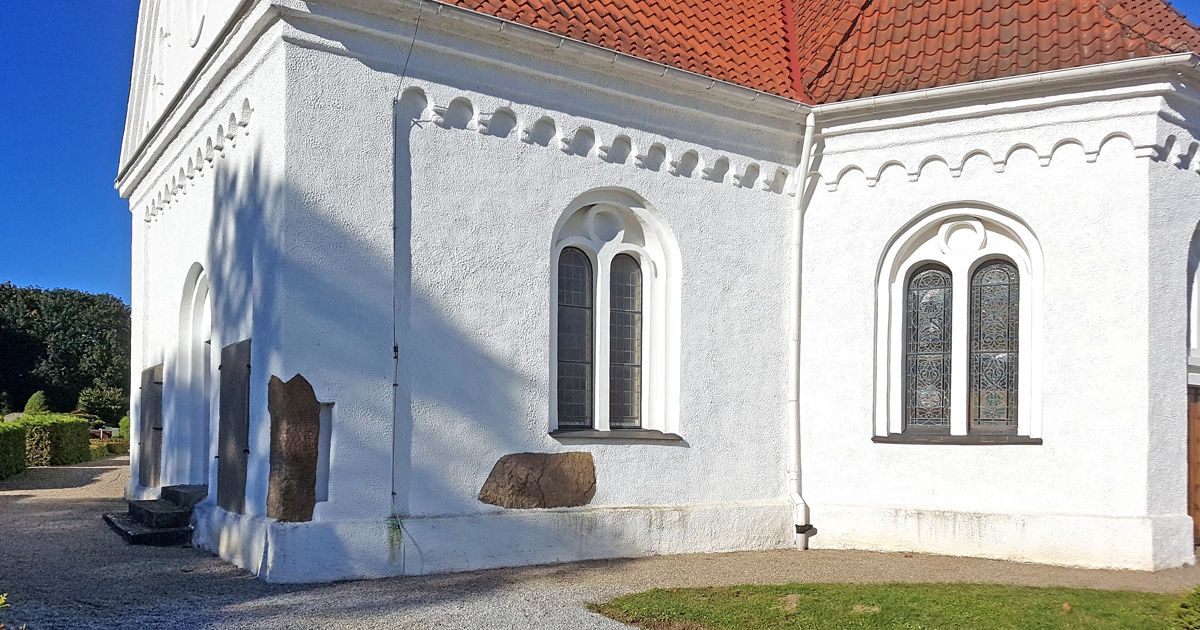 The choir of Hällestad's church with two of the three runestones about Toke Gormsson.
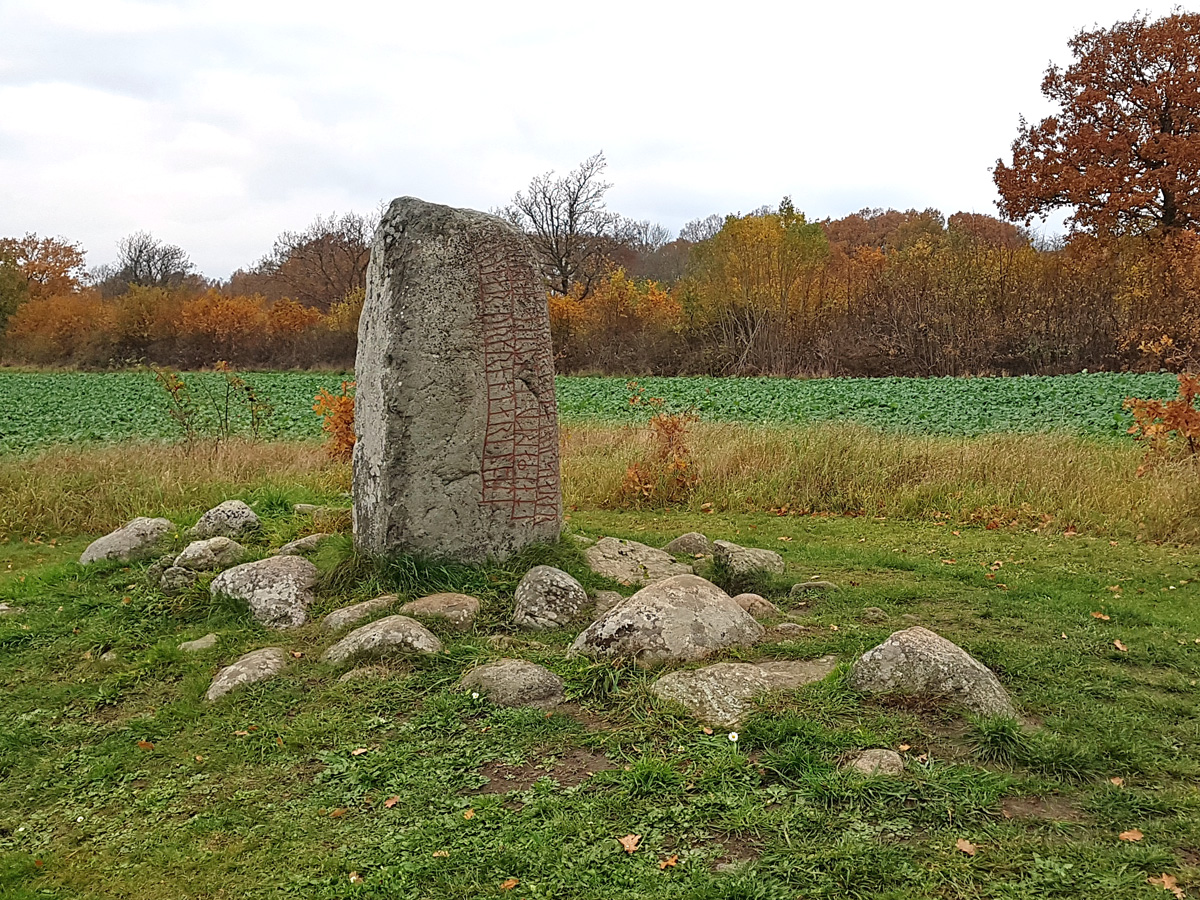 The Karlevi runestone on Öland.
On the way home, a conflict arose between the forces that had left Uppsala, and in that
fighting Sibir Fultarsson died. His men buried him on the coast of Öland and raised a
runestone, which is called the Karlevi stone . A drawing from the 1600s shows that the stone stood
together with two burial mounds, but these disappeared when the land has been cultivated.
The Karlevi runestone on Öland.
On the way home, a conflict arose between the forces that had left Uppsala, and in that
fighting Sibir Fultarsson died. His men buried him on the coast of Öland and raised a
runestone, which is called the Karlevi stone . A drawing from the 1600s shows that the stone stood
together with two burial mounds, but these disappeared when the land has been cultivated.
Now, both Harald Bluetooth and Toke Gormsson were dead, Sweyn Forkbeard was now the king of Denmark and Helga of Kyjiv ruled in Lund.
Lund as seat of King Sweyn Forkbeard
The Fortress (trelleborgen) in Lund is demolished and Lund's urban area is constructed
After Toke Gormsson was killed in Uppsala, Princess Helga ordered that the fortresses and defensive walls in Lund should be torn down.
After Tuca's death, Princess Helga ordered the destruction of the fortresses and defensive walls and that the construction of the houses, roads, gates and square should be built as in her beloved city in Greece, where she spent many years as a child. Only the moat remained of the fortress, and the community no longer resembled any other communities in the land of the Danes.
It is unclear what more fortresses there may have been than the fortress (trelleborg) in Lund, but it means that the fortress was demolished in 987 at the latest. The only thing left was the moat that remained for the time being. Helga also ordered that the houses, roads, gates and square should be built like those in the beloved city in Greece where she had spent many years as a child. Which Greek city it was, however, is not stated.
This suggests that it was then that the city plan for Lund was laid out with blocks, streets and yards and the square in the city center. It has been known for a long time that the entire urban area in Lund was laid out at once, because ditches about one decimeter deep have been found in many different places, which were dug as plot boundaries, but when this was done has been unknown before. This means that the Main Square (Stortorget) and most of the street network in Lund's city center are around 1,040 years old and that the Main Square is Sweden's oldest square.
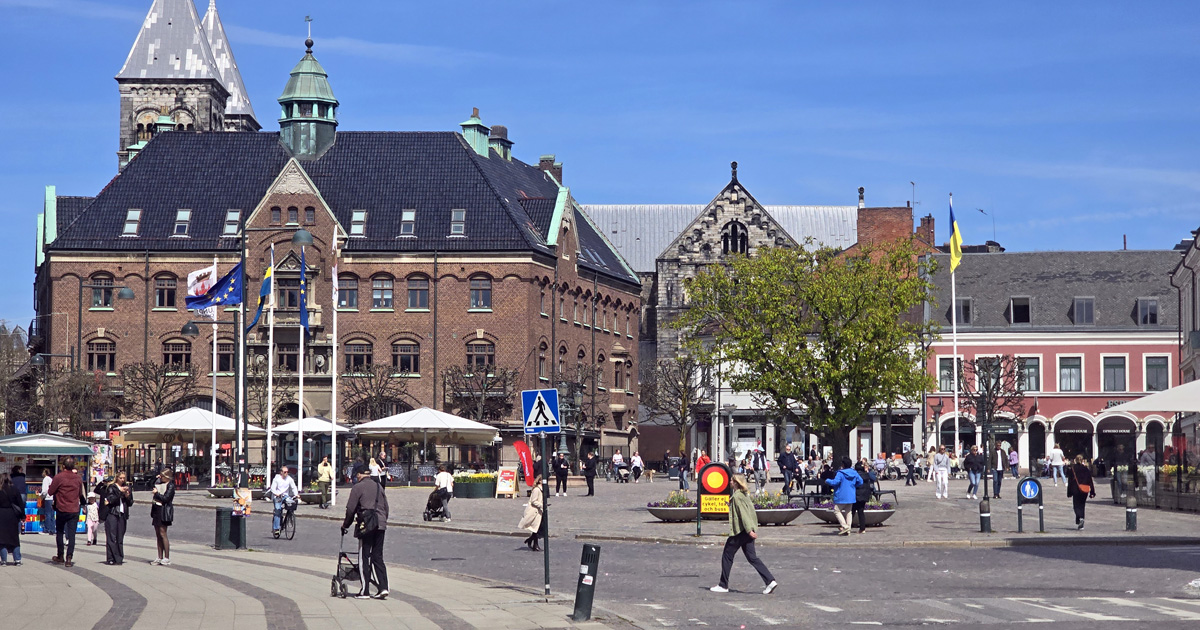 The Main Square (Stortorget) in Lund was built around the year 987 in connection with the
construction of the urban area ordered by Princess Helga and is therefore Sweden's oldest
square.
The Main Square (Stortorget) in Lund was built around the year 987 in connection with the
construction of the urban area ordered by Princess Helga and is therefore Sweden's oldest
square.
According to the Chronicle, Helga's palace, some kind of royal estate, was fenced in with a palisade. In the quote above, gates are mentioned without any further information about them. When the city wall was built around the entire city area of Lund in the 1130s, four gates were built; to the north, west, south and east, but the fact that the Chronicle mentions gates suggests that there may have been some kind of equivalent to the city wall at least 150 years earlier. Perhaps what was left of the old facility was then demolished when the city wall was built in the 1130s.
Lund as Denmark's Christian center and the seat of the king
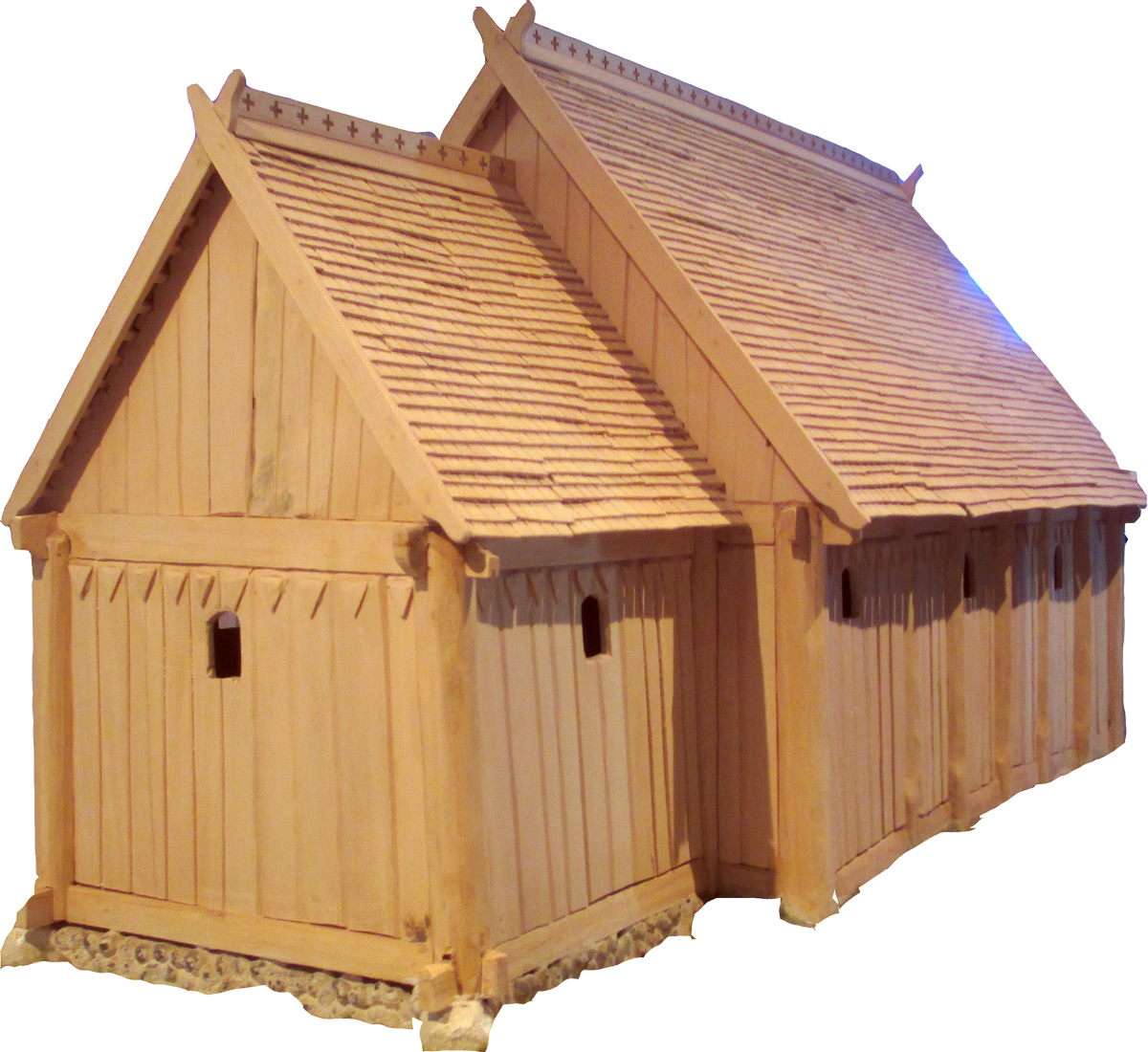 A model showing what the Trinity Church may have looked like.
According to the Chronicle, Helga persuaded Sweyn Forkbeard as king of Denmark, to make Lund
his seat and Christian capital of Denmark. Capital should probably be seen more as a Christian
center than a capital in the modern sense. It is not clear when this happened, but since the
Swedish king Erik Segersäll sent his son Olof away in 987 to be brought up by Olof's
cousin Sweyn Forkbeard in Lund, Lund must already have been Sweyn Forkbeard's seat at that
time. Sweyn Forkbeard also built a church dedicated to Trinity. That church was found in
archaeological investigations in 1982-1984 at Kattesund and has been dated to around the year
990. From the information in the Chronicle, that church may have been built even a few years
earlier.
A model showing what the Trinity Church may have looked like.
According to the Chronicle, Helga persuaded Sweyn Forkbeard as king of Denmark, to make Lund
his seat and Christian capital of Denmark. Capital should probably be seen more as a Christian
center than a capital in the modern sense. It is not clear when this happened, but since the
Swedish king Erik Segersäll sent his son Olof away in 987 to be brought up by Olof's
cousin Sweyn Forkbeard in Lund, Lund must already have been Sweyn Forkbeard's seat at that
time. Sweyn Forkbeard also built a church dedicated to Trinity. That church was found in
archaeological investigations in 1982-1984 at Kattesund and has been dated to around the year
990. From the information in the Chronicle, that church may have been built even a few years
earlier.
When Richard I of Normandy in 987 asked for help with ships and warriors, the Swedish king Erik Segersäll sent his son Olof with forces from Sigtuna to join Sweyn Forkbeard's forces. It may be the oldest mention of Sigtuna that is known. Olof was only 11 years old and was therefore not allowed to go to Normandy, but Erik wanted Olof to be brought up by his cousin Sweyn Forkbeard in Lund. Additional forces came from Jomsborg, which was now led by Olav Trygvesson because its former leader Styrbjörn had been killed in Uppsala the year before. When the forces stopped in Hedeby to deliver supplies, they were attacked by rebels. The battle lasted for several days and caused heavy losses before continuing to Normandy.
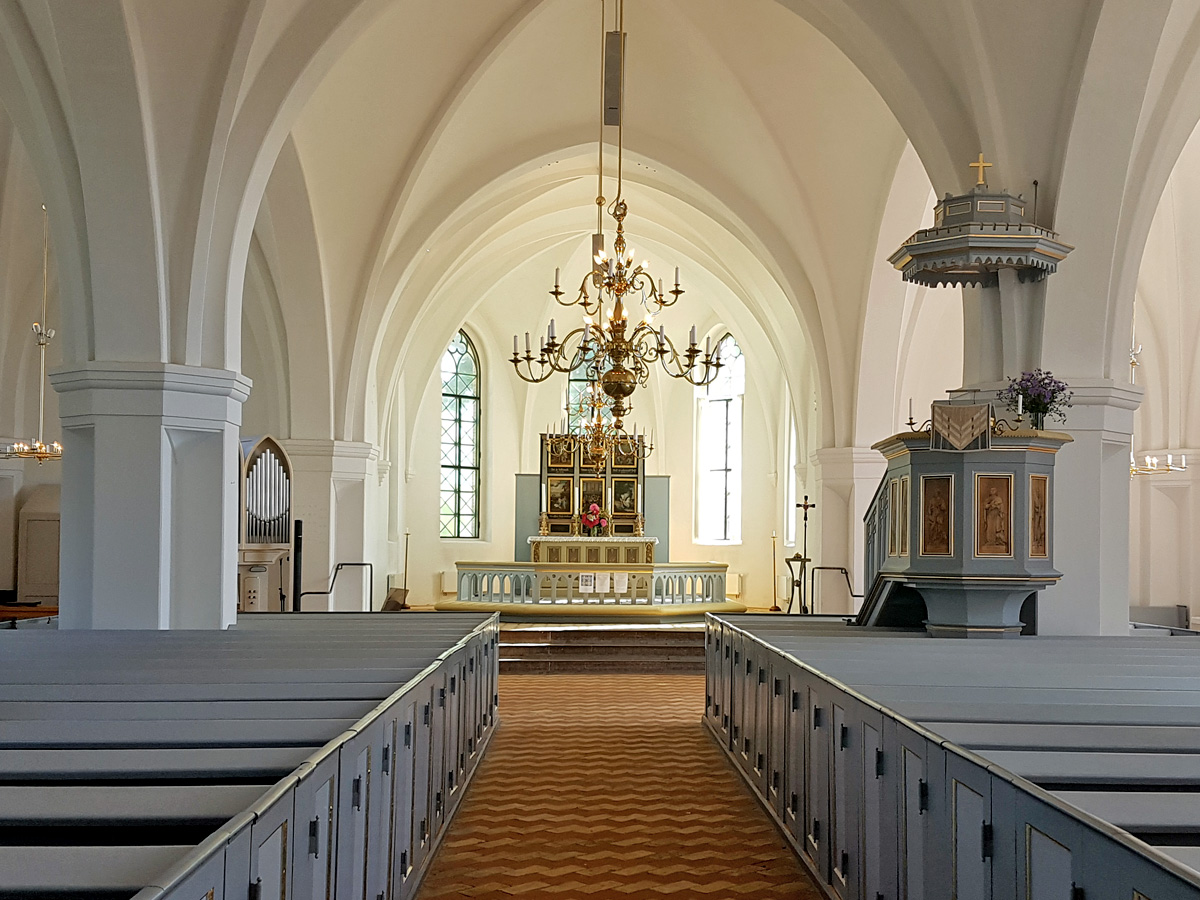 The choir in the present church in Uppåkra.
In connection with events in 989, the Chronicle tells that the very pious Princess Helga
recently ordered the construction of a church in a place called "high fields" to put an end to
the practice of pagan rituals, which were held there in secret during the celebration of John
the Baptist's birthday. The church was probably built in 988. The name "high fields"
refers to the place that is today Uppåkra (which means up on the fields), and this must be the
oldest known mention of the name Uppåkra. In connection with an archaeological investigation
in 1997 under the choir in the current church from 1864, in Uppåkra, remains was found of both
the medieval stone church from the 1100s, and of a grave from an even older church, dated with
carbon 14 to the 10th century. According to the Chronicle, that would have been a grave at the
graveyard belonging to the church Helga had built.
The choir in the present church in Uppåkra.
In connection with events in 989, the Chronicle tells that the very pious Princess Helga
recently ordered the construction of a church in a place called "high fields" to put an end to
the practice of pagan rituals, which were held there in secret during the celebration of John
the Baptist's birthday. The church was probably built in 988. The name "high fields"
refers to the place that is today Uppåkra (which means up on the fields), and this must be the
oldest known mention of the name Uppåkra. In connection with an archaeological investigation
in 1997 under the choir in the current church from 1864, in Uppåkra, remains was found of both
the medieval stone church from the 1100s, and of a grave from an even older church, dated with
carbon 14 to the 10th century. According to the Chronicle, that would have been a grave at the
graveyard belonging to the church Helga had built.
New rulers of Scania
Returnees from Constantinople in the Eastern Roman Empire
In 989, the two brothers Kunar Handrian and Toma, their sons and their men returned to Scania with great wealth after serving in the Eastern Roman emperor's Varangian guard for 20 years. A guard consisting of vikings from the Nordic countries in what was then Greek Constantinople, today's Istanbul. They were descendants of an unknown brother of Björn Jarl, and the family tree below shows the most important persons mentioned in this section to make it easier to follow their relationship.
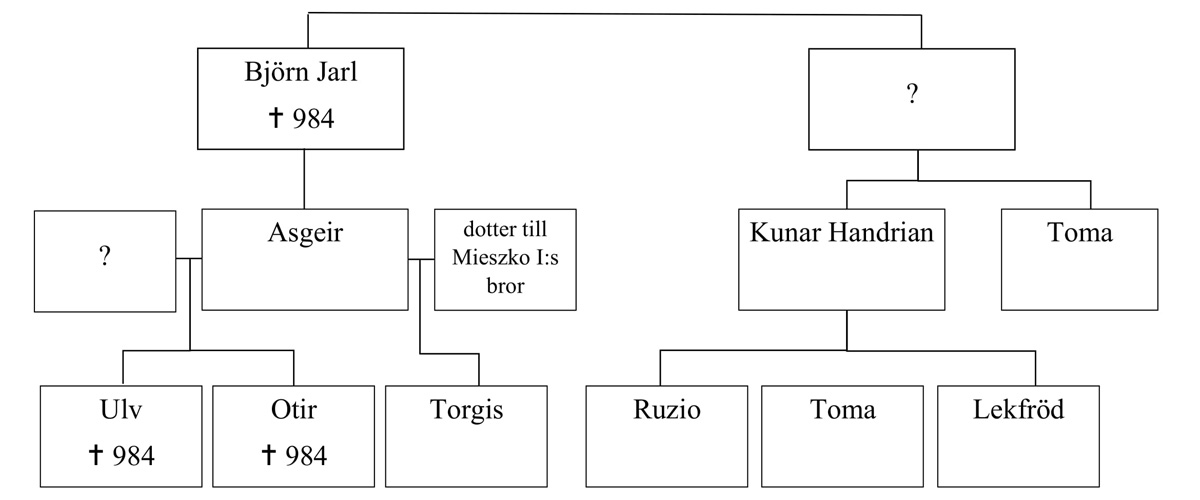 The family tree of Björn Jarl, his unknown brother and their descendants mentioned in this
section.
The family tree of Björn Jarl, his unknown brother and their descendants mentioned in this
section.
After they disembarked at a place called "Scartehaun", which could be Skarviken west of today's Ystad, they discovered that their families' property had been taken over by strangers after battles, in which their uncle Björn Jarl and most of their families had been killed by Toke Gormsson's forces in 984. They were treated hostilely and escaped barely, so they went back to their ships and continued east along the coast, disembarking in a small fishing village. They named that fishing village Symitharos, probably located at the mouth of Tommarp's stream in what today is Simrishamn. The name was chosen in honor of the brave inhabitants who received them and the companions they brought with them from the Greek island of Symi, on the southwest coast of today's Turkey.
They allied with the inhabitants, who were dissatisfied with the fact that the magnates from Zealand did not respect the previous agreement that divided Scania into two parts. This settlement was probably made in connection with Harald Bluetooth's nephew Goldenharald banished Björn Jarl from the western parts of Scania in 964. Together with the inhabitants, the brothers went on attack to regain their lost land. Those who survived the attack fled to Lund where they presented their grievances to Princess Helga.
Soon three more brothers to Kunar and Toma returned from what was then Greece, and they brought with them many men. When they heard about their uncle's death and that his family had been killed by Toke Gormsson in 984, they were seized with anger. Under the leadership of Kunar, they began to march towards Lund to bring justice and punish those responsible for the deeds. Kunar was chosen as leader because he was the eldest of the brothers and the one with the most fame. He had been the most faithful servant of the ruler Johannes of Constantinople, defeating the Muslims in many battles and conquered ten cities.
Negotiations at Arendala court site
When Kunar's forces reached Lund, they set up camp at the place south of Lund, which was called "high fields", today's Uppåkra. When Helga heard that Kunar and his forces had arrived, she ordered the priests to go in procession to the court site east of Lund with their altar relics in front of them. At the same time, she sent word to Kunar that he should also go to the court site. Helga herself walked barefoot, as a Christian sign of subservience, holding a cross with an anchor in front of her as a symbol of St. Clement. This was to ask God to inspire Kunar not to spill Christian blood by taking to battle, but instead to negotiate. Kunar's forces came in the company of Torgis, who was the grandson of their deceased uncle Björn Jarl. The court site east of Lund must have been Arendala court site , although the Chronicle does not mention the name Arendala, but tell that the court site was three Roman miles east of Lund, which corresponds to about 4.5 kilometers. Arendala court site was probably at the top of the hill east of Lund and this must be the oldest known mention of it, but how early the place began to be used as court site is not clear.
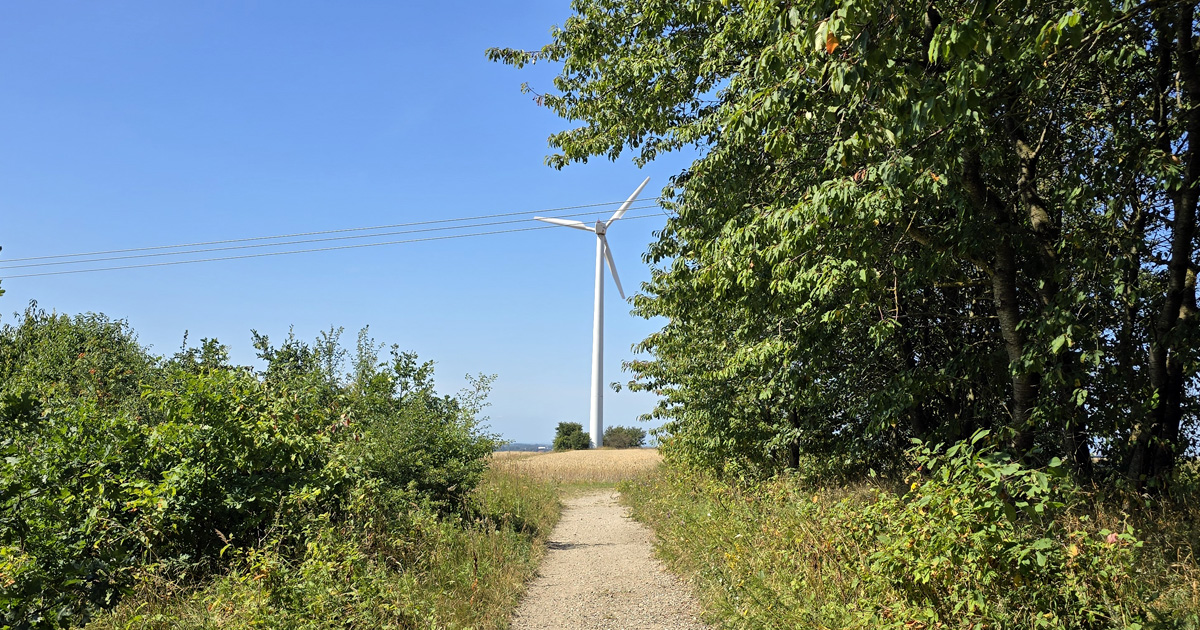 The pathway from Hardeberga church to the hill where Arendala court site probably was.
Kunar and his brother preferred to negotiate rather than fight. Torgis agreed with them and said that Helga was willing to make concessions, so no Christian blood had to be spilled. Kunar's sons Toma and Ruizo, on the other hand, tried to persuade their brothers, cousins and the other men to rebel and battle against the Danes from Jutland and Zealand. They wanted Scania to be ruled by its own king again, as it was when Björn Jarl was Scania's king until the year 964, but their attempts at persuasion failed.
God's anger intervenes in the negotiations
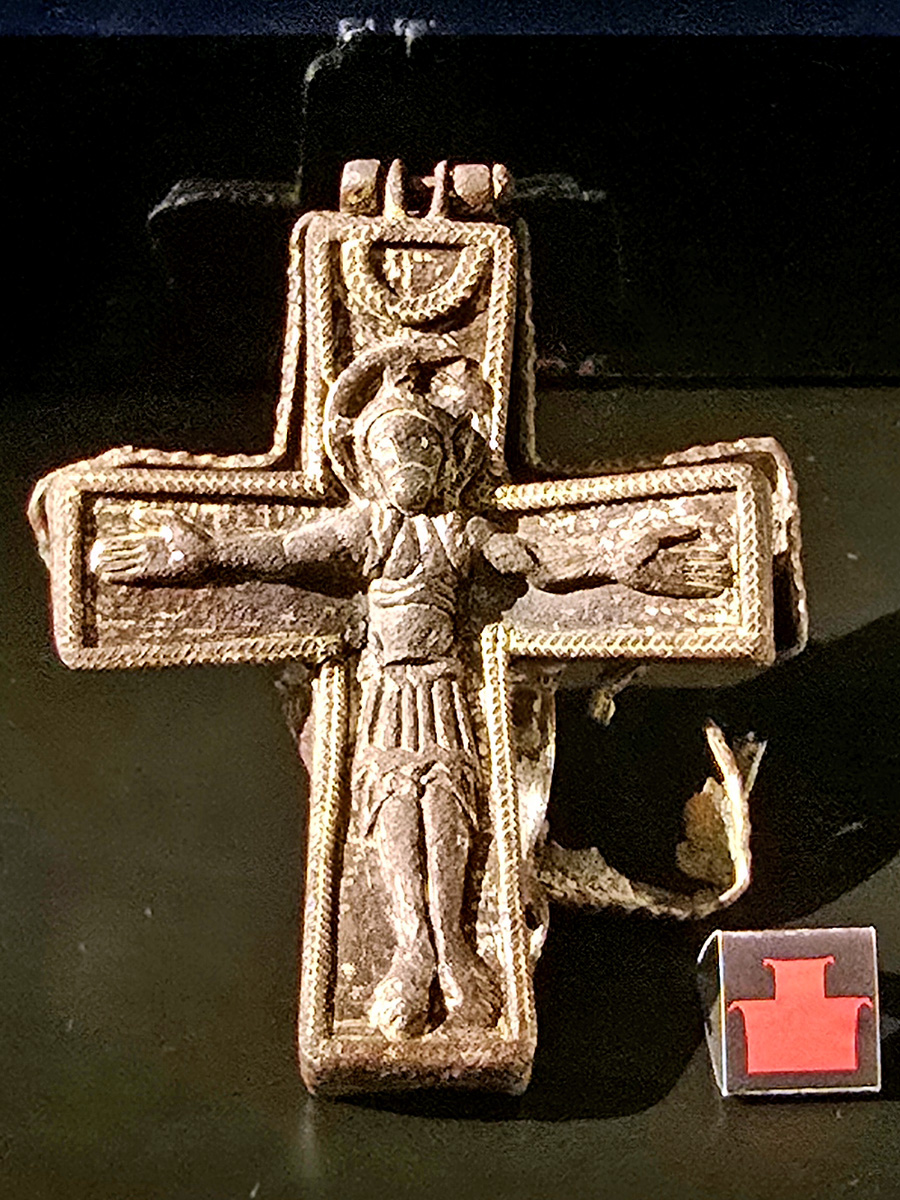 An encolpion (a small shrine for relics worn like an amulet) which has been found in Uppåkra
in 1997. It could be the enkolpion that Toma lost there in 989.
During the evening or night, Kunar's son Toma had fallen asleep, after drinking mead, with his
back turned to the wall of the church that Helga had built in Uppåkra. Suddenly, a flash of
lightning appeared in the sky, followed by a loud roar, and a nearby oak tree caught fire. In
the panic that followed, Toma lost the cross he proudly wore on his chest, a so-called
enkolpion that was designed as a relic shrine. It was a gift he had received from the king of
Constantinople after showing bravery in battle against rebels. Afterwards, he couldn't
understand how it could have disappeared. The people in the camp did not understand what
thunder was, they thought that it was God's anger that had torn the cross from Toma because he
had tried to persuade the others to go to battle. After this, no one dared to fight against
God's will.
An encolpion (a small shrine for relics worn like an amulet) which has been found in Uppåkra
in 1997. It could be the enkolpion that Toma lost there in 989.
During the evening or night, Kunar's son Toma had fallen asleep, after drinking mead, with his
back turned to the wall of the church that Helga had built in Uppåkra. Suddenly, a flash of
lightning appeared in the sky, followed by a loud roar, and a nearby oak tree caught fire. In
the panic that followed, Toma lost the cross he proudly wore on his chest, a so-called
enkolpion that was designed as a relic shrine. It was a gift he had received from the king of
Constantinople after showing bravery in battle against rebels. Afterwards, he couldn't
understand how it could have disappeared. The people in the camp did not understand what
thunder was, they thought that it was God's anger that had torn the cross from Toma because he
had tried to persuade the others to go to battle. After this, no one dared to fight against
God's will.
In connection with archaeological investigations in and around Uppåkra church in 1997, an encolpion (a small shrine for relics worn like an amulet) was found on the northeast side of the cemetery. It could be the encolpion that the Chronicle tells that Toma lost there in 989, but it is not possible to say for sure that it is the same.
Scania is divided and gets new rulers
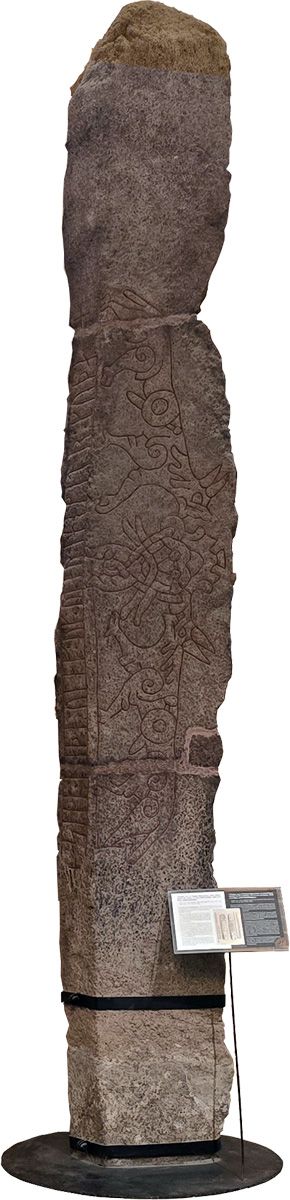 Lundagårdsstenen.
King Erik Segersäll's advisor Tosti, who took care of Erik's son Olof who later became king
Olof Skötkonung, also intervened in the negotiations at Arendala court site. He had gained
celebrity after making many profitable viking raids to England and France when he was younger.
Tosti began to praise king Erik and said that he had been a close friend of Björn Jarl.
Therefore, many of the men belonging to Kunar and Toma's family’s confidence in him and he
made them entrust to king Erik's protection.
Lundagårdsstenen.
King Erik Segersäll's advisor Tosti, who took care of Erik's son Olof who later became king
Olof Skötkonung, also intervened in the negotiations at Arendala court site. He had gained
celebrity after making many profitable viking raids to England and France when he was younger.
Tosti began to praise king Erik and said that he had been a close friend of Björn Jarl.
Therefore, many of the men belonging to Kunar and Toma's family’s confidence in him and he
made them entrust to king Erik's protection.
The negotiations at the court site ended after four days, resulting in Scania being divided into two parts. The eastern part was to be ruled by Kunar's son Toma under the protection of King Erik's son Olof and his advisor Tosti. Toma settled at a place where three main roads met. There he rebuilt a village he called Tomathorp, today's Tommarp. He built another road from the village to the nearby harbor in the east to make it easier to go to Lund.
The central and western part was to be ruled by Björn Jarl's young grandson Torgis, with Lund as seat and capital in Scania. King Sweyn Forkbeard should have sovereignty over all parts of Scania, but the people were to be ruled by Toma and Torgis. To consolidate the agreement, Torgis was to ask for Princess Helga's hand, and she agreed to become his wife.
Sometime later, Torgis raised the high runestone Lundagårdsstenen over his half-brothers Olof and Ottar, who were killed by Toke Gormsson in 984. The runestone stands today in the University Library's entrance hall. After the death of Kunar Handrian's sons, the Hunnestad Monument was raised over them near the small village Hunnestad northwest of Ystad. There is nothing left to see in the original location of Hunnestad Monument . Today, the four runestones that have been found stand in the glazed entrance to the Historical Museum in Lund.