![[Bild]](/common/img/default.png)
Drotten church ruin
Attraction
The Viking age Lund
Lund's Viking Age center
museum
about 1 hour
Drottens kyrkoruin
free entrance
accessible
varying opening hours
High resolution map
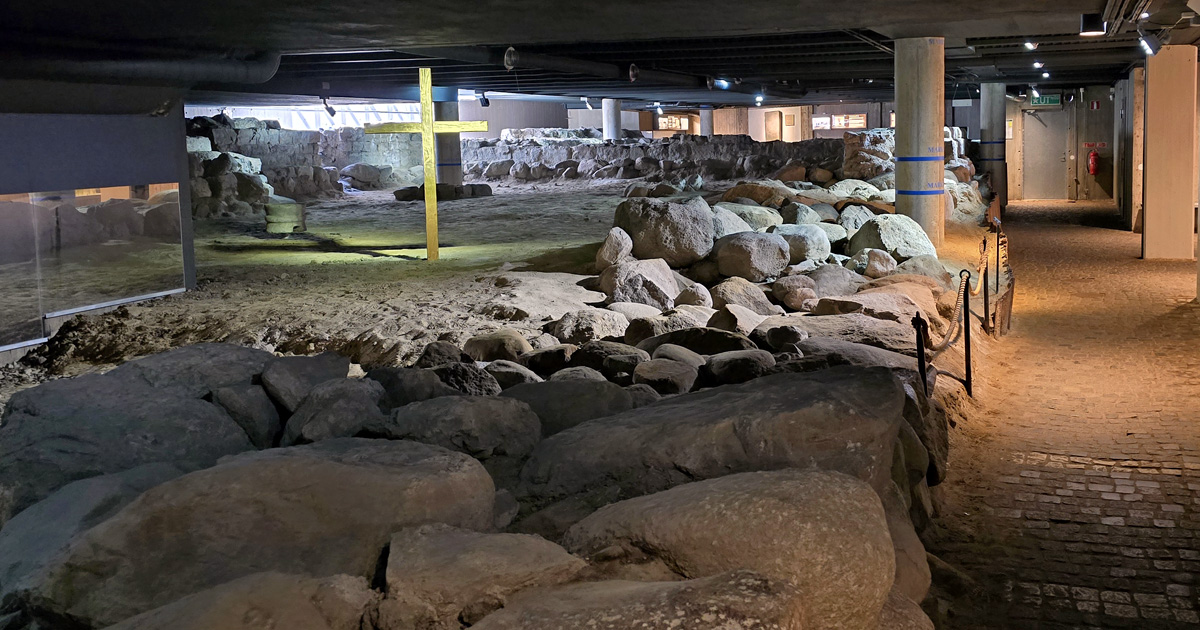
Drotten's church ruin is an unmanned basement museum where you can see the preserved ruin of
Lund's first cathedral Drotten which was built of stone and dedicated to Trinitas Salvator or
the Trinity and the Savior. There is also information about the three other churches located
at Kattesund, that were built of wood. One of these wooden churches is the Church of the
Trinity, which, according to the chronicle "Gesta Wulinensis ecclesiae pontificum", which can
be translated as the history of the Wolin bishops, was built by King Sweyn Forkbeard around
the year 987. It seems like Sweyn Forkbeard's remains were buried in that church in the spring
of 1014, but the burial chamber turned out to be emptied. Sweyn Forkbeard's remains may have
been transferred to the burial chamber in Drotten, which may have been built as a burial
church for King Sweyn Forkbeard. Drotten became Lund's first cathedral when Bishop Henrik
became the first bishop of the Lund diocese, at latest in 1059. Formally, the cathedral
chapter was established by King Canute the Holy and his deed of gift on 21 May 1085.
The first archbishopric church in the Nordic countries
Bishop Asser Svendsen was elevated to archbishop of all Christian Scandinavia in 1104, and then Drotten served as archbishop church until the new cathedral was inaugurated on 1 September 1145. In the tower of Drotten a tomb and a stone were found with an inscription about a Margaret. She may have been that Margaret who was first Queen of Norway and then Queen of Denmark until her death in 1130. Perhaps she was the one who paid to rebuild Drotten into an archbishop's church. After the reformation of the Danish Church, on October 30th, 1536, Drotten was demolished. It is the ruin of the church, as it looked at the reformation, that can be seen in the museum of Drotten church ruin.
The information at the museum Drotten's church ruin is not up to date
This visitor's guide tells about the interesting Viking age history of the four churches located at Kattesund, and about some of the objects and information you will find in the museum Drotten church ruin.
It is good to be aware that the information in this visitor's guide differs in several ways from the information in the museum Drottens church ruin. The exhibition in the museum was installed after the archaeological investigation, carried out between 1982 and 1984, and not updated since. There is also information only in Swedish. This visitor's guide, and the others to which it refers, have been updated with new interpretations of the history. Therefore, the information differs.
Entrance and opening hours to Drottens kyrkoruin
Since the museum is unmanned, are there no fixed opening hours. You can visit Drotten's church ruin through the entrance to the Old Lund association's (Gamla Lund) office or the restaurant Gattostretto when they are open. Sundays is closed and usually three or four weeks around the end of July and early August is also closed. You enter the church ruin via a spiral staircase, but there is also a lift. There is a toilet at Drotten's church ruin as well.
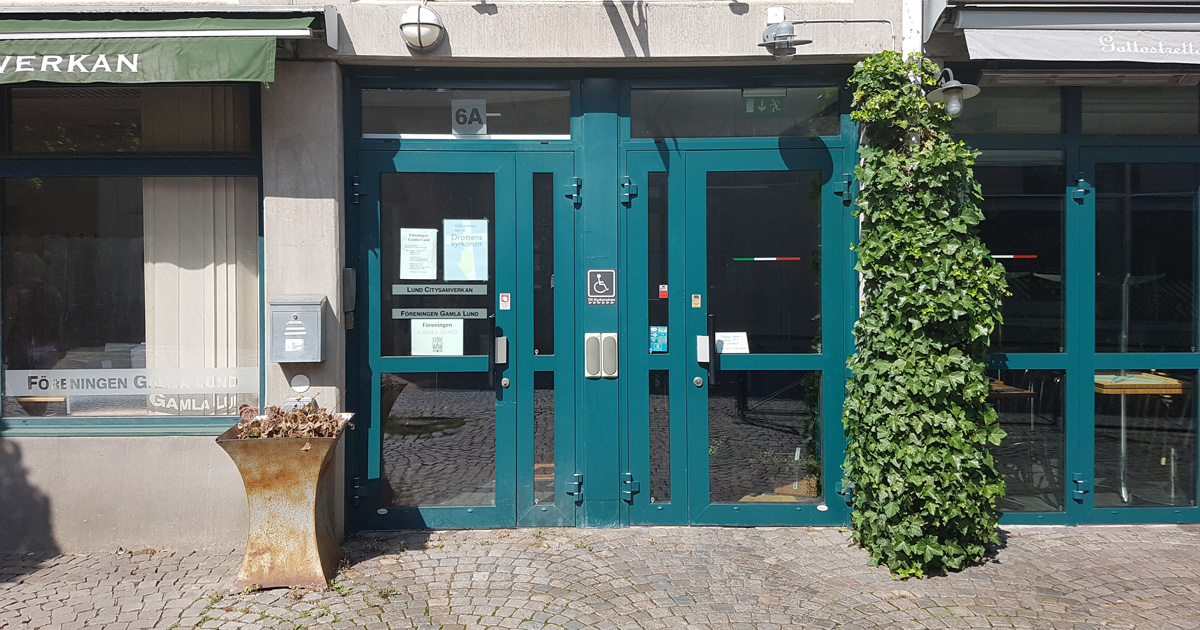 You can enter Drotten's church ruin either through the door on the left when the Gamla Lund
association is open or through the door on the right when restaurant Gattostretto is open.
You can enter Drotten's church ruin either through the door on the left when the Gamla Lund
association is open or through the door on the right when restaurant Gattostretto is open.
The archaeological investigations of the Kattesund churches
On the map in the next section, you can see where the four Kattesund churches were located. As early as 1961, the eastern Kattesund Church (D) was found, considered to be the largest stave church that has been found in the Nordic countries. Between 1982 and 1984, a major archaeological investigation was carried out before residential buildings were built. The remains of the Trinity Church Trinitas (A), the wooden church that is usually called the south Kattesund Church (C) and the ruins of the church Drotten (B) built of stone and consecrated to Trinitas Salvator or the Trinity and the Savior, were found. While the archaeological investigation was ongoing, public opinion began to grow in favour of preserving the ruin of Drotten. Therefore, the Drottens Church ruin museum was created and opened in 1987.
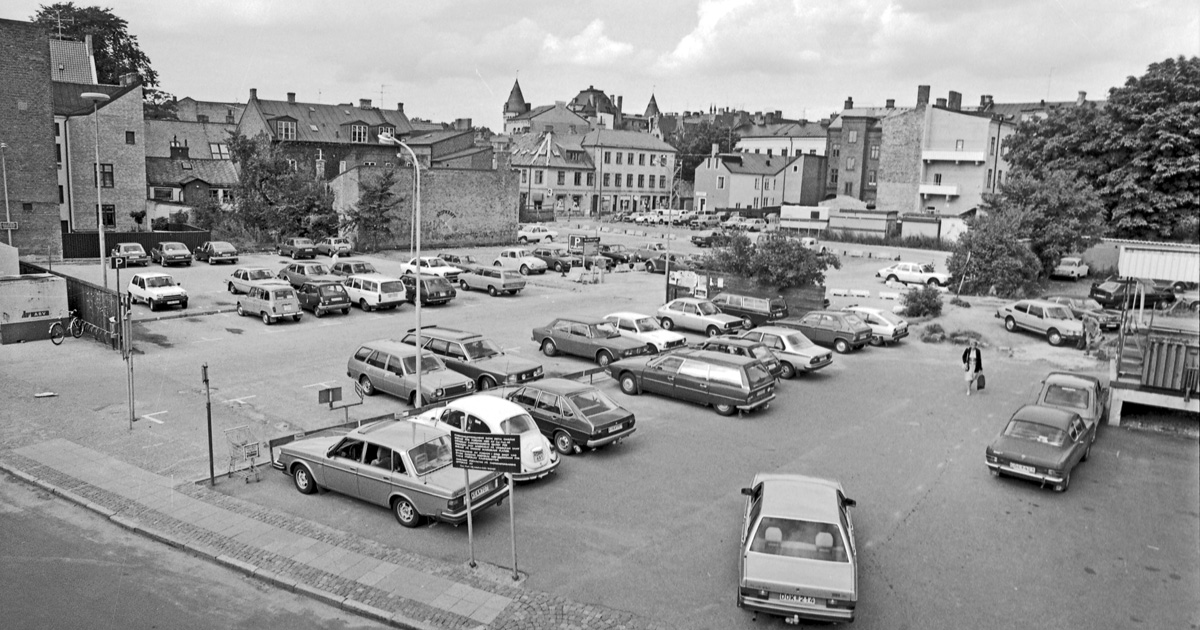 A picture of the Kattesund area towards northwest, taken by Hagblom Foto on August 24, 1982,
before the major archaeological investigation began. Many of the buildings, including the high
wall in the middle of the picture and the loading dock to the right, are still there today.
A picture of the Kattesund area towards northwest, taken by Hagblom Foto on August 24, 1982,
before the major archaeological investigation began. Many of the buildings, including the high
wall in the middle of the picture and the loading dock to the right, are still there today.
Map of the Kattesund churches locations
The map below shows where the four Kattesund churches were located and the white arrow shows the entrance to Drotten's church ruin. The churches have interesting, and in some cases very complex history, which you can read more about in the visitor's guides about each church. The oldest of the churches was King Sweyn Forkbeard's wooden church, the Church of the Trinity (A), which was built around the year 987. It was replaced by Drotten (B), which probably began to be built in the 1020s, and was completed in the 1040s. Drotten was also rebuilt at least twice. The south Kattesund church (C) was built as a wooden church in the 1040s. It was preceded by a shed where two church bells were cast around 1042–1043, at least one of which was probably intended for Drotten. The east Kattesund church (D) was built as a wooden church around the year 1050 and was excavated archaeologically in 1961 and 1974. It is the largest stave church found in the Nordic countries. Parts of the church's walls are marked with white paving stones in the pavement.
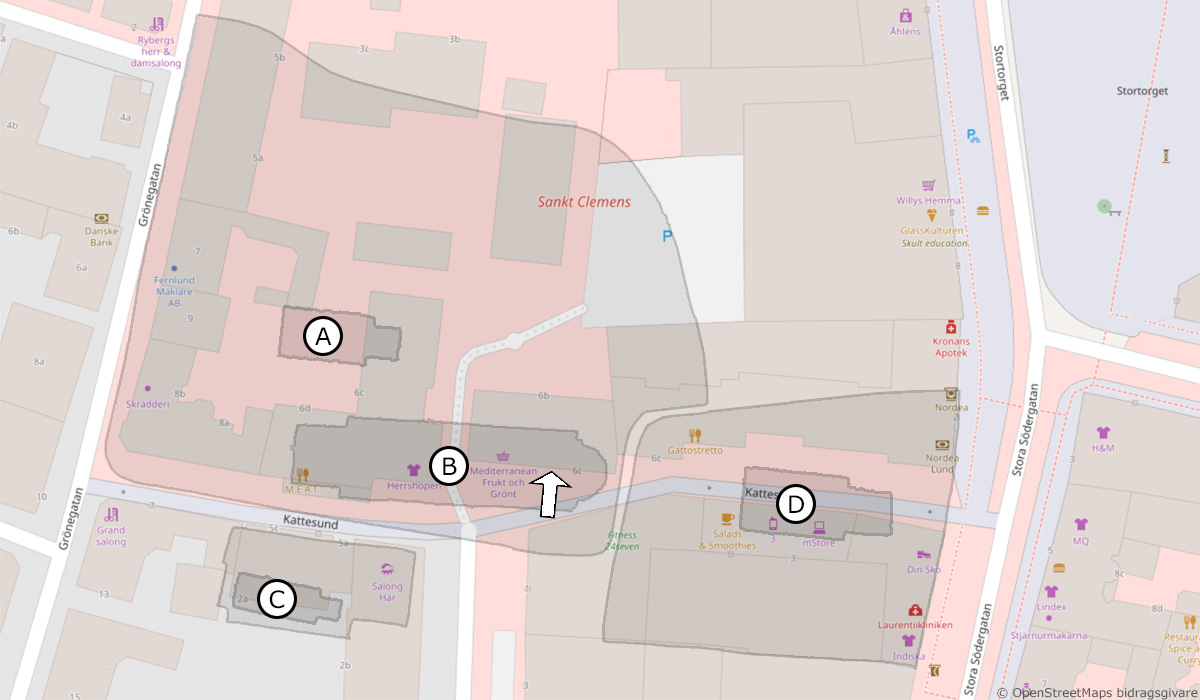 The places where the churches in Kattesund and the cemeteries were. The arrow shows where the
entrance to Drotten's church ruin is located.
The places where the churches in Kattesund and the cemeteries were. The arrow shows where the
entrance to Drotten's church ruin is located.
Map of Drotten's church ruin for visitors
The map below gives information about and shows the objects in the museum Drottens church ruin that this visitor's guide tells about. The arrow shows where you can enter the museum via a spiral staircase. To the left of the stairs there is a toilet and to the right there is an elevator. The brightest area of the map is available to visitors.
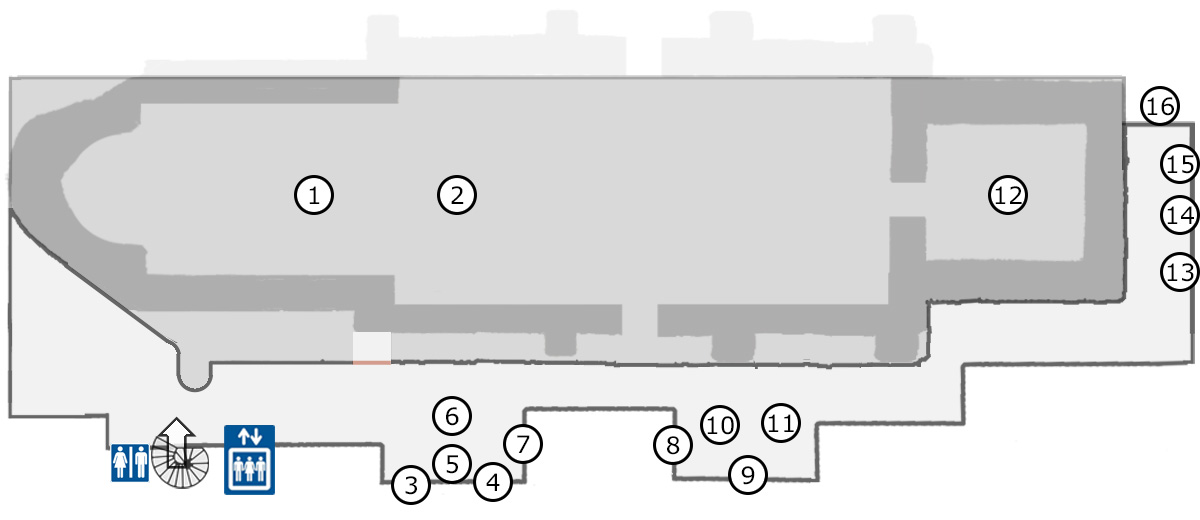 Map of the various objects in Drotten church ruin and information this visitor's guide tells
you about.
Map of the various objects in Drotten church ruin and information this visitor's guide tells
you about.
1) Grave chamber of King Sweyn Forkbeard
There is information indicating that King Sweyn Forkæg's remains were buried in a burial chamber under the choir of the wooden church Trinity (A), which he himself had built around the year 987. It was the oldest of the four Kattesund churches. Although, the tomb was empty when it was archaeologically examined. King Canute the Great may have moved his father Sweyn Forkbeard's remains to a new burial chamber under the choir of Drotten (B). The burial chamber was 6.3 meters wide and 4.9 meters long. The ceiling height was 1.6-1.8 meters and may have been covered with a wooden roof or low cross vaults, but that can be difficult to see it in the ruin. This burial chamber was also empty when it was investigated archaeologically, so the remains that were placed there must have been moved again. There is no information about where they may have gone. It seems that the burial chamber was filled again around the year 1150, when Drotten was taken over by the Premonstratens order to serve as a monastery church. If so, the time when the burial chamber was filled corresponds well with the time when Lund Cathedral was inaugurated, September 1st, 1145.
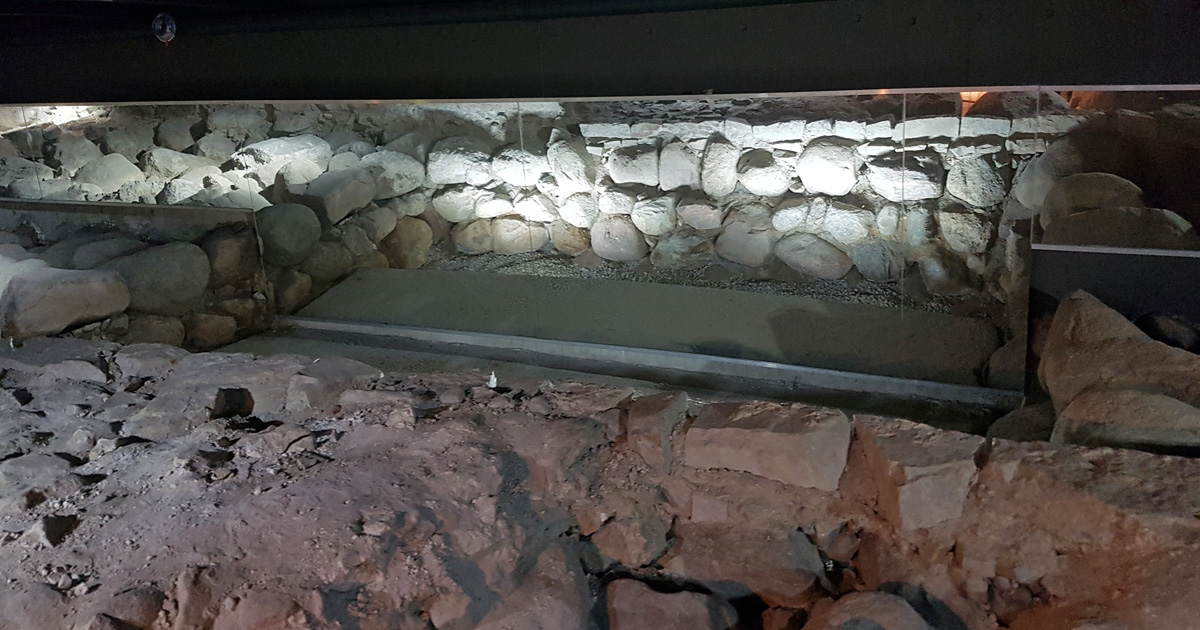 The burial chamber under the choir in Drotten where King Sweyn Forkbeard's remains may have
been buried.
The burial chamber under the choir in Drotten where King Sweyn Forkbeard's remains may have
been buried.
2) Grave chamber of Bishop Bernhard
There was also a burial chamber under the eastern part of the longhouse of Drotten. It seems that Drotten began to be built in the 1020s, under the leadership of Bishop Bernhard brought to Lund from England by the King Canute the Great. The construction was halted around the year 1030 when Bernhard died, and he was probably buried in this burial chamber. The burial chamber was 9 meters wide, which was the same as the longhouse, 6 meters long and a ceiling height of no more than 1.5 meters. It may have been covered with a wooden roof or low cross vaults. The burial chamber was empty when it was archaeologically examined, so the remains that was buried there must have been moved, but there is no information about that. It seems that the burial chamber was filled again in the early 1100s, when Drotten was rebuilt to serve as a temporary archbishop's church until Lund Cathedral was ready and could be inaugurated.
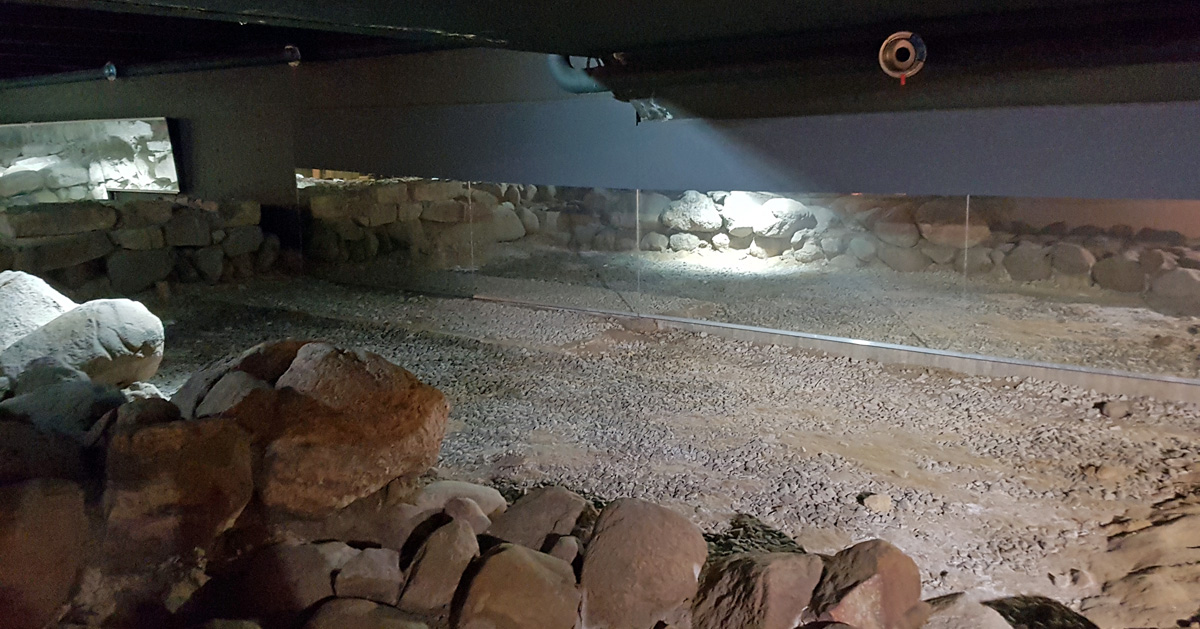 The place where the larger burial chamber was located, under the eastern part of the longhouse
in Drotten, where Bishop Bernhard's remains may have been buried.
The place where the larger burial chamber was located, under the eastern part of the longhouse
in Drotten, where Bishop Bernhard's remains may have been buried.
3) Information about the Trinity Church Trinitas
The showcase, in the picture below, shows a model of how the Trinitas Church Trinity (A) may have looked like. According to the chronicle "Gesta Wulinensis ecclesiae pontificum", Sweyn Forkbeard let it be built around the year 987, and some things are told about it. When the exhibition in Drotten's church ruin was made in the 1980s, this was the oldest church known in Scania. According to the chronicle, the royal church of St. Clement, built of stone, was preceded by a wooden church built in the 960s. That must then have been the first church built in Lund, and perhaps also the first church in Scania. St. John the Baptist's Church, which was located on the north side of Lund Cathedral, was, according to the chronicle, built in 975 and is also older than the Trinity Church. The history of the Trinity Church is still very interesting, not least because it seems that Sweyn Forkbeard was buried there, in a burial chamber under the choir.
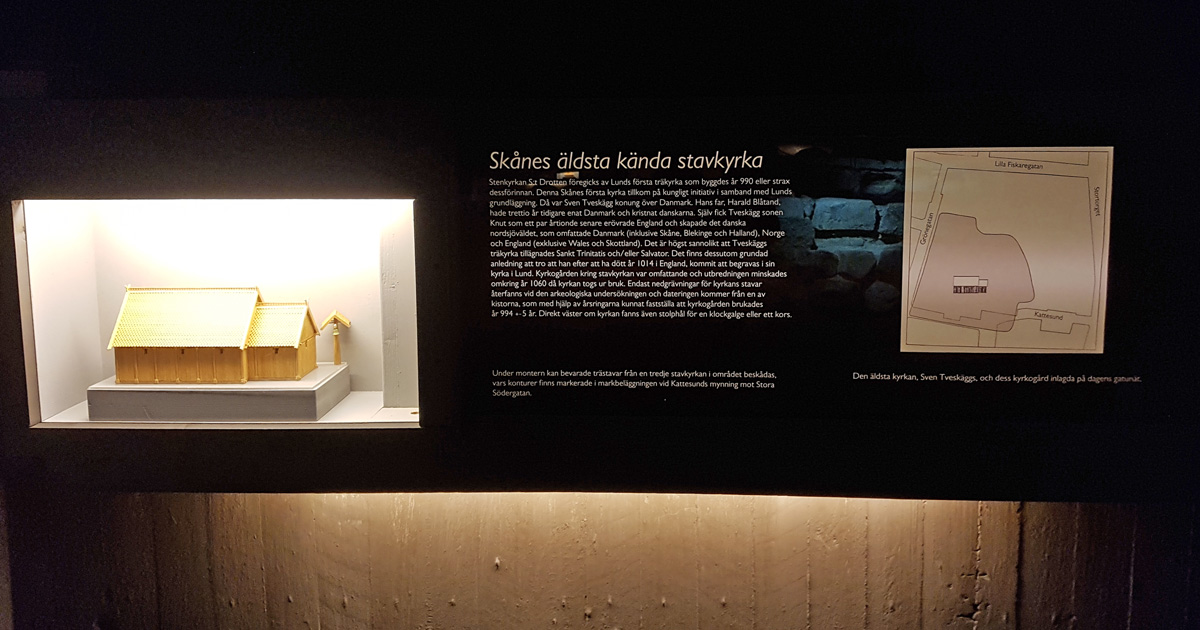
4) Information about the South Kattesund church
The showcase in the picture below shows a model of how the South Kattesund church (C) may have looked like and tell some information about it. Before the church was built, there was a shed used as a bell-casting workshop, dated to around 1042–1043. At least one of the two bells casted there is presumed to have been made for Drotten (B). The church was probably built in the 1040s, slightly earlier than the display case says, serving as a church for the English bell casters who were buried at the cemetery. The entire church was 19 meters long and 6.5 meters wide, the longhouse was 15 meters long and the choir 4 times 4 meters large.
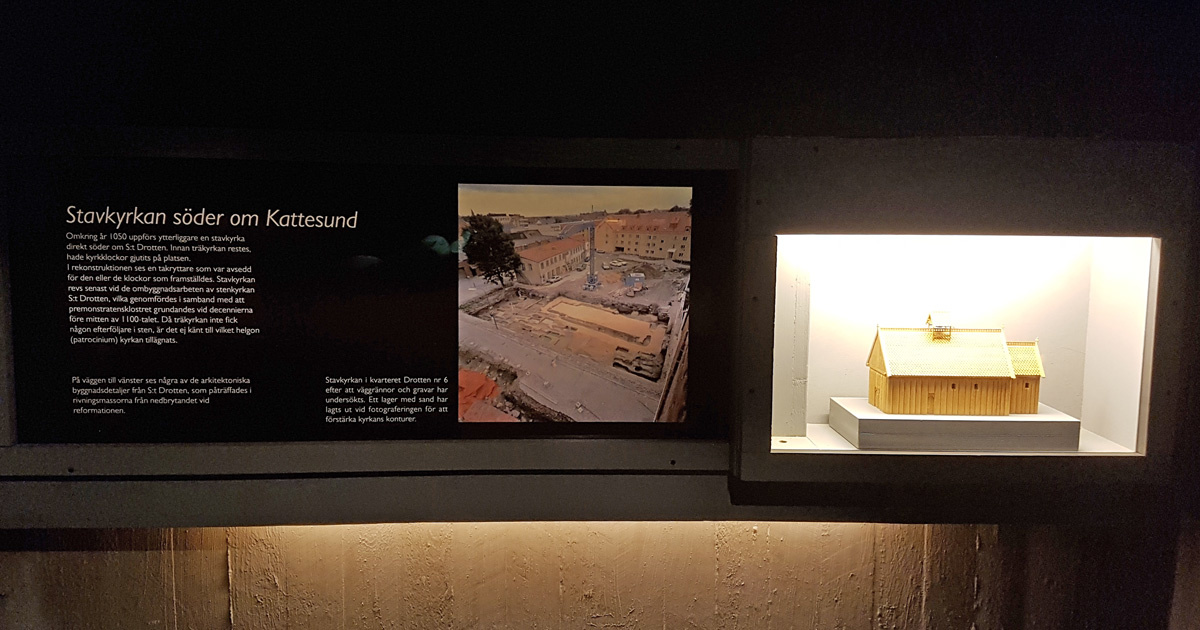
5) Staves fron the East Kattesund church
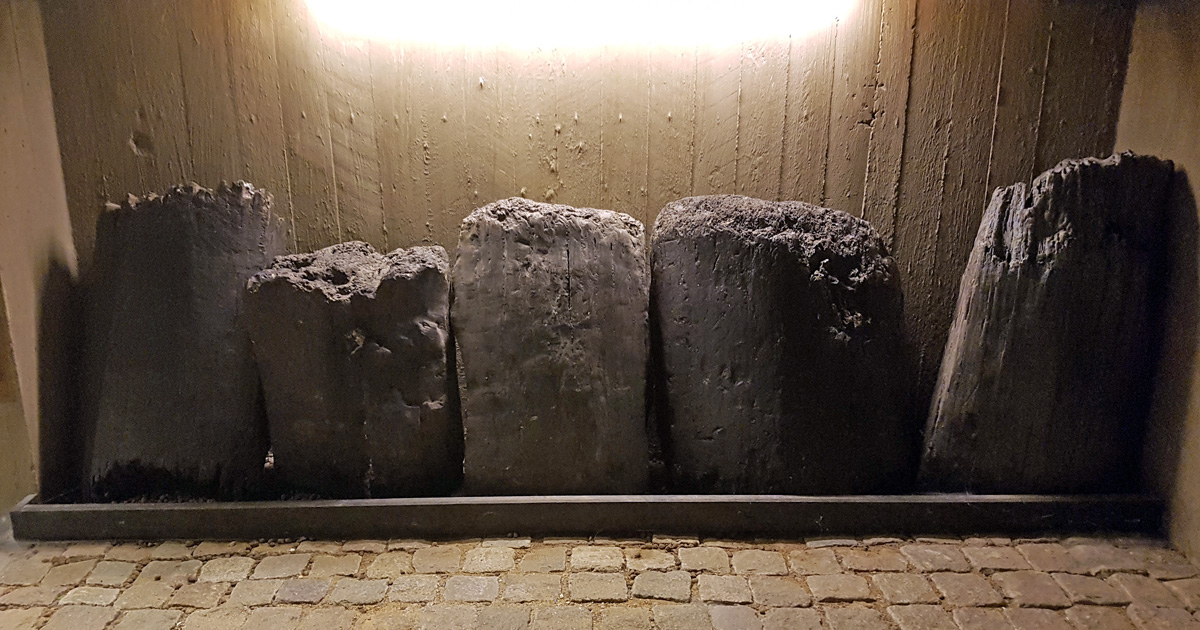
On the flooring below the showcase, two groups with the bottom pieces from staves that were part of the Eastern Kattesund church (D) are shown. The staves have been dated to around year 1050, and therefore the church is believed to been built around the year 1050. An interesting thing is that eleven staves were dated to around year 850, which is long before the Danish royal power conquered the southwestern parts of Scania, about year 964. Those staves must have come from some other earlier building that may have been somewhere else. It is easy to assume that it may have been from what today is Uppåkra. The church was excavated archaeologically in 1961 and 1974. A marking with white stones in the pavement shows where it was located. The church was 26 meters long, the longhouse 18 meters long and 11 meters wide, while the choir was 8 times 8 meters. It is said that this church is the largest stave church that has been found in the Nordic countries.
6) A film about the Kattesund churches
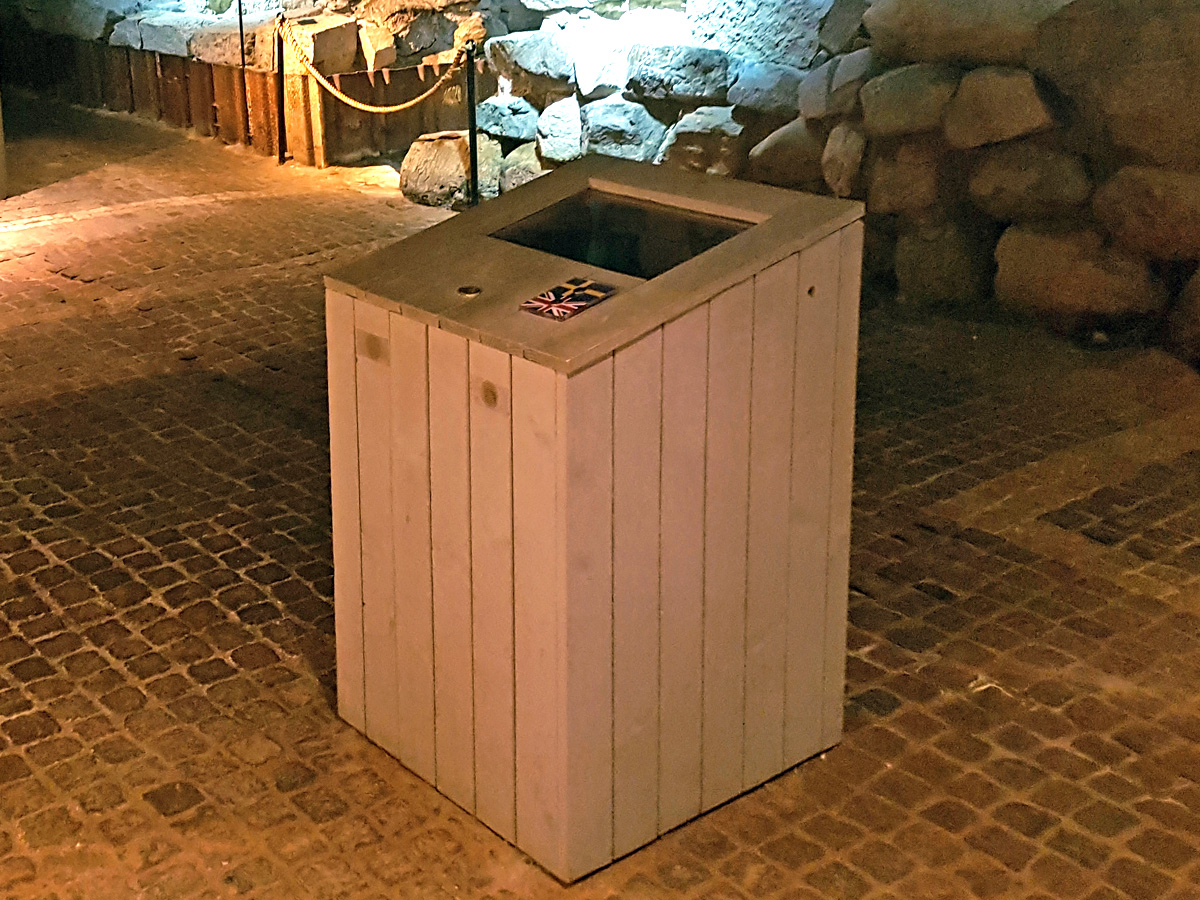 The showcase with an information film about Svend Tveskæg's church (A) and Drotten
(B).
The film is approximately 5 minutes and tells in Swedish or English about King Sweyn
Forkbeard's church (A) and Drotten (B). The film is interesting, but a lot of
new information and new interpretations since the 1980s, when the film was made, implies that
a large part of the information is no longer correct.
The showcase with an information film about Svend Tveskæg's church (A) and Drotten
(B).
The film is approximately 5 minutes and tells in Swedish or English about King Sweyn
Forkbeard's church (A) and Drotten (B). The film is interesting, but a lot of
new information and new interpretations since the 1980s, when the film was made, implies that
a large part of the information is no longer correct.
In the film, a model is shown Drotten having two towers, but Drotten has probably never looked like that. The model (11) you can see in Drotten's church ruin gives a more accurate picture of what Drotten may have looked like. After a rebuilding around 1180, Drotten looked like model (12).
7) Stone fragment on the wall
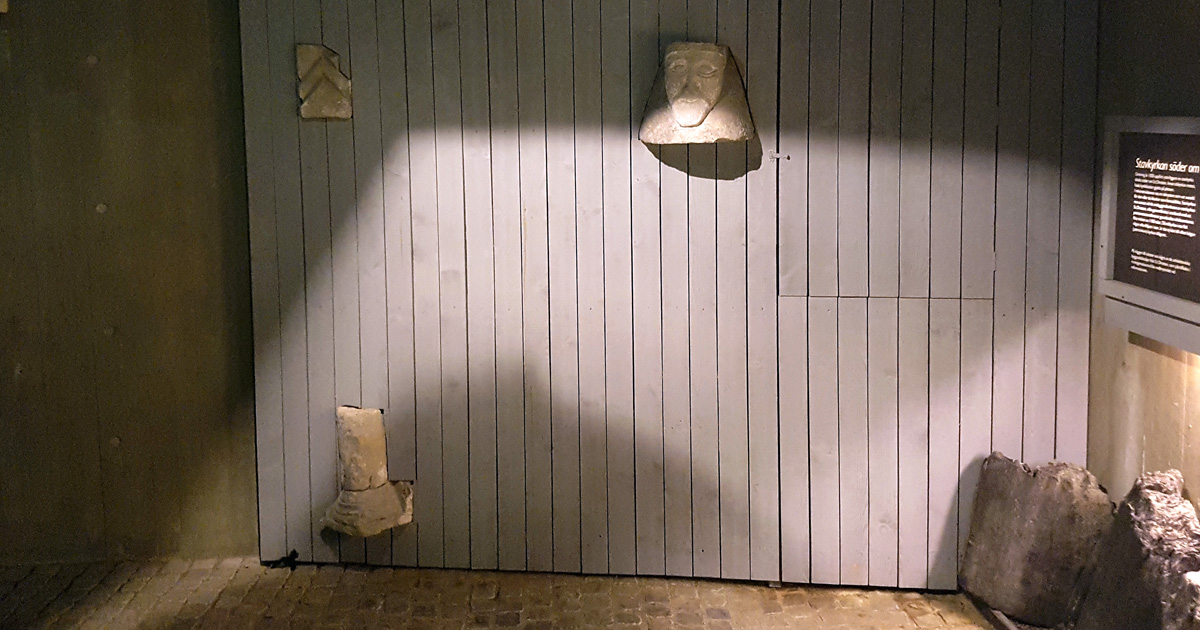
On the wall, there are three fragments of stone that were found in the demolition masses left after the demolition of Drotten, which took place after the Reformation of the Danish Church on October 30th, 1536. The man head could be an image of a king or the Christ.
8) Information about Drotten
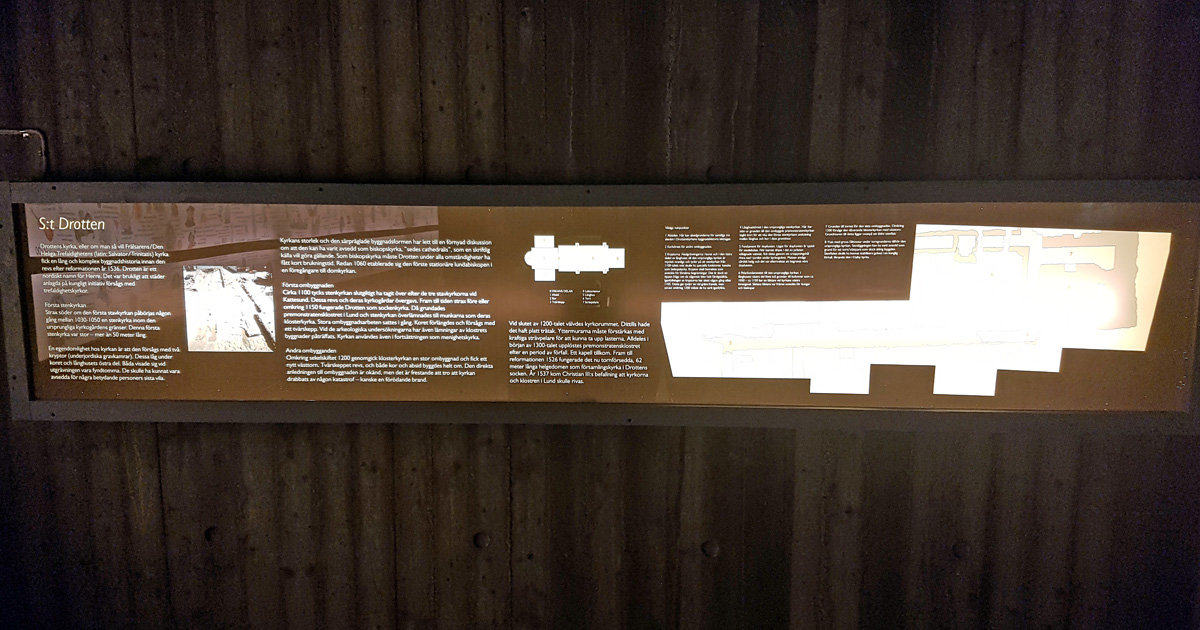
The showcase in the picture below provides information about Drotten's (B) complex building history. There are so much new information and new interpretations since the 1980s, when the exhibition in Drotten's church ruin was made, that much of the information is no longer correct.
The first church seems to be built as early as the 1020s. At that time, it consisted only of the choir with apse, a short longhouse and the two burial chambers. One of the burial chambers was under the choir. Perhaps Sweyn Forkbeard's remains were buried there after being moved from the burial chamber in the Trinity Church (A). The other, slightly larger burial chamber was under the short longhouse. Bishop Bernhard's remains may have been buried there when he died around 1030. His dead seems to have halted the further construction of Drotten. It was not until Bishop Henrik came to Lund in the early 1040s that the construction of Drotten was resumed and completed around year 1050.
The Lund diocese was formed in 1059 at the latest, when Scania was divided into two bishoprics, one in Lund and one in Dalby. Henry became bishop in Lund having Drotten as his episcopal church. Therefore, Drotten must be regarded as Lund's first cathedral. At the same time, Egino became bishop in Dalby and began the construction of Dalby church. Henry died around 1066 and the two bishoprics were merged into one diocese with Egino as the second bishop of Lund diocese. Drotten probably continued to be Lund's episcopal church, and when Lund became an archbishopric in 1103, Drotten was the first archbishops church in Scandinavia until Lund Cathedral was inaugurated on September 1st, 1145.
The information in the exhibition states that the first bishop of Lund diocese must have had a predecessor to Lund Cathedral, built around the year 1060, as episcopal church. There are remains of a large stone building under Lund Cathedral, and it was long believed that it was an episcopal church that was the forerunner of Lund Cathedral. Recent investigations of that building, along with information in historical written sources, suggest that it may have been built as early as around 1030, and used by some kind of monastic activity that was transformed into the Sankt Laurentius canon community at Lund Cathedral in connection with King Canute the Holy's deed of gift May 21st, 1085.
The first rebuilding of Drotten was probably made around year 1110 and seems to have adapted Drotten to become an archbishop's church until Lund Cathedral was completed. The second rebuilding of Drotten was made around year 1180 when Drotten was the monastery church of the Premonstratens order. They began to use it as their monastery church sometime after Lund Cathedral was inaugurated, but something caused that the monastery activities were closed in the early 13th century. Then Drotten was used as a parish church until the Reformation on October 30th, 1536, and served as a city church for the town's burghers.
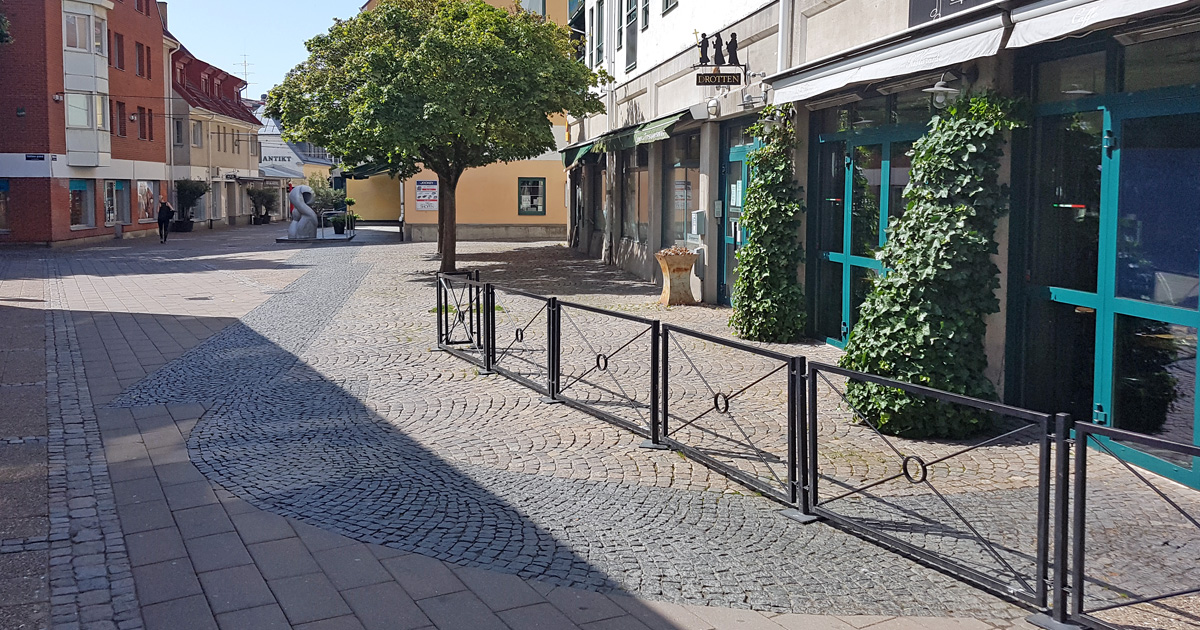 Grey stones in the pavement outside Drotten's church ruin show where the walls for Drotten's
church were.
Grey stones in the pavement outside Drotten's church ruin show where the walls for Drotten's
church were.
9) Historical timeline
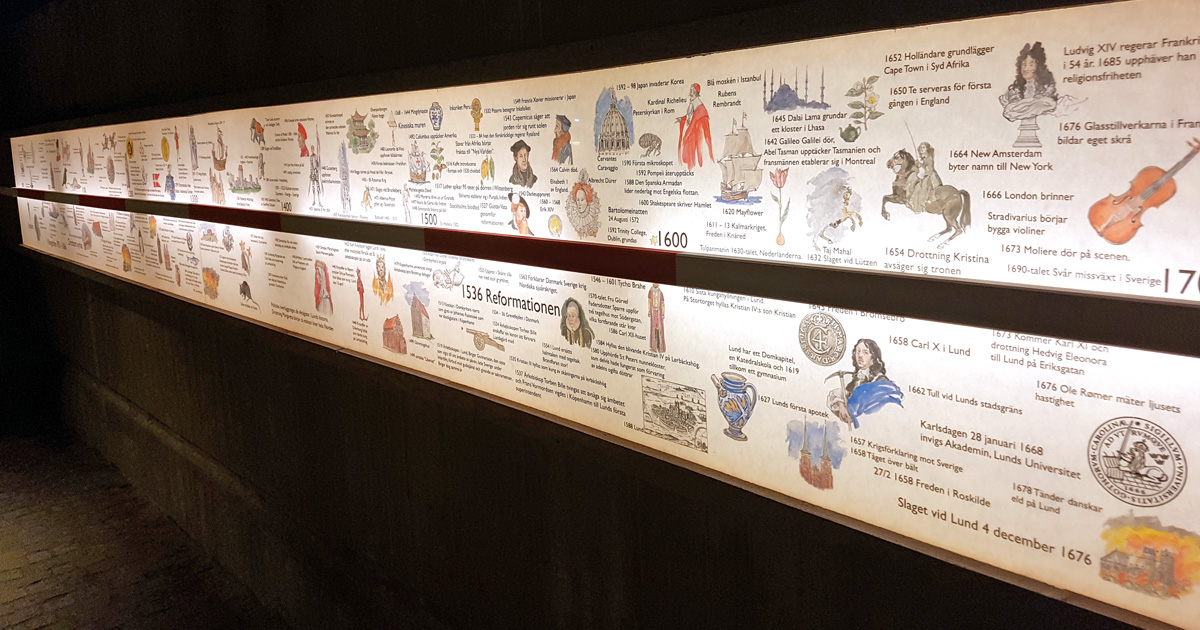
The historical timeline in the image below stretches from the 10th century to the end of the 1600s. It is divided into two parts, where the upper part shows interesting historical events around the world while the lower part shows interesting historical events in Lund. There are also beautiful illustrations for many of the events. Since the timeline was created, Lund's oldest history has been rewritten. Nowadays it is known that Lund's history begins around the year 964. The history of Uppåkra begins around 100 years B.C. and stretches until the year 964 when the Danish royal power conquered Scania.
10) Model of Drotten as a monastery church and parish church
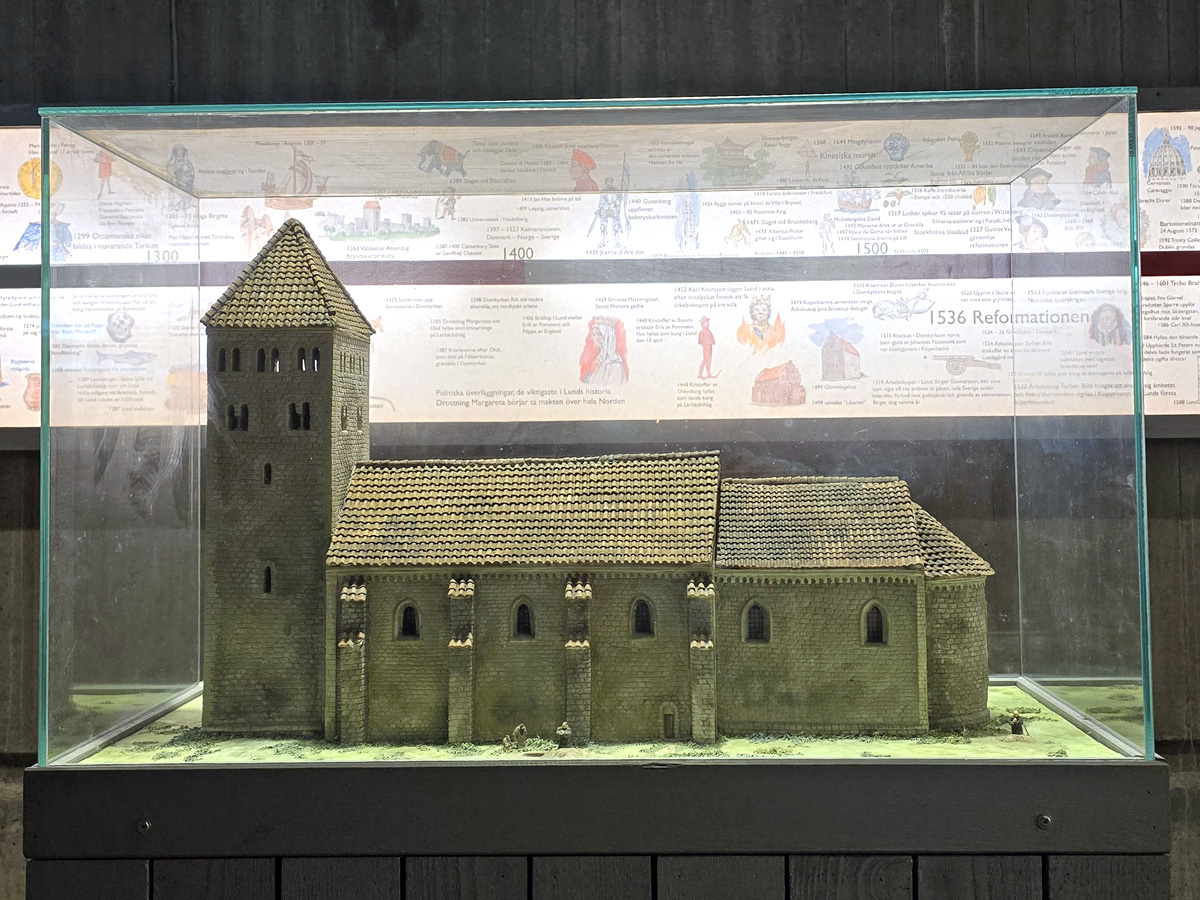 The model in this showcase shows how Drotten (B)looked after a rebuilding around 1180.
At that time, the church was a monastery church for the Premonstratens order. The rebuilding
meant that the previous choir, which had two transepts, was torn down and replaced with a new
18-metre-long and 8.5-metre-wide choir with apse, so the whole church was 51.5 metres long.
The model in this showcase shows how Drotten (B)looked after a rebuilding around 1180.
At that time, the church was a monastery church for the Premonstratens order. The rebuilding
meant that the previous choir, which had two transepts, was torn down and replaced with a new
18-metre-long and 8.5-metre-wide choir with apse, so the whole church was 51.5 metres long.
In the early 13th century, the monastery was decommissioned. During the rest of the Middle Ages, Drotten was a parish church and functioned as a city church for the town's burghers. During the 14th century, a chapel was built on the north side of the church, but it is not included in this model.
11) Modell of Bishop Henriks Episcopal church
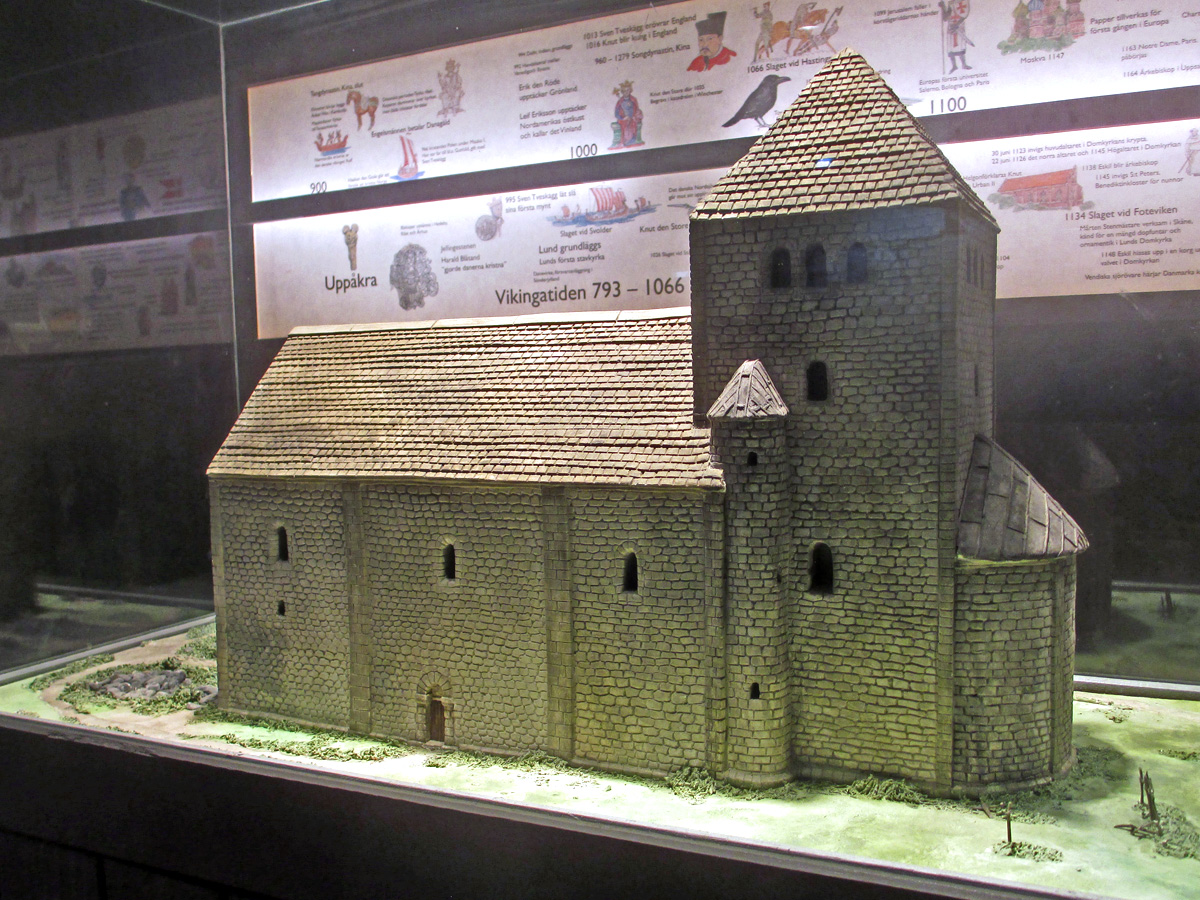 The model in this showcase shows what Drotten (B) looked like when it was completed
sometime around 1050. The construction was led by Bishop Henrik, who is considered the first
bishop of the Lund diocese. The building probably began in the 1020s, but seems to be on hold
around 1030, in connection with the death of bishop Bernhard.
The model in this showcase shows what Drotten (B) looked like when it was completed
sometime around 1050. The construction was led by Bishop Henrik, who is considered the first
bishop of the Lund diocese. The building probably began in the 1020s, but seems to be on hold
around 1030, in connection with the death of bishop Bernhard.
This model shows how Drotten looked like when the bishopric was formed in Lund, at the latest year 1059, with Henrik as bishop. Since Drotten was Henrik's episcopal church, it must have been the first cathedral in Lund. Although, there was no cathedral chapter at that time. The diocese was established with King Canute the Holy's deed of gift on May 21st, 1085, and at that time Drotten was still the episcopal church.
12) The west tower
What can be seen are the large stones that formed a 12-meter wide and 12-meter-long foundation for a tower with a vestibule to the west. The foundation was probably laid in connection with the rebuilding of Drotten sometime around 1110, aiming at Drotten to function as a temporary archbishop's church until Lund Cathedral was inaugurated on September 1st, 1145. At that time, the choir and the previous tower in the east were demolished. No new tower was built then, but the foundation was covered with sandstone chips and soil. Sometimes later, a 10.5 times 10.5-meter tower was built on the stone foundation. At the same time, a gallery was probably set up on the second floor of the tower, which may have been ae place for the royal family.
The ground floor of the tower was used as a private burial chapel for a few generations. A total of eight people were buried there, four adult men, one of whom reached a high age, two adult women and two children. One of them was the noble Margareta (15).
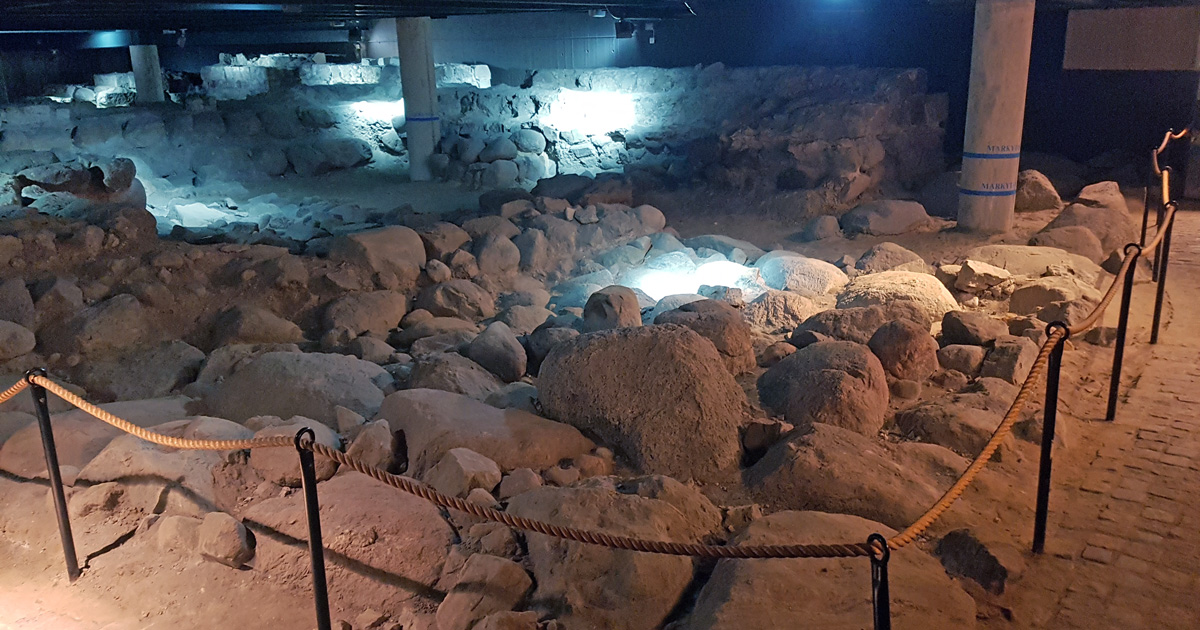 The place where the rebuilt tower was located in the west, probably built sometime in the
first half of the 12th century.
The place where the rebuilt tower was located in the west, probably built sometime in the
first half of the 12th century.
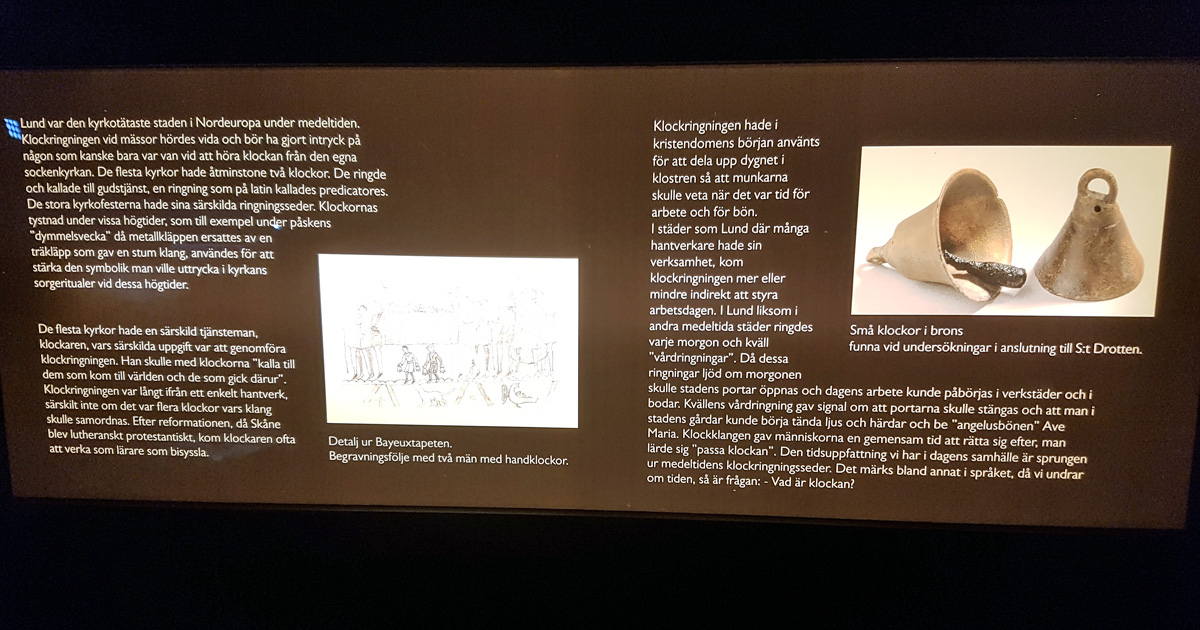
13) Information about bells and bell ringing
The showcase in the picture below tells about church bells and how bell ringing governed life in the cities in the mediaeval times. In Lund there were 22 churches and four monasteries from the middle of the 13th century until the Reformation of the Danish Church on October 30th, 1536. The bells called to church service one or more times a day, which must have been heard all over the medieval Lund.
14) The bell casting pit
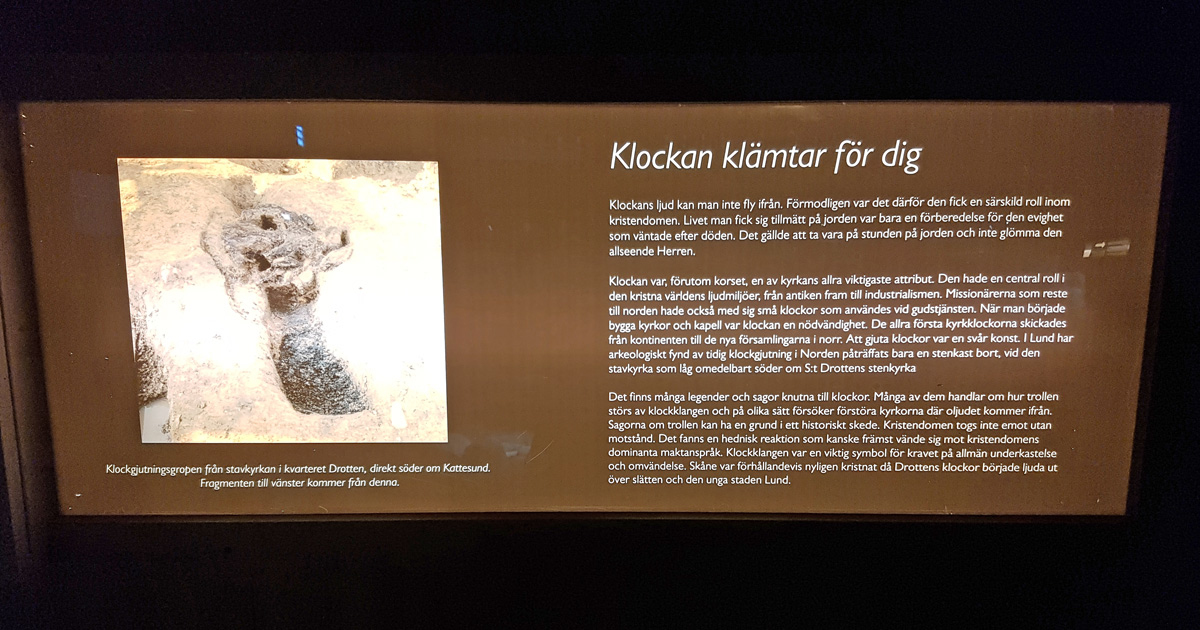
 Before the South Kattesund church (C) was built, there was a shed used for bell-casting,
dated to around 1042–1043, on that site. Two bells were cast there and at least one of them is
presumed to have been aimed for Drotten (B), which got its tower around 1050.
Before the South Kattesund church (C) was built, there was a shed used for bell-casting,
dated to around 1042–1043, on that site. Two bells were cast there and at least one of them is
presumed to have been aimed for Drotten (B), which got its tower around 1050.
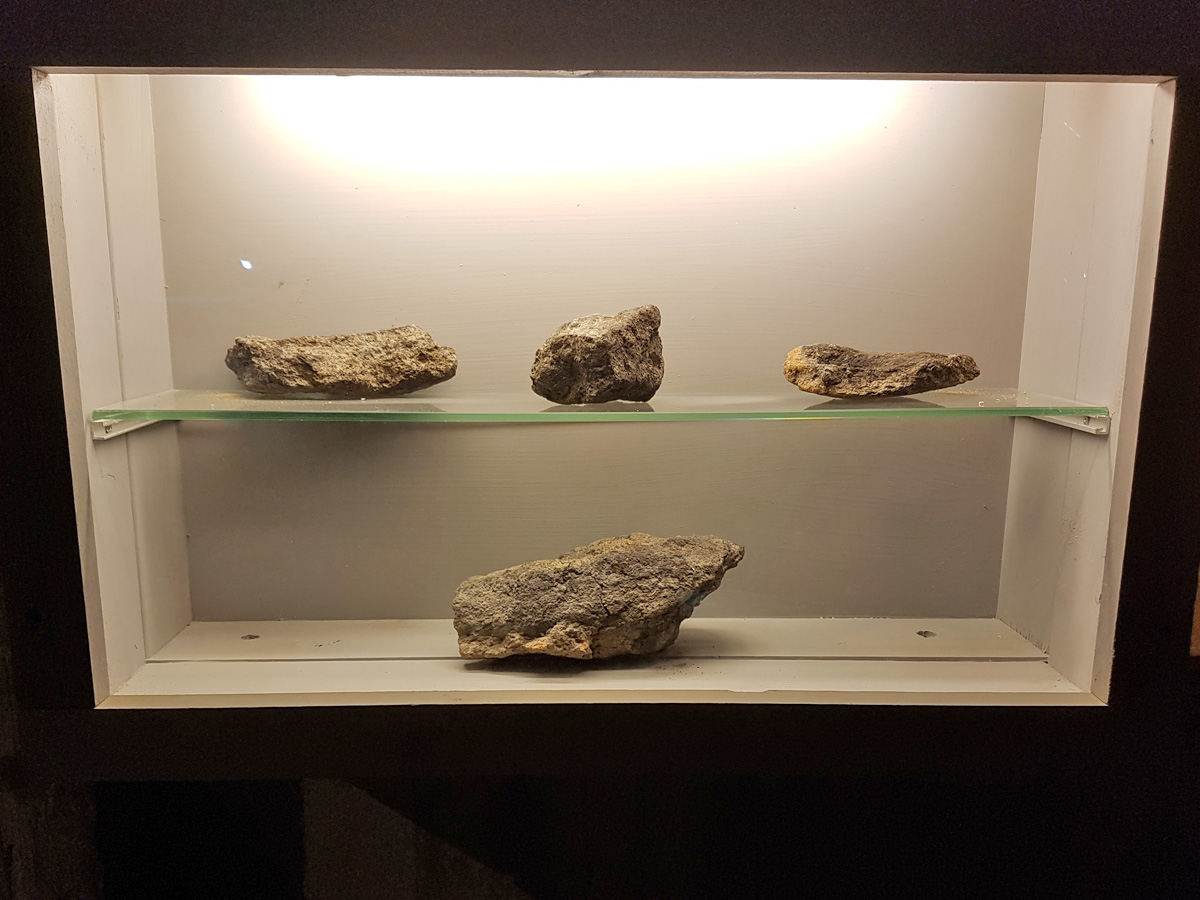
The showcase shows a picture of one of the bell casting pits and some fragments that were found at the site. In the 1040s, a wooden church was built there, probably for the English bell casters who got their final rest in the cemetery.
15) The grave slab of the noble Margareta
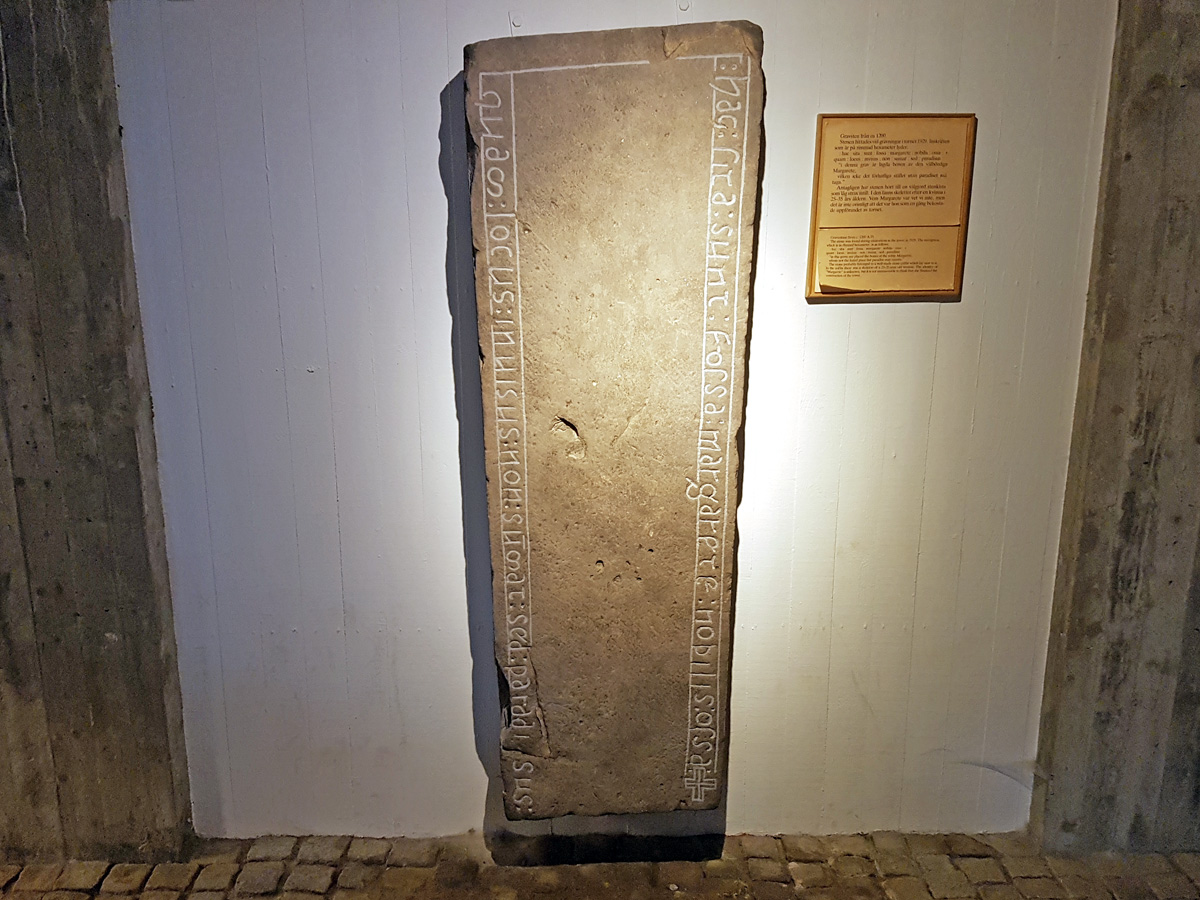 The grave slab that mentions the noble Margareta lay over a burial coffin, found in the middle
of the tower ground floor. It was probably the first grave there. The burial coffin was made
with the same type of ordinary square-hewn stones used in the church construction. The
deceased's head rested on a stone of chalk, which previously had been part of a round-arched
frieze in the church.
The grave slab that mentions the noble Margareta lay over a burial coffin, found in the middle
of the tower ground floor. It was probably the first grave there. The burial coffin was made
with the same type of ordinary square-hewn stones used in the church construction. The
deceased's head rested on a stone of chalk, which previously had been part of a round-arched
frieze in the church.
The bones in the coffin were examined by an osteologist, a researcher specialized in bones and skeletons. The bones came from a woman who was in her 35s when she died. Along the sides of the grave slab there is a historical handwriting made in small letters in hexameter that reads
hac : sita : sunt : fossa : margarete : nobilis : ossa : + quam : locus : inuisis : non : sumat : sed : paradisus
which means
In this grave rests the bones of the noble Margareta. May she not be taken to the hateful place, but to paradise.
Who this Margareta was is unclear, but the fact that she is described as noble indicates that she is of noble birth and background. The description fits well with Margareta Ingesdotter, who was the daughter of the Swedish king Inge Stenkilsson. She first became queen of Norway and then queen of Denmark, which she remained until she died around 1130.
16) Graves and burial practicies
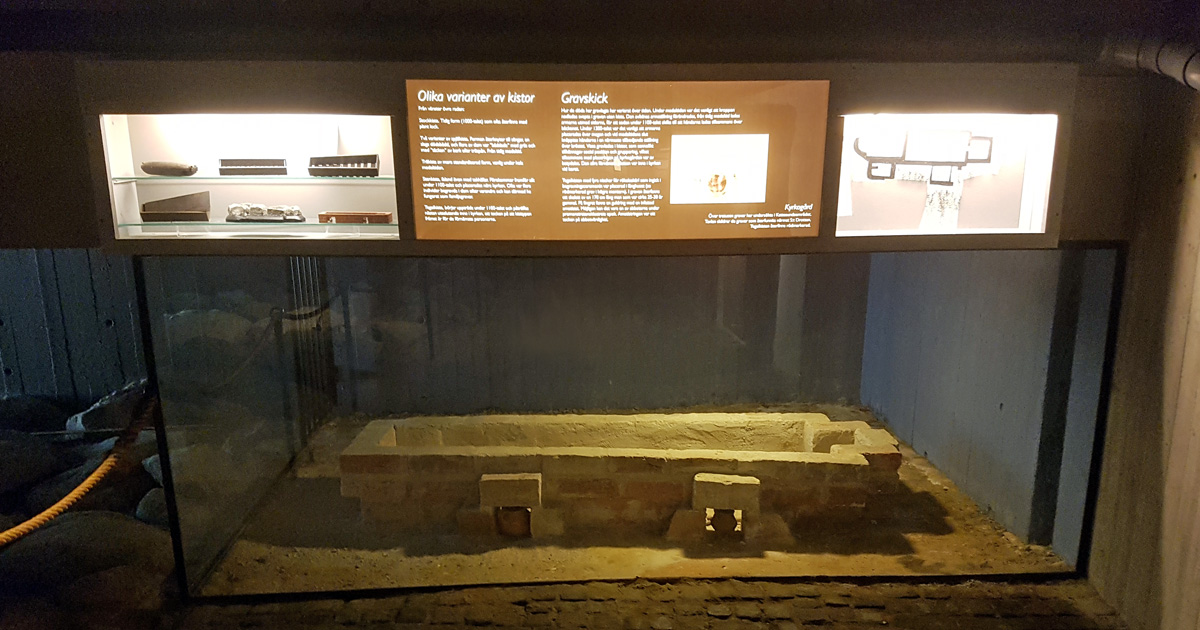
In the showcase in the picture below, different types of grave coffins and burial practices are shown and told. There is also a brick coffin with four niches for incense vessels, that were part of the funeral ceremony. The grave was located far to the left in the longhouse of Drotten (B) and contained the remains of a 178 cm tall man about 25-30 years old. One picture shows a gold ring with an amethyst that sat on one of his fingers. It has been interpreted that he could have been one of the abbots from the time when Drotten was the monastery church for the Premonstratens order.
The wooden church Tinitas (A) and later Drotten (B) was surrounded by a large cemetery. It was about 6,300 m² with about 3,400 graves, of which about 2,700 have been documented. There were also many buried inside the church Drotten. Among other things, the tower (12) was used as a private burial chapel. A total of 190 graves has been found inside the church, in the tower, longhouse and choir.